+919871148514
 info@memorableindia.com


Day By Day Itinerary
DAY 1

Arrival in Haridwar
On arrival at Dehradun Airport or Railway Station, you will be picked up and transferred to Haridwar by private vehicle. After check-in and some relaxation, proceed to explore the sacred city of Haridwar, one of the seven holiest cities in Hinduism and the gateway to the Char Dham circuit.
Visit prominent temples including Chandi Devi Temple, Mansa Devi Temple, and Daksha Mahadev Temple.
In the evening, witness the spiritually uplifting Ganga Aarti at Har Ki Pauri, where priests perform rituals with lamps, chants, and offerings along the holy Ganges. Return to the hotel for dinner and an overnight stay in Haridwar.

DAY 2
Haridwar to Barkot
After breakfast, begin the drive from Haridwar to Barkot. The route passes through Dehradun and Mussoorie, with an opportunity to stop at Kempty Falls along the way. Barkot is a small town on the banks of the Yamuna River and serves as the base camp for the Yamunotri trek. The scenery transitions from the Shivalik foothills to the lower Himalayas as you gain altitude throughout the day. Check in at your hotel in Barkot, have dinner, and rest well for the Yamunotri trek the following day.
DAY 3
Barkot to Yamunotri and Back
Early morning drive from Barkot to Janki Chatti, the starting point of the Yamunotri trek. The trek to the Yamunotri Temple is approximately 6 km on a well-marked mountain trail. Ponies and palkis are available for those who prefer not to walk the entire distance. At the temple, offer prayers at the shrine dedicated to Goddess Yamuna. Visit the Surya Kund hot spring, where pilgrims traditionally cook rice and potatoes in the naturally boiling water to offer as prasad. After darshan, trek back to Janki Chatti and drive to Barkot for an overnight stay.
Yamunotri: The temple is the source of the Yamuna River and is one of the four Dhams. The shrine sits at a significant altitude surrounded by glaciers and mountain peaks. The current temple structure was built by Maharani Guleria of Jaipur.
DAY 4
Barkot to Uttarkashi
After breakfast, drive from Barkot to Uttarkashi. The town is situated on the banks of the Bhagirathi River and is known as the “Kashi of the North.” It is home to the ancient Vishwanath Temple, a significant Shiva shrine. Check in at your hotel and spend the afternoon visiting the Vishwanath Temple and, if time permits, the Nehru Institute of Mountaineering. The rest of the day is at leisure to prepare for the Gangotri visit the next morning.
DAY 5
Uttarkashi to Gangotri and Back
Early morning departure for Gangotri. The drive follows the Bhagirathi River upstream through increasingly dramatic gorges, pine and deodar forests, and narrow mountain stretches. Gangotri Temple, dedicated to Goddess Ganga, sits at the spot where the river is believed to have descended to earth from heaven. Attend the temple prayers, visit the sacred Bhagirathi Shila (the rock where King Bhagirath is said to have meditated), and take in the powerful landscape of snow-capped peaks and rushing glacier water. After darshan, drive back to Uttarkashi for dinner and overnight stay.
Gangotri: The temple was originally built by Amar Singh Thapa, a Gorkha commander, in the early 18th century. The town sits at the origin of the Bhagirathi River, which becomes the Ganga downstream.
DAY 6
Uttarkashi to Guptkashi
This is the longest driving day of the yatra. After breakfast, begin the journey from Uttarkashi to Guptkashi. The route moves from the Bhagirathi basin to the Mandakini basin, passing through small hill towns, terraced farmland, and forested valleys. Guptkashi is the base town for the Kedarnath trek and is home to the ancient Vishwanath Temple (distinct from the one in Uttarkashi). The name “Guptkashi” translates to “Hidden Kashi,” and the town holds deep significance in Shaiva tradition. Check in at your hotel, have dinner, and rest well. An early start is essential for the next morning for the Kedarnath trek.
DAY 7
Guptkashi to Kedarnath
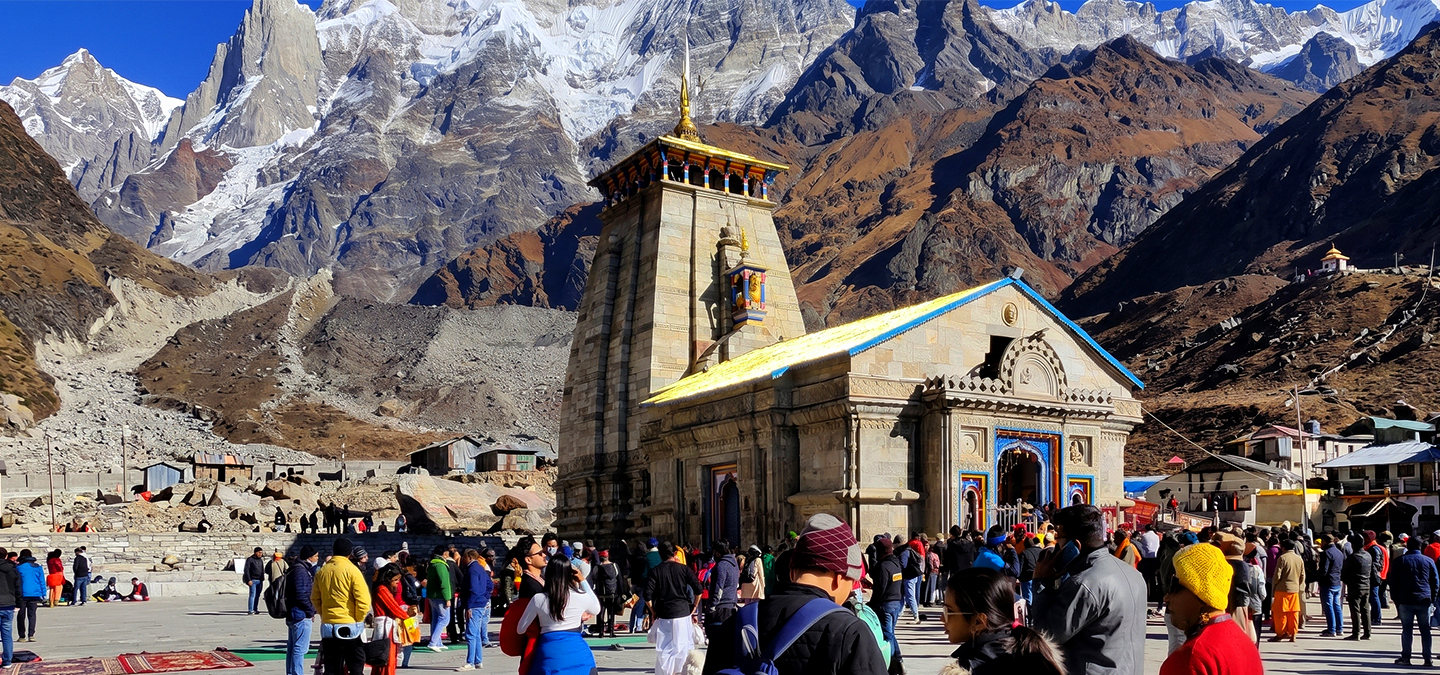
After an early breakfast, drive from Guptkashi to Sonprayag. From Sonprayag, take a local jeep to Gaurikund, the starting point of the Kedarnath trek. The 16 km uphill trek to Kedarnath Temple is the most physically demanding section of the entire Char Dham Yatra. The trail follows the Mandakini River and passes through forests, waterfalls, and increasingly rocky terrain. Ponies, palkis, and helicopter services are available for those who prefer not to trek the full distance.
Arrive at Kedarnath and attend the evening aarti at the ancient temple dedicated to Lord Shiva. Kedarnath Temple is one of the 12 Jyotirlingas of Lord Shiva and sits against the backdrop of the majestic Kedarnath mountain range. According to legend, the Pandavas sought Lord Shiva’s blessings here after the Kurukshetra war, and Lord Shiva took the form of a bull to elude them. The hump of the bull remained at Kedarnath, and the other parts appeared at four other locations, now worshipped as the Panch Kedar.
Overnight stay at Kedarnath (basic guesthouses or government-run accommodation).
Note: Meals at Kedarnath are not included in the package due to limited dining infrastructure.DAY 8
Kedarnath to Guptkashi
Wake early for morning darshan at the Kedarnath Temple. After prayers, begin the 16 km trek back to Gaurikund. Take the local jeep to Sonprayag and then drive back to Guptkashi. This day is intended for recovery after the demanding Kedarnath trek, so the pace is kept relaxed. Check in at your hotel in Guptkashi. Dinner and overnight stay.
DAY 9
Guptkashi to Badrinath via Joshimath
After breakfast, depart from Guptkashi for Badrinath. The route passes through Chamoli district and crosses several of the Panch Prayag, the five sacred river confluences of Uttarakhand. You will pass through or near Rudraprayag (confluence of Mandakini and Alaknanda), Karnaprayag, Nandprayag, and Vishnuprayag along the way. Stop briefly at Joshimath, the winter seat of Lord Badrinath and home to the Narsingh Temple, which houses the winter idol of Lord Badrinath when the main temple at Badrinath closes for the season. Continue the drive to Badrinath. Check in at your hotel. If you arrive in time, visit the Tapt Kund (hot spring) near the temple for an evening soak.
Joshimath: The town is also significant as the place where Adi Shankaracharya is believed to have established one of his four sacred Mathas (monasteries).
DAY 10
Badrinath Darshan and Mana Village
This day is dedicated entirely to Badrinath and its surroundings. Begin with a morning visit to the Badrinath Temple for darshan. The temple is dedicated to Lord Vishnu and is one of the most revered pilgrimage sites in India. After prayers, visit the Tapt Kund (hot spring), Narad Kund, and the Brahma Kapal ghat, where pilgrims perform pind daan (ancestral rites).
In the afternoon, take a short trip (3 km) to Mana Village, the last Indian village before the Indo-Tibetan border. At Mana, visit the Vyas Gufa (the cave where Ved Vyas is believed to have composed the Mahabharata), the Bhim Pul (a natural rock bridge said to have been placed by Bhima of the Pandavas), and the Saraswati River, which emerges briefly above ground near the village before disappearing underground.
Return to your hotel in Badrinath. Dinner and overnight stay.
Badrinath: The temple is believed to have been established by Adi Shankaracharya in the 8th century. The black stone idol of Lord Vishnu (as Badrinarayan) is considered self-manifested. The temple opens and closes each year according to dates set by the temple committee.
DAY 11
Badrinath to Rishikesh via Kirtinagar
After breakfast, begin the long descent from Badrinath back toward the foothills. The route passes through Joshimath, Chamoli, Rudraprayag, and Kirtinagar before arriving in Rishikesh. The landscape shifts gradually from snow-capped peaks and narrow gorges to forested hills and the wide riverbanks of the Ganga in Rishikesh.
Check in at your hotel in Rishikesh. If you arrive with enough time and energy, visit the Triveni Ghat for the evening Ganga Aarti, or take a walk along the river near Ram Jhula and Laxman Jhula. Dinner and overnight stay.
Rishikesh: Known as the “Yoga Capital of the World,” Rishikesh sits at the confluence of the Ganga and the Chandrabhaga River. The town is a popular spiritual and wellness destination and serves as a fitting end to the Char Dham Yatra before you return to Dehradun.
DAY 12
Rishikesh to Dehradun
Early morning, we suggest a quiet walk along the Ganga riverfront in Rishikesh to take in the peaceful atmosphere one last time. Return to your hotel for breakfast and check out. Drive from Rishikesh to Dehradun. Our representative will drop you at the Jolly Grant Airport or Railway Station in time for your onward journey. Your 12 days chardham tour package from Dehradun concludes here, leaving you with memories of a pilgrimage that covered the full sacred circuit of Uttarakhand’s Char Dham.