 +919871148514
 info@memorableindia.com
India’s architectural history covers more than 5,000 years of uninterrupted civilisation, and each era has left behind monuments that showcase the technical brilliance and artistic vision of those who built them. From the geometric precision of Mughal era mausoleums to the stone carvings of medieval temple complexes, these structures are much more than tourist attractions; they are primary sources for understanding how different dynasties, religions and cultures shaped the subcontinent. Many of these landmarks are also recognised among the Unesco World Heritage Sites In India, reflecting their global cultural significance.
This guide examines eight architectural sites that represent the diversity of Indian history. Each location has been chosen for its historical importance, engineering innovation and the unique architectural language that it represents. Planning visits to various sites in different regions allows travellers to trace the growth of Indian architecture in different periods and geographical settings, especially when curated thoughtfully as part of thematic journeys like a Central India Heritage Tour.
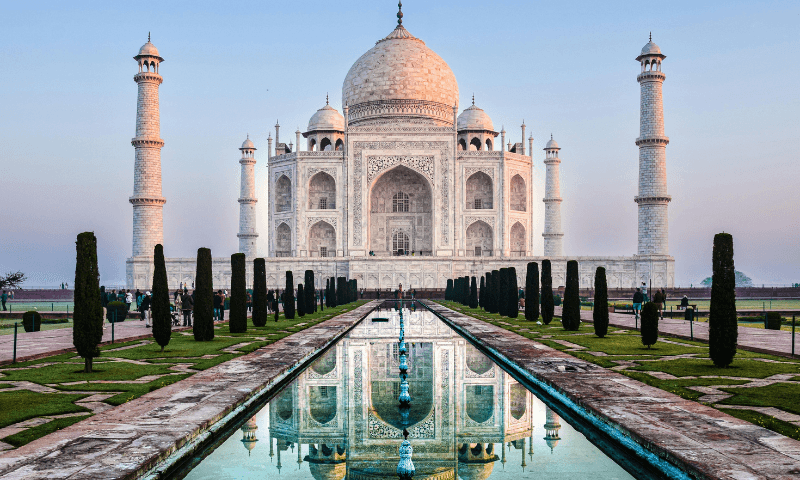
The Taj Mahal is the most recognised example of Mughal architecture, completed in 1653 after 22 years of construction. Built by Emperor Shah Jahan as a mausoleum for his wife Mumtaz Mahal, the monument showcases the Mughals’ mastery of symmetry, proportion, design and material craftsmanship. The main dome stands 73 meters tall with four minarets sloping slightly outward to prevent collapse onto the tomb during an earthquake – a choice made by the architect.
The white Makrana marble changes its appearance throughout the day according to the lighting conditions; it appears pinkish in the morning, white in midday, and golden at sunset. Intricate work in polished semi-precious stones such as lapis lazuli, jade and turquoise is inlaid in floral patterns across the walls called pietra dura. Visit during early morning hours to avoid crowds and witness the monument in its best light. The site remains closed on Fridays.
Hampi was the capital of the Vijayanagara Empire from 1336 to 1565, and its ruins cover an area of 26 square kilometers of boulder-strewn landscape. The site has more than 1,600 monuments, including temples, royal structures, water systems, and fortifications. The Virupaksha Temple has been in continuous use since the 7th century and the Vittala Temple complex is the architectural peak of the empire, with the stone chariot and musical pillars that emit different notes when struck.
The hydraulic engineering at Hampi deserves special attention as aqueducts, tanks, and channels that are evidence of sophisticated water management in a semi-arid land. The Stepped Tank near the Krishna Temple has geometric precision in its descending levels. Allow at least two full days to tour the main monuments clusters. The closest airport is Hubli, 144 kilometers from Hampi, for which regular bus services are available.
The Chandela Dynasty built 85 temples at Khajuraho between 950 and 1050 CE, out of which 25 remain standing today. These sandstone buildings exhibit nagara-type architecture with high shikhara towers, elaborate friezes, and sculptures on almost every exterior surface. The Kandariya Mahadeva temple is dedicated to Lord Shiva, and is 31 meters high and has more than 900 sculptures.
While the erotic sculptures get most of the attention, they only represent 10% of the entire carvings. The majority are of gods, celestial beings, musicians and scenes from daily life. The temples form either a western (Hindu), eastern (Hindu and Jain), or southern group. The heaviest tourist traffic is in the western group. Visit between October and February for comfortable weather. The town has its own airport with connectivity to Delhi and Varanasi, and is frequently included in itineraries branded as Unesco World Heritage Sites in India Part 2 for travellers exploring central temple architecture.
Built in the 13th century by King Narasimhadeva I, the Konark Sun Temple was designed as a giant chariot for the sun god Surya, made with 24 elaborately carved wheels and seven horses. The Kalinga arches have reached their greatest height here; however, the main sanctum of this temple collapsed in the 19th century. What remains – the audience hall and dancing hall still show extraordinary craftsmanship in khondalite stone.
Each of the 24 wheels is 3 meters in diameter and works as a sundial, with spokes and shadows showing the time with precision. The temple walls are detailed with sculptures of daily life, celestial beings, and erotic imagery in the Khajuraho style. The location at the beach exposes the structure to the salt air erosion, and thus, conservation efforts are ongoing. Located 65 kilometers from Bhubaneswar, the site works great as a day trip from the state capital and often features in coastal itineraries marketed under themes like Cultural Echoes Coastal Charm.
Maharaja Sawai Pratap Singh commissioned Hawa Mahal in 1799, which appears to be a five-storey facade; however, it is only a single room deep structure. The “Palace of Winds” has 953 small windows (jharokhas), which were built to let the royal women view street life while maintaining purdah. The red and pink sandstone honeycomb structure incorporates Rajput architecture, which is combined with Mughal design influences.
The design creates a natural cooling effect of the hundreds of windows that makes it habitable even during Rajasthan’s intense heat. There is a pyramid-shaped structure, which tapers as it rises up to 15 meters. The best photographs are taken from the rooftops of the shops across the street, not from the ground level, where most tourists stop. Entry tickets include access to the archaeological museum inside. Jaipur’s fair-sized architecture can be explored with round-trip India tour packages that include the city’s forts and palaces.
The present Mysore Palace replaced an earlier wooden structure, which burned down in 1897. British architect Henry Irwin modeled the new palace in the Indo-Saracenic style, which is a combination of Hindu, Islamic, Rajput, and Gothic styles. Completed in 1912, the palace consists of three-story stone buildings with domes made of marble, a five-story tower, and large courtyards. The Wodeyar dynasty used it as their official residence until 1950.
The Durbar Hall is adorned with elaborate ceiling designs, stained glasswork and a golden throne that is used for the annual festival of Dasara. The palace has more than 97,000 light bulbs, which light up the palace every Sunday evening and during festivals – a spectacular sight. Photography is forbidden inside the palace. Plan visits in September or October to see the palace in full ceremonial mode during the Dasara festival. Regular trains and buses are available to connect Mysore with Bangalore at a distance of 140 kilometres.
Emperor Shah Jahan ordered the Red Fort in 1638 when he transferred the Mughal capital from Agra to Delhi. The huge red sandstone fortress has a total area of 94 acres, with walls 33 meters high on the riverside. The fort housed the emperor’s private space, including apartments, audience halls, royal baths, and gardens. The architecture offers some evidence of Mughal design at its administrative best, structures such as the Diwan-i-Aam (Hall of Public Audience) and Diwan-i-Khas (Hall of Private Audience).
British colonial forces did much to modify the fort after 1857, demolishing many buildings and using others as barracks. The Lahori Gate and Delhi Gate are still the main entrances. The fort is now the site of the celebration of Independence Day in India each 15th of August when the Prime Minister of India addresses the country from its ramparts. Sound and light shows are held most evenings in both Hindi and English. Located in the old area of Delhi, the fort is easily connected to other historical sites in the area.
Gol Gumbaz serves as the mausoleum of Mohammed Adil Shah which was finished in 1656. The defining feature of the structure is its dome – the second largest pre-modern dome in the world, with a diameter of 44 meters, larger only than the Pantheon in Rome. The dome rests on an octagonal base directly without any supporting pillars, showing wonderful structural engineering for the times.
The whispering gallery within the dome gives the building unique acoustics – anything uttered on one side of the building carries clearly to the opposite end 38 meters away. Four seven-story minarets fill the corners of the square structure, with staircases leading from the base of the dome to its top. The simple exterior of the building contrasts with the complex engineering required for the dome’s construction. Bijapur is located 530 kilometers south of Mumbai, and it can be reached by train or bus. Early morning visits provide the best acoustics before tourists arrive.
Visiting different architectural places requires a bit of strategic planning, considering the size and variations in the infrastructure in India. Grouping sites by region makes practical sense – combine the Taj Mahal with Red Fort in a northern circuit, or put Hampi with Gol Gumbaz and Mysore Palace in Karnataka. Train networks link major cities reliably, although bookings in advance are required during peak tourist seasons (October to March).
Organized India travel packages do a better job of logistics than independent travel does for multi-city travel, especially when internal travel, accommodation coordination, and guide services are important. Each site deserves different time allotments – the Taj Mahal needs 2-3 hours, while the ruins of Hampi, which are sprawling, will take many days. Heat and crowds are at their worst from April through June; Monsoon season (July to September) has different effects on outdoor sites in different parts of the country.
These eight architectural sites belong to different eras in India’s building traditions, ranging from medieval Hindu temple complexes to the Mughal imperial buildings to Indo-Saracenic palace designs. Each location provides specific information about the engineering skills, the artistic sensibilities, and cultural priorities of its builders. Visiting them in person brings out details that no photograph can capture – the size of structures, the precision of stone carving, and the way these buildings interact with their geographical settings.
The logistical difficulties in visiting multiple locations in various Indian states make organized itineraries worth considering for travelers who value efficiency and local expertise. Understanding the historical context before visiting is an excellent way to enhance the experience – these monuments speak much more clearly when visitors have some understanding of the political, religious, and technological circumstances under which they were created.
Which architectural site in India receives the most visitors annually?
The Taj Mahal is visited by 7-8 million people each year and is the most visited architectural monument in India. Red Fort in Delhi and Mysore Palace come next with 2-3 million visitors each. These numbers vary depending on tourism trends and seasonal patterns.
How much time should travelers allocate for visiting these eight sites?
A full day visit to all 8 sites takes 12-15 days at a minimum, including travel time from one site to another. This assumes 1-2 days at each site, depending on the level of complexity (Hampi will take 2-3 days, whereas Hawa Mahal and Gol Gumbaz can be covered in half-day visits). Add buffer days to allow for transit delays and rest.
Are photography restrictions common at Indian architectural sites?
Photography policies differ from place to place. Mysore Palace does not allow any photography indoors, while the Taj Mahal does, but limits tripods. Hampi and Khajuraho allow photography without any restrictions. Some sites do have separate camera charges for professional equipment. Always be aware of current policies at ticket counters before shooting.
What is the best season to visit these architectural sites?
October through March provides the most pleasant weather in these locations with cooler temperatures and minimal rainfall. The best time for tourists is November to February, when larger crowds are expected, but the weather is more temperate. The monsoon season (July-September) affects the outdoor sites in Karnataka and Odisha more seriously than the desert sites in Rajasthan.
Do these sites require advance booking or special permits?
The Taj Mahal controls the number of visitors by time, and it is better to book tickets online to avoid waiting at ticket counters for long hours, although at the security check, there will be some waiting. Other sites generally offer same-day ticket purchases, but online booking is a time saver when possible. No special permit is required for Indian or foreign nationals at these places, but one must have a valid photo ID for ticket verification.
Are professional tour guides available at these architectural places?
All eight sites have government-sanctioned guides who provide historical context and architectural information that enhance the visit. Guide fees differ according to location and language, typically ranging from ₹ 500-2,000 for 2-3 hour tours. Many guides work independently at site entrances, while others can be pre-booked through official tourism offices or tour operators.
15 Amazing Temple Fairs in India: A Traveller’s Guide to Faith, Colour and Living Tradition
30 Sep 2026
13 Best Places to Explore in the Youngest State of Telangana
29 Sep 2026
12 Less Explored Destinations in Maharashtra Worth Adding to Your Travel List
28 Sep 2026
11 Must-Visit Museums in India for Wildlife Lovers
27 Sep 2026
11 Best Places in India to Celebrate Christmas
26 Sep 2026


