 +919871148514
 info@memorableindia.com

Himachal Pradesh carries its spiritual identity as plainly as it carries its mountains. Across the Kangra, Kullu, Mandi, and Chamba valleys, temple spires appear on ridges, by riversides, and inside village squares, each with its own legend and lineage. For travellers, these shrines are not just religious stops. They are historical anchors that explain how communities grew, how trade routes once moved, and how the hill culture of this state still functions today.
This guide walks you through the famous temples in Himachal Pradesh that genuinely merit a detour, organised region by region so your itinerary stays practical. You will find Shakti Peeths tied to ancient Puranic legend, Shiva temples with carved stone shikharas, and quieter shrines wrapped in deodar forests. Use this as a working reference for a short weekend circuit or a longer pilgrimage with family.
The name Dev Bhoomi, or Land of the Gods, is not a tourism tagline. It reflects a lived reality where local deities, called devtas, still influence village festivals, agricultural cycles, and dispute resolution. According to the Himachal Pradesh Tourism Department, the state hosts hundreds of temples that span centuries, from Nagara style stone structures to pagoda roofed wooden shrines unique to the western Himalayas.
This diversity is why a single temple tour here can feel like three different trips. The Kangra belt leans into Shakti worship, Kullu celebrates its devta tradition during Dussehra, and Chamba preserves rare Gupta era bronzes inside working temples.
The Kangra region holds the highest concentration of famous temples in Himachal Pradesh, and most pilgrims structure their trips around this cluster. Three of the five Shakti Peeths in Himachal Pradesh sit within a two hour driving radius here, which makes the valley the natural base for a focused pilgrimage.
Located in Jwalamukhi town, this shrine is one of the 51 Shakti Peeths of India. The temple has no idol in the conventional sense. Instead, nine natural flames burn continuously from fissures in the rock, each named after a goddess. The eternal flame has drawn mentions in ancient texts and continues to attract devotees year round. Mughal emperor Akbar reportedly tried to extinguish it and later offered a gold canopy in acknowledgement, a story documented in several regional accounts.
Set in Kangra town, this is another Shakti Peeth with a history of destruction and rebuilding. The current structure dates from the early twentieth century after the 1905 Kangra earthquake. Visit during Navratri when the entire town turns into a fair ground with regional performers, sweet stalls, and local artisans.
Ten kilometres from Dharamshala on the banks of the Baner river, Chamunda Devi draws steady footfall from travellers already in the McLeodganj area. The temple sits at a scenic bend with mountain views that reward even casual visitors.
Baijnath is a Shiva temple from the thirteenth century and one of the most architecturally complete Nagara style structures in the state. The main shikhara, carvings of river goddesses at the entrance, and the enclosed courtyard are protected under the Archaeological Survey of India. If you appreciate temple architecture, this stop alone justifies the Palampur detour.
Often called the Ellora of the Himalayas, Masrur is a group of fifteen monolithic temples carved from a single sandstone outcrop around the eighth century. The site is less crowded than other Kangra shrines and offers a clean view of Dhauladhar peaks on clear days.
For travellers combining these shrines with hill station time, our curated Dharamshala tour options pair the Kangra temple circuit with McLeodganj and Bir in a single itinerary.
Perched on the highest point in Shimla town, Jakhu is a Hanuman temple with a 108 foot statue visible from most parts of the city. Local legend connects the hill to Hanuman resting here while searching for the Sanjeevani herb. The walk up from the Ridge takes about forty minutes through pine forest and is a Shimla ritual in itself.
About eleven kilometres from Shimla, Tara Devi sits on a wooded hilltop at 1,851 metres. The shrine is quieter than Jakhu and offers a cleaner view of the Choor Chandni range on a clear morning.
A longer drive from Shimla toward Rohru brings you to Hatkoti, a riverside group of stone temples dedicated to Hateshwari Mata. These eighth century shrines rarely feature in standard tourist circuits, which is exactly why they are worth seeking out. Planning a longer stay in the state capital? Our Shimla trip options include extensions into the Rohru and Chanshal valley belt.
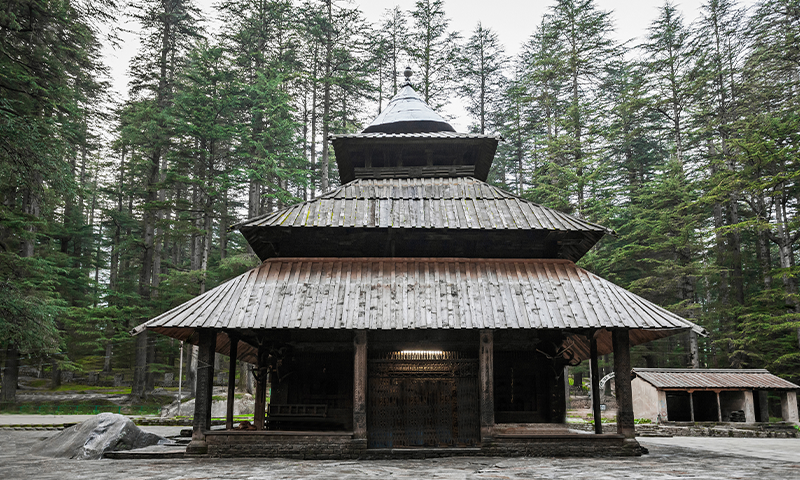
The pagoda roofed Hidimba temple in Manali is dedicated to Hidimba, the demoness wife of Pandava prince Bhima from the Mahabharata. Built in 1553 by Raja Bahadur Singh, the temple sits inside a cedar grove in Dhungri. Early morning visits avoid the day tripper crowds.
A short walk from old Manali, Manu temple honours sage Manu, considered the author of the Manusmriti. The temple is a quiet counterpoint to the busier Hidimba shrine and sits within old village lanes worth exploring on foot.
Reaching Bijli Mahadev requires a three kilometre uphill trek from the road head above Kullu town. The temple is famous for a tall staff that reportedly attracts lightning, which splits the Shiva lingam inside. Priests then reset it using butter and lentils until the next strike. The view across the Beas and Parvati valley confluence is a reward in itself.
Manikaran in the Parvati valley is unusual in that it holds both a revered Gurudwara and a Shiva temple built around natural hot springs. The site has mentions in both Sikh and Hindu traditions, making it one of the more culturally layered stops in the region. These shrines fit naturally into our Manali itineraries and are easy to combine with the Solang Nallah and Rohtang sector.
Mandi is sometimes called Chhoti Kashi for a reason. The town has over eighty temples, and the Bhutnath Shiva temple from the sixteenth century sits at its ceremonial heart. The Mandi Shivratri fair, held each spring, draws devtas from across the district in colourful palanquin processions.
Perched on a hilltop above the Govind Sagar reservoir, Naina Devi is another of the 51 Shakti Peeths. The temple is accessible by a short cable car ride from the base, which has made it a popular family pilgrimage stop for travellers coming in from Punjab and Haryana.
Located near Jogindernagar, this is one of the few prominent Baglamukhi shrines in north India and attracts devotees who perform specific havans. The surrounding area is a pleasant mix of tea gardens and small village markets.
The Lakshmi Narayan complex in Chamba town contains six stone temples built between the tenth and nineteenth centuries. The main shrine houses a marble image of Vishnu brought from the Vindhyas, and the complex remains in active worship, which is unusual for monuments of this age.
Deep in the Bharmour valley sits the Chaurasi group of eighty four stone temples, some over 1,400 years old. The site is sacred to the Gaddi shepherd community and sees peak activity during the Manimahesh Yatra, a Shiva pilgrimage held each August or September.
Chintpurni Devi, in Una district, completes the Shakti Peeth cluster that most pilgrims cover alongside Jwala Ji and Naina Devi. The temple sits in a small town that fills up during Navratri and Shravan Ashtami, so early morning darshan slots are the smartest window. Nearby, the Deotsidh temple of Baba Balak Nath in Hamirpur attracts regional devotees in large numbers, especially on Sundays and during the Chaitra Mela. The surrounding Shivalik foothills make the drive from Chandigarh or Pathankot straightforward, and most travellers combine these two shrines with a Jwala Ji stop over two days.
For most of the shrines listed above, the shoulder months of March to June and September to November offer the best mix of weather and accessibility. Monsoon between July and August can disrupt road access to high altitude temples like Bijli Mahadev and Chaurasi Bharmour, so pre book stays with flexible cancellation. Winter brings its own appeal to lower altitude Kangra and Una temples, though Shimla and Manali routes may face snow closures that can hold up vehicles for a day or two. Festival calendars matter too. Navratri, Shivratri, and the Kullu Dussehra transform these temples into cultural events, though crowds and traffic swell significantly. If you want quiet darshan, aim for weekdays in late April or mid October when weather is settled and school holidays have not kicked in.
A practical seven to ten day Himachal Pradesh temple tour can cover the main Kangra Shakti Peeths, extend into Chamba for heritage, and close with a Shimla or Kullu segment depending on your interests. Keep these pointers in mind:
For a structured plan built around your preferred regions and travel pace, our Himachal Pradesh tour packages include temple focused and mixed itineraries with experienced local guides.
The famous temples of Himachal Pradesh reward unhurried travel. Rather than ticking off a long list, pick a region, give it two or three days, and let the local pace shape your experience. If you need help structuring the route, the Memorable India travel desk can tailor an itinerary around your dates, pace, and interests.
The most visited shrines include Jwala Ji, Chintpurni, Naina Devi, Brijeshwari, Chamunda, Baijnath, Hidimba Devi, Jakhu, Bijli Mahadev, and the Lakshmi Narayan complex in Chamba. These cover Shakti Peeths, major Shiva shrines, and historic stone temples.
Himachal is home to five of the 51 Shakti Peeths: Jwala Ji, Brijeshwari Devi, Chamunda Devi, Naina Devi, and Chintpurni. Pilgrims often combine all five in a single circuit lasting four to five days.
The Masrur rock cut temples near Kangra date to around the eighth century and are among the oldest surviving temple structures in the state. The Chaurasi complex in Bharmour and the Hatkoti shrines are of similar antiquity.
Most temples permit photography in outer courtyards but prohibit it inside sanctums. Jwala Ji, Naina Devi, and Chintpurni enforce this strictly. Check with temple staff before clicking anywhere near the inner sanctum.
Yes, with the right planning. Naina Devi has a cable car, Chamunda Devi is road accessible to the gate, and the Kangra town shrines involve minimal climbing. Avoid Bijli Mahadev and Chaurasi Bharmour if mobility is a concern.
For a Delhi or Chandigarh weekend, the Chintpurni, Jwala Ji, and Naina Devi circuit works as a two to three day plan. For a Manali weekend, Hidimba Devi and Manu temple cover the key visits comfortably.
Most shrines expect modest clothing that covers shoulders and knees, and leather belts, wallets, or bags must be left outside the inner sanctum. At Baba Balak Nath, women traditionally do not enter the main cave sanctum, so plan accordingly. Carry a small cloth bag for footwear at busier temples like Naina Devi and Chintpurni where storage counters get overwhelmed on weekends.
A Guide to Famous Temples in Himachal Pradesh
24 Oct 2026
9 Best Places to Visit in Lakshadweep, a Top Island Getaway in India
23 Oct 2026
7 Reasons Why One Should Travel by Indian Rail
22 Oct 2026
6 Reasons to Visit Chopta Valley in the Himalayas
21 Oct 2026
5-Step Guide to Plan a Jungle Safari Trip to Corbett National Park
20 Oct 2026


