+919871148514
 info@memorableindia.com
Karnataka has an unusually rich treasure of temple architecture. The state was shaped by dynasties who built not only for worship but for permanence, and their legacy includes rock-cut shrines, riverside sanctuaries, coastal pilgrim centres and ruins, which have been listed by UNESCO. Whether it is a committed Karnataka pilgrimage tour or if you are combining the sacred with the rest of a broader Karnataka heritage and nature tour, the state does not have as much variety as most travellers expect.
This guide covers 10 of the most famous temples of Karnataka, in a way that gives practical context on what exactly makes each particular temple worth your time, how to reach them, and how to sequence your visit.
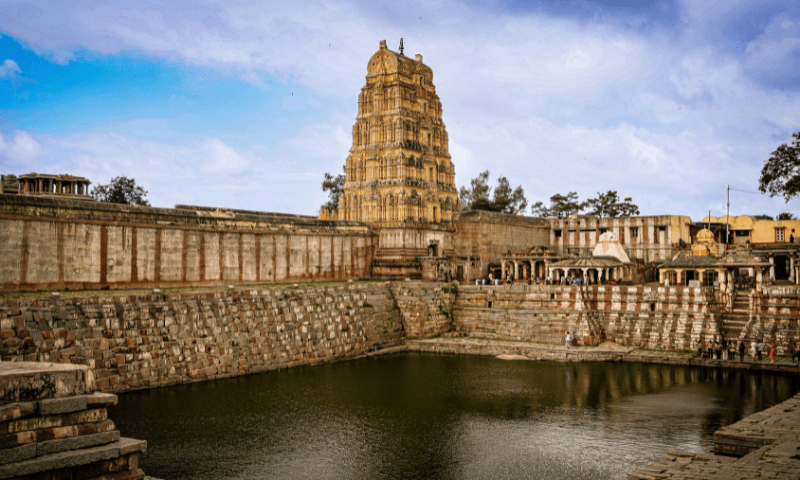
Hampi’s Virupaksha Temple is the only living temple within the otherwise ruined complex of the Vijayanagara Empire, making it a rare combination of living worship and archaeological fantasy. Dedicated to Lord Shiva as Virupaksha, the temple remained in continual use since the 7th century and still remains the spiritual anchor of the Hampi, UNESCO heritage tour Karnataka travellers come for.
The first thing that you see from the road is the towering gopuram at 50 metres. Inside the corridors lead to the sanctum sanctorum, where rituals are conducted daily. The annual festival of chariots in February, and the Pampa Devi marriage festival in December bring large crowds for this colourful festival.
Getting there: Hampi is located at a distance of 350 km from Bangalore via NH 67, or can be taken to Hospet (13 km away) by train.
In the same complex as Hampi, the Vittala Temple requires a separate visit. Dedicated to Lord Vishnu in his Vittala form, the 15th-century structure is known for its ornate stone chariot and musical pillars, which are said to produce tonal sounds on being tapped. It is a protected monument by the Archaeological Survey of India.
The moment to visit the Vittala Temple is in early morning, before the heat and the crowds. Photography buffs will notice that the stone chariot is unique to photograph at golden hour.
Getting there: About 3 km east of the main Hampi bazaar, it can be reached by coracle or on foot.
The Sri Krishna temple at Udupi is one of the most popular Vaishnava shrines in South India. Founded by the philosopher-saint Madhvacharya in the 13th century, the temple is unique because the idol of Lord Krishna is seen through a window of nine holes called Navagraha Kitiki, which was said to have been created by a devotee-saint Kanakadasa when he was denied entry.
The temple is administered by eight mutts in rotation and the cycle of utsav implies that there is always some kind of festival or ritual activity going on. Udupi is also an important stop on any Karnataka pilgrimage tour packages circuit covering the coastal belt.
Getting there: Udupi is 403 km away from Bangalore and is well-connected by rail and road.
Gokarna has much weight in Hindu Sacred Geography. The Mahabaleshwara Temple here is the abode of the Atmalinga of Lord Shiva, which is connected with the legend of Ravana and Ganesha in the Shiva Purana. The town itself is regarded as one of the seven Mukti Kshetras of Karnataka: sacred places related to the belief of getting liberated.
The temple is in the centre of the Gokarna town, which is compact and best explored on foot. The Tamra Gowri and Ganapathi temples are not far away, forming a part of the same circuit of pilgrimage. Gokarna is also the destination for travellers who combine a visit to the temple with the beaches at Om Beach and Kudle Beach.
Getting there: About 485 km from Bangalore, nearest railway station is Gokarna Road, 10km from the town.
Murudeshwara’s defining image is a 37 metre statue of Shiva rising above the Arabian Sea, seen from a considerable distance. Built on Kanduka Hill on the coastal Karnataka shoreline, the temple complex includes a 21-storey gopuram from which one has panoramic sea views from the top storeys.
The temple is dedicated to Lord Shiva and is set in a place which has very few parallels on India’s western coast. The combination of religious importance and dramatic coastal scenery makes it a constant attraction to both pilgrims and general travellers.
Getting there: 485 km from Bangalore via Udupi; closest station is Murudeshwara on the Konkan Railway.
Nestled in the hills of the forest region of the Western Ghats, Kukke Subrahmanya is one of the most important serpent deity temples in South India. The presiding deity is Lord Subrahmanya, worshipped here as the protector of the serpents, the divine serpent Vasuki also being present in the sanctum. The temple attracts plenty of devotees to get relief from Sarpa Dosha, a horoscopic affliction, which is related to serpents in Vedic astrology.
The surroundings are dense as well as green, with the Kumaradhara River flowing close by. The combination of forested terrain and spiritual atmosphere makes Kukke Subrahmanya a place to visit in a temple that is not so crowded, though deeply meaningful compared to the more crowded coastal shrines.
Getting there: About 105 km from Mangalore by NH 275.
Dharmasthala is an anomaly in the religious life of India, in that the temple is dedicated to Lord Shiva, the temple is run by the Jain Heggade family, but the priests follow the Vaishnava path. This interfaith management model has existed for centuries and is an uncommon example of harmony, of which the town is rightly proud.
The temple does not charge anything, and the meals are provided to everyone irrespective of their religion. Dharmasthala is also popularly on the coastal Karnataka temple circuit and a good connect with a visit to Kukke Subrahmanya and Udupi.
Getting there: 75km from Mangalore via Belthangady.
Set on the banks of the Bhadra River, in the Western Ghats, the Annapoorneshwari Temple at Horanadu is dedicated to the goddess of nourishment. The presiding deity is shown holding a vessel of rice and the temple is associated with a prayer for plenty of food and family welfare.
The place is scenic in that the river and the forested hills provide a natural backdrop. Free meals are served to all the devotees every day, as a practice continued from the temple trust. Horanadu is usually combined with a visit to Sringeri which is about 40 km from Horanadu.
Getting there: 370 kms from Bangalore the nearest town is Sringeri.
Sringeri is one of the four holy mathas founded by Adi Shankaracharya in the 8th century making it a place of pilgrimage of national importance for the followers of the Advaita Vedanta tradition. The Sharada Peetham dedicated to Goddess Saraswati is located next to the Tunga River; the entire complex comprises the Vidyashankara Temple, which is in the Hoysalan-Vijaynagaran style and was built in the 14th century.
The Vidyashankara Temple is architecturally unique in that the pillars are oriented so that the sun’s rays fall on certain symbols in the zodiac on the appropriate months. Sringeri makes a natural base for visiting nearby Horanadu and Kollur, and fits well into an even wider Karnataka holiday packages itinerary covering the Chikmagalur and coastal belt.
Getting there: 350 kms from Bangalore via Chikmagalur.
The Chennakeshava Temple at Belur, which was built by the Hoysala king Vishnuvardhana in the 12th century, is one of the finest examples of Hoysala temple architecture in India. Every surface of the exterior is covered by intricate carvings representing deities, mythological scenes, celestial beings, and decorative motifs, which have been carried out with such precision as to have led to their being compared to the work on jewellery in stone.
The temple’s construction took more than 100 years to complete, and is regarded as the High Water Mark of the Hoysala craftsmen. It is often combined with a visit to the Hoysaleswara Temple at Halebidu, some 16 km away for a complete overview of Hoysalan temple architecture. Both places are covered in any well-structured Karnataka heritage and nature tour.
Getting there: Belur is 220 km from Bangalore, about 40km from Hassan.
A well-organized Karnataka temple pilgrimage tour circuit can be organized in various ways depending upon your point of departure and time of travel.
Coastal and Western Ghats Circuit (7-8days from Bangalore): Kukke Subrahmanya, Dharmasthala, Udupi Sri Krishna Temple, Gokarna Mahabaleshwara, Murudeshwara, Kollur Mookambika (bonus stop), Horanadu, Sringeri.
Heritage and North Karnataka Circuit (4-5 days): Hampi Virupaksha Temple, Vittala Temple, Badami and Pattadakal Temples (UNESCO sites), Belur and Halebidu.
Combined Tour: Many travellers going on Karnataka holiday packages combine both the circuits over 10-12 days, though often in combination with the popular resorts of Mysore and Coorg for a more complete South Karnataka tour. Those interested in doing some wildlife can extend the trip towards Bandipur or Nagarhole, which is conveniently located between Mysore and the Kodagu region. For a perfect package of wildlife extension, Memorable India’s Karnataka Wildlife Tour covers both national parks with guided safari itineraries.
For those looking to plan a spiritual journey dedicated to South India, Memorable India’s Pilgrimage Tours section has some tailored ones that cover the major sacred circuits with professional support.
Q1. Which is the most famous temple in Karnataka?
The Virupaksha Temple at Hampi is widely regarded as the most iconic in Karnataka, both in terms of the active religious significance and the fact that it is a part of the list of UNESCO World Heritage sites for the Vijayanagara ruins. The Udupi Sri Krishna Temple and Gokarna Mahabaleshwara Temple are also the most revered ones.
Q2. What is the best Karnataka temple pilgrimage tour circuit for first-time visitors?
For the first time visitors, the coastal circuit with Kukke Subrahmanya, Dharmasthala, Udupi, Murudeshwara, Gokarna, Horanadu, and Sringeri is the most rewarding. It can be done from Bangalore in 7-8 days and encompasses different temple styles, coastal views, and forested hill terrain.
Q3. Is Hampi only about ruins, or is it a pilgrimage site too?
Hampi is genuinely both. The Virupaksha Temple is in continuous worship for more than a thousand years. It is not a museum exhibit but a functioning temple with daily rituals, annual festivals, and a resident priestly community. The Hampi UNESCO heritage tour of Karnataka, followed by the Karnataka visitors, comprises both the archaeological and living religious aspects of the site.
Q4. Which temples in Karnataka are best for Hoysala architecture?
Chennakeshava Temple at Belur and Hoysaleswara Temple at Halebidu are the two best examples of the Hoysala temple architecture. Both are within 16km of each other near Hassan and can be visited in a single day.
Q5. What is the significance of Dharmasthala Temple?
Dharmasthala is important for the model of interfaith administration. The temple follows Shaivite traditions, the priests are Vaishnava, and the administration is managed by Jain. This peculiar arrangement has been preserved for centuries. The temple is also famous for providing free meals for everyone who comes for pilgrimage; it is one of the main stops on the Western Ghats pilgrimage belt.