 +919871148514
 info@memorableindia.com
Telangana became a full Indian state on 2 June 2014, carved out of the erstwhile Andhra Pradesh after a long political movement. That makes it India’s youngest state, though certainly not its youngest in terms of history. The land stretches from the granite ridges of the Deccan Plateau to the thick teak forests along the Godavari, and the sightseeing map here reads like a compressed course in South Indian history: Kakatiya fortresses, Nizami palaces, Buddhist ruins, weaving villages, and a capital city that quietly reinvented itself as a global IT hub.
For travellers used to the Kerala backwaters or the Karnataka temple circuit, Telangana still feels underrated. That is exactly what makes it rewarding right now. Crowds are manageable, food is memorable, and the distances between headline sights are drivable in a single day. This guide walks through thirteen places worth blocking on a Telangana itinerary, with practical notes on what each one adds to the trip.
Hyderabad serves as the capital and the natural entry point, with a busy international airport connecting the state to Europe, Southeast Asia, and the Gulf. Winters, from November through February, are the accepted travel window; summers turn harsh across the plateau, and the June to September monsoon suits waterfall chasers more than fort climbers. A private car with driver is the most flexible way to move between districts.
The 400-year-old capital is where most Telangana trips begin. Charminar still anchors the old city, with Chowmahalla Palace, Mecca Masjid, and the pearl and bangle bazaars of Laad Bazaar within walking distance. Golconda Fort takes a good half-day for the climb to Baradari and the acoustics demonstration at Fateh Darwaza, while Qutb Shahi Tombs sit right next door for a quieter follow-up.
Save one evening for a plate of Hyderabadi dum biryani at Shah Ghouse or Bawarchi, and one morning for the Salar Jung Museum, one of India’s largest single-collector museums. Hussain Sagar with its Buddha statue on the central rock and the Necklace Road promenade around it are the standard evening walks; Birla Mandir at sunset gives you the city skyline in one frame. Ramoji Film City on the southeast outskirts is easy to bolt on for families travelling with children.
Families with time to spare often extend the visit with a Hyderabad-anchored South India temple tour from Hyderabad that begins at Tirupati and closes at Madurai.
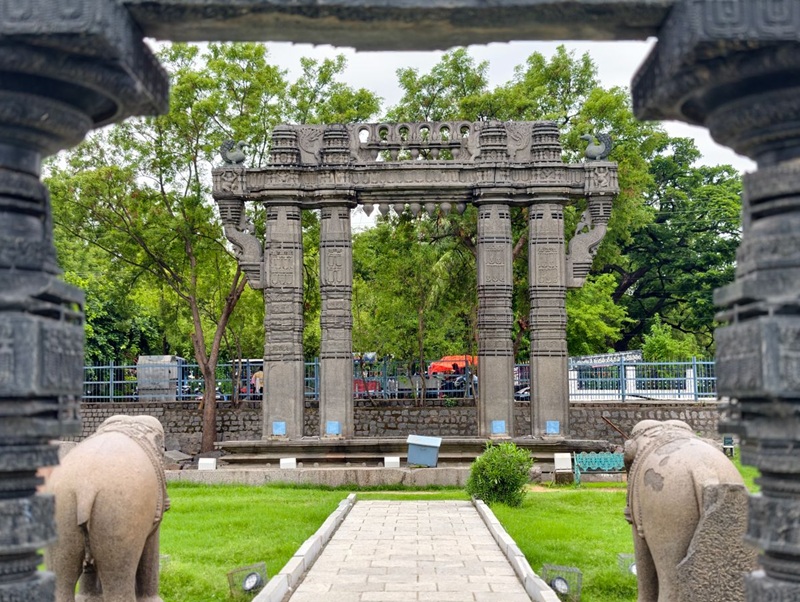
About 145 km northeast of Hyderabad, Warangal was the capital of the Kakatiya dynasty from 1163 to 1323 CE. The city’s headline sight is the ruined Warangal Fort, where the four ornate stone gateways of the Kakatiya Kala Thoranam still stand, along with pillars, lintels, and the temple platform of what was once the Swayambhu Shiva Temple. The state emblem of Telangana carries this same gateway motif, which is a fair indication of how central Warangal is to Telangana’s cultural identity.
A short drive away, the Thousand Pillar Temple at Hanamkonda, dating to 1163 CE, and the Bhadrakali temple beside its scenic tank are worth adding. Warangal makes a comfortable overnight base for the next stop on this list.
Roughly 70 km from Warangal, the Rudreshwara (Ramappa) Temple at Palampet was inscribed on the UNESCO World Heritage List in 2021. Built in 1213 CE under the Kakatiya ruler Ganapati Deva, the sandstone temple is celebrated for its floating bricks that reportedly weigh less than water, its dancing figure brackets carved on black basalt, and the remarkable fact that the sculptor Ramappa’s name, rather than the ruler’s, was given to the shrine. It is one of the very few temples in India named after its architect, and a mandatory stop for anyone interested in Deccan temple architecture.
On the outskirts of Hyderabad, Ramoji Film City spans about 1,666 acres and is recognised by the Guinness Book of World Records as the largest integrated film studio complex in the world. Themed gardens, permanent movie sets doubling as railway stations, temples, courtrooms, and airports, a hotel strip, and daily film-themed shows make this a full-day family stop. The Eureka rides, Sun Fountain, and the Wild West stunt show are the standard crowd pullers. Book the guided bus tour, keep the kids in comfortable shoes, and expect a lot of walking. Weekday visits are markedly less crowded than weekends and school holidays.
Fifty kilometres from Hyderabad on the Warangal highway, Bhongir Fort sits atop a single dome of granite that rises around 500 feet above the surrounding plain. Built by the Western Chalukyan ruler Tribhuvanamalla Vikramaditya VI in the 10th century, the fort is now a favourite for weekend rock climbing and rappelling with certified local operators. The climb to the top takes about an hour at an easy pace, and sunset views over Bhuvanagiri town are the payoff. Wear grippy shoes; the granite gets slippery even in dry weather.
Around 60 km east of Hyderabad, the Sri Lakshmi Narasimha Swamy Temple at Yadadri is the state’s most visited Vaishnavite pilgrimage site. A large-scale renovation completed in recent years has given the hilltop shrine a fully re-clad black granite exterior and expanded the queue, guesthouse, and prasadam infrastructure considerably. Devotees typically combine it with Bhongir on the same day trip, and it is also a natural inclusion in any custom India pilgrimage tour package built around temples in the Telangana and Andhra region.
Roughly 150 km south of Hyderabad on the Krishna river, Nagarjuna Sagar is one of India’s tallest masonry dams and its reservoir is among the largest man-made lakes in the country. The real draw for slow travellers, though, is Nagarjunakonda, an island in the middle of the reservoir. This was the site of a 3rd century CE Ikshvaku capital and a major Buddhist learning centre named after the philosopher Nagarjuna.
When the dam was built in the 1960s, ruins from the valley floor were painstakingly relocated stone by stone to the island above the waterline. A short ferry ride connects the mainland to the island, where an on-site museum holds inscriptions, stupa fragments, and Buddha figures. Ethipothala waterfall and Anupu amphitheatre are natural add-ons; the Nagarjunakonda and Amaravati Buddhist tour ties this stop to Vijayawada for a longer regional circuit.
Deep in the eastern belt, about 300 km from Hyderabad, Bhadrachalam is a small temple town on the banks of the Godavari. The Sri Sita Ramachandraswamy Temple here is associated with the 17th century poet-saint Kancherla Gopanna, better known as Bhakta Ramadasu, who is credited with rebuilding the shrine during the reign of Qutb Shahi ruler Abul Hasan Tana Shah. Rama Navami celebrations draw pilgrims from across the Telugu-speaking states, and the ceremonial Sitarama Kalyanam mandapam is the emotional centre of the temple complex. Combine it with Parnasala, an hour’s drive away, where local tradition places Rama, Sita, and Lakshmana during their forest exile, and consider the Papikondalu boat cruise on the Godavari between November and February for a striking hill and river landscape.
Sixty kilometres from Hyderabad, Bhoodan Pochampally was named among the Best Tourism Villages by the United Nations World Tourism Organization in 2021, one of only three Indian villages on that list. The village produces the distinctive tie-dye Pochampally ikat sarees, and most weaver homes will open their looms to visitors on request. It is also historically significant as the place where Vinoba Bhave launched the Bhoodan land donation movement in 1951. Add half a day to your itinerary if you plan to shop directly from the weavers; prices at source are noticeably fairer than at retail showrooms in Hyderabad.
Around 100 km northwest of Hyderabad, Medak is best known for the Medak Cathedral, a Gothic revival Church of South India cathedral built in 1924 and considered one of the largest churches in Asia. Its 175-foot bell tower and stained-glass windows depicting the life of Christ are the visual anchors, and the acoustics inside the nave are worth the drive on their own. Medak Fort, on a nearby hilltop, offers plateau views and a manageable climb, while Pocharam Wildlife Sanctuary is a comfortable side trip for anyone keen on peacocks, sambar, spotted deer, and open scrub landscapes.
Set inside the Kadam river valley in Kumurambheem Asifabad district, Kuntala Falls plunges from around 148 feet, making it the tallest waterfall in Telangana. Best viewed between July and October when the Kadam is in full monsoon flow, the falls sit within reach of Nirmal and are commonly combined with Pochera and Gayatri waterfalls on the same circuit. The drive north from Hyderabad is around 250 km, and an overnight stop at Nirmal or Adilabad helps ease the return. Check local advisories after heavy rain; the approach steps can flood.
Barely 80 km from Hyderabad, Ananthagiri sits in the Nallamala range at around 2,500 feet. Coffee plantations, the source of the Musi river that runs through Hyderabad, and the 8th century Anantha Padmanabha Swamy Temple make it the go-to hill retreat for city residents. Trekking trails, forest homestays, and cycling routes have grown steadily here in the last five years, and it makes a pleasant single-night detour on any Telangana itinerary. The Telangana Tourism Haritha resort offers a reliable base for families who prefer not to camp.
Perched on the banks of the Godavari near the Maharashtra border, Basar is home to the Jnana Saraswati Temple, one of only two prominent Saraswati shrines in India along with the historic Sharda Peeth. Families bring young children here for the traditional Akshara Abhyasam ceremony, when a child is formally introduced to the alphabet, and the temple is busiest during Vasant Panchami. Basar is about 200 km north of Hyderabad, connected by a good highway and rail link, and pairs well with Nizamabad and Kuntala on a longer northern loop.
A well-paced first visit covers Hyderabad, Warangal, Ramappa, Bhongir, and Yadadri in about five days. Add three more for Nagarjuna Sagar, Pochampally, and a Medak day trip. Bhadrachalam, Kuntala Falls, and Basar sit further out and reward longer itineraries of ten to twelve days.
Telangana rewards travellers who are curious about India beyond the standard postcards. The state is young on paper but deeply layered in the ground beneath it, and the thirteen places above form a fair snapshot of what makes it worth flying into Hyderabad for. Heritage lovers will find enough in Warangal, Ramappa, and Golconda alone to justify the trip; pilgrims can build a serious circuit around Yadadri, Bhadrachalam, and Basar; families get a natural mix of Ramoji Film City, Nagarjuna Sagar, and Ananthagiri. It is one of the few Indian states where you can move between a UNESCO temple, a working weaving village, and a world class biryani plate in a single 48-hour window.
For a customised route that stitches these sights around your dates, food preferences, and travel pace, our team at Memorable India is happy to help. Share your requirements through the Memorable India Contact Us page and one of our travel specialists will design a Telangana itinerary that fits.
Telangana is the youngest state of India, formed on 2 June 2014 after being carved out of the erstwhile Andhra Pradesh. It is the 29th state by order of formation and has Hyderabad as its capital.
The best time to visit Telangana is between October and February, when the weather is dry and pleasant across the plateau. March to May is hot and best avoided for fort visits, while June to September is ideal only for waterfalls like Kuntala and Pochera.
Five days cover the essentials, meaning Hyderabad, Warangal, Ramappa, Bhongir, and Yadadri. Eight days let you add Nagarjuna Sagar, Pochampally, and Medak. A full ten to twelve day trip is needed to include Bhadrachalam, Basar, and Kuntala Falls.
Yes, Telangana is generally safe for family travel, including for senior citizens and children. Hyderabad and the main heritage circuit are well policed and tourist infrastructure is reliable. Standard travel precautions apply, and hiring a chauffeured car for intercity movement is recommended over self-driving.

A Guide to Exquisite Indian Handicrafts and Where to Buy Them in India
26 Oct 2026
A Journey to Leh and Srinagar: Firsthand Travel Experience
25 Oct 2026
A Guide to Famous Temples in Himachal Pradesh
24 Oct 2026
9 Best Places to Visit in Lakshadweep, a Top Island Getaway in India
23 Oct 2026
7 Reasons Why One Should Travel by Indian Rail
22 Oct 2026


