 +919871148514
 info@memorableindia.com
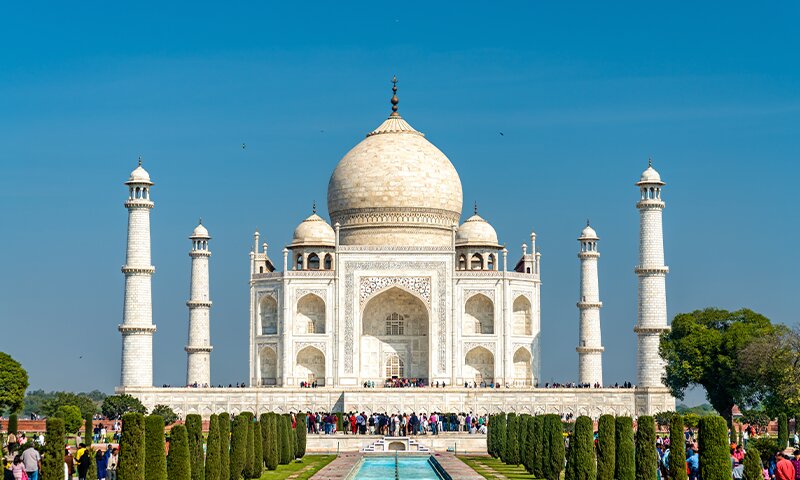
Few monuments carry the weight of expectation the way the Taj Mahal does. Most travellers arrive in Agra with a mental image built from decades of postcards, film frames, and textbook pages, and yet the first sighting still tends to unsettle that image entirely. The scale is quieter than photographs suggest. The marble shifts colour through the day in ways no camera captures well. And the crowd, if you have not planned for it, can turn a once-in-a-lifetime moment into a shuffling queue.
This guide is built for travellers who want to see the monument properly rather than tick it off. It covers what you actually need to know before visiting the Taj Mahal in 2026, from ticket categories and gate rules to timing strategies, transport options, and the small planning choices that decide how the day feels.
The Taj Mahal was commissioned in 1631 by Mughal Emperor Shah Jahan as a mausoleum for his second wife, Mumtaz Mahal, who died during the birth of their fourteenth child. Construction stretched over roughly two decades and drew in an estimated twenty thousand artisans, calligraphers, stonecutters, and inlay specialists from across the Mughal empire and beyond. The chief architect is generally credited as Ustad Ahmad Lahori.
What most visitors remember is the central dome, but the complex is a full architectural composition. A red sandstone gateway, a formal charbagh garden divided by water channels, a mosque to the west, a mirror-image guesthouse to the east, and the mausoleum itself all sit on a raised marble plinth above the Yamuna River. The site was inscribed on the UNESCO World Heritage List in 1983 and is described in the citation as the jewel of Muslim art in India.
Understanding this composition matters practically. Rushing straight to the mausoleum and leaving is the most common mistake first-time visitors make. The gardens, the side buildings, and the river-facing terrace are part of the experience, not filler.
The materials themselves tell a story of empire-scale logistics. White marble was quarried in Makrana, Rajasthan, and hauled to Agra by bullock cart. Jasper came from Punjab, jade and crystal from China, turquoise from Tibet, lapis lazuli from Afghanistan, sapphire from Sri Lanka, and carnelian from Arabia. Twenty-eight varieties of semi-precious and precious stones were used in the pietra dura inlay that still covers the cenotaphs and screen walls today.
The Taj Mahal opens 30 minutes before sunrise and closes 30 minutes before sunset, every day except Friday, when the complex remains closed for the weekly Jumma prayers at the on-site mosque. There is no fixed clock time because opening and closing shift with the solar calendar.
Entry is managed by the Archaeological Survey of India through the official Taj Mahal ticketing portal. Ticket prices for 2026 are tiered by nationality:
Online booking through the ASI portal offers a small discount, ₹5 off for Indian tickets and ₹50 off for foreign tickets, and lets you skip the counter queue at the gate. Save the QR code on your phone and take a printed backup, since mobile signal near the entry gates can be patchy.
The complex has three gates. Entry is allowed only through the Western Gate near Saheli Burj and the Eastern Gate near Shilpgram. The Southern Gate is exit-only at present. The Western Gate tends to be busiest with group tours, so independent travellers often find the Eastern Gate faster in the early morning.
Food, tobacco products, drones, tripods, large bags, and any sharp items are prohibited. Small handbags, cameras, and water bottles are permitted. Cloakroom facilities near the gates hold larger bags for a nominal fee.
The most comfortable window for a trip runs from October to March, when Agra sits between 8°C and 25°C and the sky is generally clear. November mornings can bring a light fog that lifts by mid-morning and produces some of the most atmospheric photographs of the year.
April to June is punishing. Temperatures regularly cross 42°C, and walking across sun-heated marble in the afternoon is genuinely difficult, particularly for older travellers and young children. If you must travel in summer, aim strictly for sunrise entry and be off the plinth by nine in the morning.
The monsoon months of July to September bring humidity and short heavy showers, but the gardens are at their greenest and the crowds thin out. A wet marble surface reflecting an overcast sky is a very different Taj Mahal than the sunlit one most people picture, and worth considering if you value quieter viewing over blue-sky photography.
Weekdays, particularly Tuesday to Thursday, are always calmer than Saturdays and Sundays.
Sunrise is when the monument earns its reputation. The marble shifts from a soft pink through pale gold to a clean white within the first hour of light, and the reflecting pool in the charbagh becomes usable for photographs before the crowd blocks the sightlines. Arriving at the gate 30 minutes before opening puts you inside with the first batch of visitors.
Sunset offers a warmer, gentler palette, though the crowds are heavier through the afternoon. If you cannot manage sunrise, aim for the last two hours before closing rather than mid-day.
Night viewing at the Taj Mahal is a separate and lesser-known experience. It is available on only five nights each lunar month, on the full moon and the two nights on either side, between 8:30 PM and 12:30 AM. Entry is in batches of 50 visitors, and tickets must be booked in person at the ASI office in Agra 24 hours in advance. It is not available on Fridays or during the month of Ramzan. Numbers are strictly capped, so this option needs planning around your dates.
Agra sits roughly 230 kilometres southeast of Delhi and is one of the most straightforward heritage cities to reach in India.
The Yamuna Expressway has made road travel between Delhi and Agra genuinely easy. A private car takes around three and a half to four hours door to door, which is what makes the same-day format popular. If you want the whole day handled with tickets, guide, and transport pre-arranged, a curated Same Day Delhi Agra Tour removes the coordination burden and lets you focus on the monument itself.
The Gatimaan Express and the Shatabdi Express connect New Delhi to Agra Cantonment in under two hours. Both are comfortable, punctual, and considerably faster than driving in peak Delhi traffic. Agra has three main stations: Agra Cantonment, Agra Fort, and Raja-ki-Mandi. Agra Cantonment is the primary arrival point for most long-distance trains.
Agra has a small civil airport (Kheria) with limited scheduled flights. Most international travellers fly into Delhi and continue overland. For a fuller itinerary, the classic Golden Triangle Tour covering Delhi, Agra, and Jaipur remains the most efficient way to see the region without repeated backtracking.
Entry begins at the outer forecourt, where you clear security and hand over your ticket. From there, you walk through the great red sandstone gateway, the Darwaza-i-Rauza, and the Taj Mahal reveals itself in a single framed view at the end of the archway. It is the moment most photographs are taken.
The charbagh, the four-quartered Mughal garden, sits between the gateway and the mausoleum, split by long water channels lined with cypress trees. The reflecting pool at the centre offers the classic symmetrical composition. Photographers should be aware that the pool is drained periodically for maintenance, so a fully mirrored shot is not always available.
Shoe covers are handed out (or you can carry your own) before you step onto the marble plinth. The mausoleum interior is dim by design, lit only by filtered daylight through the pierced marble screens. Photography is not permitted inside the inner chamber. What draws attention here is the pietra dura inlay work on the cenotaphs, thousands of pieces of semi-precious stones set into marble in floral patterns that appear painted from a distance.
The mosque to the west and the jawab (mirror guesthouse) to the east are worth walking through even briefly. They frame the mausoleum and offer some of the best angles for photography that avoid the front-facing crowd entirely.
For a broader sense of what else fits into an Agra stay, our field notes on places to visit in Agra beyond the Taj Mahal cover Agra Fort, Itmad-ud-Daulah, Mehtab Bagh, and Fatehpur Sikri in useful planning detail.
Agra has three main hotel zones, and the choice affects your morning quite directly. Taj Ganj, the neighbourhood immediately south of the monument, puts you within walking distance of the Western Gate and is the best base if sunrise entry is a priority. It carries a mix of heritage boutique hotels, mid-range guesthouses, and budget stays. The area is old and dense, so expect narrow lanes and modest street frontage rather than resort-style approaches.
Fatehabad Road is the modern hotel strip, roughly two to three kilometres from the monument, and hosts most of the international chain properties and luxury heritage hotels. It is the standard choice for travellers on curated packages who want reliable service standards, larger rooms, and easy vehicle access.
The cantonment area near Agra Cantonment railway station suits travellers arriving by train who want convenient transfers. It is quieter than the tourist zones and generally offers better value, but transfers to the Taj Mahal take 15 to 20 minutes by car in morning traffic.
The Taj Mahal rewards travellers who arrive prepared. A pre-booked ticket, an early morning slot, a licensed guide, and two unhurried hours inside the complex change the visit from a monument sighting into something closer to what Shah Jahan actually built. The rest of Agra, the fort, the smaller Mughal tombs, the marble inlay workshops in Tajganj, adds meaningful context to what you see on the plinth.
If you would like a curated itinerary built around your travel dates, gate preference, and pace, the team at Memorable India is happy to help. Reach out through our contact page and we will structure the visit around what actually matters to you.
Q1. What is the entry fee for visiting the Taj Mahal in 2026?
The entry fee is ₹50 for Indian and OCI cardholders, ₹540 for SAARC and BIMSTEC nationals, and ₹1,100 for other foreign tourists. An additional ₹200 per person is charged for entry into the main mausoleum. Children under 15 enter free, regardless of nationality.
Q2. Is the Taj Mahal closed on any day of the week?
Yes. The Taj Mahal is closed to tourists every Friday, when the on-site mosque holds Jumma prayers. It is open every other day of the week from 30 minutes before sunrise to 30 minutes before sunset.
Q3. What is the best time of day to visit the Taj Mahal?
Sunrise is widely considered the best time to visit the Taj Mahal. The light is soft, the marble takes on shifting pink and gold tones, and crowds are lightest in the first hour. Sunset is the second-best option; midday is best avoided in summer.
Q4. Can you visit the Taj Mahal at night?
Night viewing is available on five nights per lunar cycle, on the full moon and the two nights on either side, between 8:30 PM and 12:30 AM. It is not offered on Fridays or during Ramzan. Tickets must be booked in person at the ASI Agra office at least 24 hours in advance.
Q5. How do I get to the Taj Mahal from Delhi?
The Taj Mahal is around 230 kilometres from Delhi. The Yamuna Expressway takes three and a half to four hours by car. The Gatimaan Express and Shatabdi Express reach Agra Cantonment in under two hours. Same-day tours from Delhi handle all logistics, including tickets and guide.
Q6. How much time should I plan for the visit?
Two to three hours inside the complex is a realistic minimum. This allows time for the gateway, the gardens, the mausoleum, the mosque, and the river-facing terrace without rushing. Photography enthusiasts and history-focused travellers often spend closer to four hours.

A Guide to Exquisite Indian Handicrafts and Where to Buy Them in India
26 Oct 2026
A Journey to Leh and Srinagar: Firsthand Travel Experience
25 Oct 2026
A Guide to Famous Temples in Himachal Pradesh
24 Oct 2026
9 Best Places to Visit in Lakshadweep, a Top Island Getaway in India
23 Oct 2026
7 Reasons Why One Should Travel by Indian Rail
22 Oct 2026


