Krishna worship runs like a bright thread through India’s spiritual map, connecting sandstone shrines in the plains of Uttar Pradesh with sea-facing sanctuaries in Gujarat, coconut-grove sanctums in Kerala, and Hoysala-era wonders in Karnataka. For many Indian and international travellers, planning a temple circuit around the flute-playing Lord is as much about geography as it is about faith. Some temples mark scriptural events from the Bhagavata Purana, others preserve idols that saints once recovered, unearthed, or received in dreams.
This curated Krishna temples list India travellers can plan realistic itineraries around brings together thirty of the most significant Krishna shrines in the country, organised by region. Each entry covers what makes the temple distinct, what devotees can expect at darshan, and how the site fits into the wider pilgrimage map.
North India: The Braj Bhoomi Circuit
Braj Bhoomi, the belt stretching across Mathura, Vrindavan, Barsana, Nandgaon, and Gokul, is the heart of Krishna’s earthly leelas. A well-planned two or three day loop covers most of the famous Krishna temples in India from this region. Detailed local context is available in our Vrindavan pilgrimage guide.
Krishna Janmabhoomi Temple, Mathura. Built around the prison cell believed to be Krishna’s birthplace, this Uttar Pradesh complex is one of the most visited Vaishnava sites in India. The Garbha Griha is a narrow subterranean chamber that draws long queues on Janmashtami. Security is tight, and mobile phones are not permitted inside.
Dwarkadhish Temple, Mathura. Not to be confused with its Gujarat namesake, this 1814 shrine established by Seth Gokul Das Parikh is central to Mathura’s daily worship life. The evening jhanki, when deities are dressed and revealed on swings during Jhulan Yatra, is worth planning around.
Banke Bihari Temple, Vrindavan. Founded by Swami Haridas in the nineteenth century, this Vrindavan shrine follows an unusual rhythm: a curtain in front of the deity is drawn every few minutes so devotees do not enter a trance from prolonged gaze. Bells and conches are absent, in keeping with the temple’s tradition.
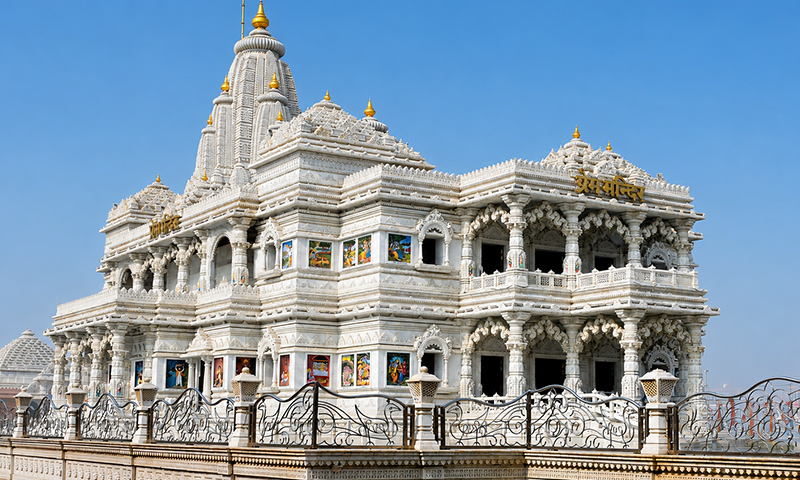
Prem Mandir, Vrindavan. Consecrated in 2012 by Jagadguru Kripalu Ji Maharaj, the white marble Prem Mandir spans a 54-acre complex on Vrindavan’s outskirts. Evening light shows and detailed dioramas of Krishna’s leelas make it particularly engaging for families and first-time visitors.
ISKCON Krishna Balaram Mandir, Vrindavan. The Vrindavan headquarters of the International Society for Krishna Consciousness, inaugurated in 1975 at Raman Reti. The samadhi of founder Srila Prabhupada sits within the complex, drawing devotees from every continent for daily kirtan.
Radha Raman Temple, Vrindavan. One of the seven principal Goswami temples, Radha Raman houses a svayambhu (self-manifested) deity said to have appeared from a Shaligram stone in the sixteenth century for Gopala Bhatta Goswami. The idol is small and intimate, and photography is not permitted.
Radha Vallabh Temple, Vrindavan. Founded by Hit Harivansh Mahaprabhu in 1585, this temple places Radha as the supreme beloved, with only a crown placed beside Krishna’s idol to symbolise her presence. Its sangeet tradition is among Vrindavan’s most refined.
Radha Damodar Temple, Vrindavan. Established by Jiva Goswami and closely associated with Srila Rupa Goswami, this Seva Kunj temple houses a small deity of Damodar once worshipped by the Goswamis themselves. The bhajan kutir tradition here is central to Gaudiya Vaishnava practice.
Radha Gopinath Temple, Vrindavan. Another of the Sapta Devalayas, Gopinathji was originally installed by Madhu Pandit Goswami. The current deity is a replica, since the original was moved to Jaipur during the Mughal period for safekeeping.
Nidhivan, Vrindavan. More sacred grove than temple, Nidhivan’s dense, intertwined trees are believed by devotees to be gopis who take human form for Krishna’s nightly Raas Leela. Gates close well before sundown, and no one, including priests, remains inside overnight.
Shriji Temple, Barsana. Perched atop Bhanugarh hill in Radha’s hometown, this temple is the epicentre of Lathmar Holi, when women from Barsana playfully strike visiting men from Nandgaon with sticks. The climb is steep but manageable in the early hours.
Nand Bhavan Temple, Nandgaon. Believed to be the home of Krishna’s foster father Nanda Maharaj, the temple stands on Nandishwar Hill and offers wide views across the Braj countryside. Combine with Barsana for a full-day cultural loop through the Braj heartland.
Most Braj Bhoomi travellers pair these temples with Agra and Delhi in a compact 3-day loop. Curated options are available on our Mathura and Vrindavan tour package page.
West India: Dwarka, Nathdwara and the Coastal Krishna Trail
Dwarkadhish Temple, Dwarka. One of the four Char Dhams and among the seven Sapta Puri sacred cities, the five-storey Dwarkadhish Temple in Gujarat rises above the confluence of the Gomti river and the Arabian Sea. Its current form dates to the sixteenth century, though the site is considered far older.
Bet Dwarka Temple, Okhamandal. A short boat ride from Okha, Bet Dwarka island is traditionally held to be Krishna’s actual residence, with mainland Dwarka serving as his royal capital. The main shrine attributed to the Vallabhacharya tradition welcomes small groups of Vaishnavites through the day.
Rukmini Devi Temple, Dwarka. About two kilometres from Dwarkadhish, this twelfth-century temple honours Krishna’s principal queen. Local lore attributes its distance to Durvasa’s curse, which is why Rukmini and Krishna are enshrined separately in this circuit.
Ranchhodraiji Temple, Dakor. Around 90 kilometres from Ahmedabad, Dakor’s Ranchhodraiji temple houses an idol believed to have been brought from Dwarka by the devotee Bodana. Purnima days draw thousands of walking pilgrims from surrounding Gujarat villages.
Shrinathji Temple, Nathdwara. The seven-year-old Krishna form known as Shrinathji is the presiding deity of the Pushtimarg sect founded by Vallabhacharya. Located about 48 kilometres from Udaipur, the temple famously offers eight darshans a day, each with distinct clothing, jewellery, and seasonal mood.
Govind Dev Ji Temple, Jaipur. Housed within Jaipur’s City Palace complex, this temple protects an idol originally installed in Vrindavan by Rupa Goswami and relocated to Amber during Aurangzeb’s reign. Seven aartis daily draw large morning and evening crowds throughout the year.
For pilgrims planning the western coastal circuit, our Dwarkadhish with Jyotirlings tour covers Dwarka, Bet Dwarka, Somnath, and the surrounding temple towns.
South India: From Guruvayur to Udupi
Guruvayur Sri Krishna Temple, Kerala. Often called the Dwarka of the South, Guruvayur in Thrissur district enshrines Krishna as Guruvayurappan in his child form. Non-Hindus are not permitted inside, and a strict dress code is enforced. The elephant sanctuary at Punnathur Kotta is a popular add-on.
More on the temple’s rituals is available through the Guruvayur Devaswom official portal.
Ambalappuzha Sri Krishna Temple, Alappuzha. Famous for its palpayasam prasadam, a sweet milk-and-rice offering steeped in local legend, this Kerala temple is closely linked with the Champakulam Moolam boat race. The presiding idol depicts Krishna as Parthasarathi, Arjuna’s charioteer at Kurukshetra.
Aranmula Parthasarathy Temple, Kerala. On the banks of the Pampa river, this temple is one of the 108 Divya Desams venerated by the Alvar saints. It is best known for the Aranmula Uthrattathi snake boat race, held annually during Onam and rooted in the temple’s centuries-old ritual calendar.
Trichambaram Krishna Temple, Kannur. This lesser-known Kerala temple depicts Krishna in a fierce, victorious form after slaying his uncle Kamsa. The eleven-day annual utsavam in March draws crowds from across northern Kerala for its unique Koodi Ezhunnellippu procession.
Udupi Sri Krishna Matha, Karnataka. Founded by philosopher-saint Madhvacharya in the thirteenth century, Udupi’s shrine is unique for its Kanakana Kindi, a nine-holed silver window through which devotees traditionally view the idol, honouring the legend of Kanakadasa. Administration rotates among eight mathas in a two-year Paryaya cycle.
Deeper context on Karnataka’s temple circuit is covered in our guide to famous temples to visit in Karnataka, which sequences Udupi with Hampi, Belur, and Sringeri.
Krishna Temple, Hampi. Built in 1513 by Krishnadevaraya to commemorate his conquest of Udayagiri, this Vijayanagara-era temple sits within Hampi’s UNESCO-listed monument group. Its stepped tank and intricate frieze work reward slow exploration; the original sanctum idol now sits in a Chennai museum.
ISKCON Bangalore, Karnataka. Inaugurated in 1997 on Hare Krishna Hill in Rajajinagar, this is among the largest ISKCON temples in the world. The fusion of contemporary architecture with traditional gopurams makes it particularly popular with younger urban visitors and out-of-town pilgrims.
Parthasarathy Temple, Triplicane, Chennai. Dating to the Pallava-era eighth century, this Divya Desam depicts Krishna as Parthasarathi with visible battle scars from the Kurukshetra war. The temple is among the oldest structures in Chennai and remains an active worship centre with daily rituals in Tamil.
Rajagopalaswamy Temple, Mannargudi. Known as the Dakshina Dwaraka, this vast sixteenth-century Tamil Nadu temple in Tiruvarur district has a 154-foot rajagopuram and a massive temple tank called Haridra Nadi. Its eighteen-day Panguni Brahmotsavam is the annual highlight.
Pandava Thoothar Perumal Temple, Kanchipuram. One of the fourteen Divya Desams in Kanchipuram, this temple depicts Krishna as the messenger who negotiated on behalf of the Pandavas with the Kauravas. The sanctum idol shows Krishna in a rare seated posture and is a compact stop within a Kanchipuram day trip.
Eastern India: Puri and the Gaudiya Belt
Jagannath Temple, Puri, Odisha. One of the Char Dhams, Puri’s twelfth-century Jagannath Temple enshrines Krishna as Jagannath alongside Balabhadra and Subhadra. The annual Rath Yatra in June or July draws millions and is among India’s most watched religious events. Non-Hindus are not permitted inside the main shrine.
ISKCON Mayapur, West Bengal. Located at the birthplace of Chaitanya Mahaprabhu, the ISKCON global headquarters at Mayapur is anchored by the ambitious Temple of the Vedic Planetarium. The complex serves as an international training and pilgrimage centre for Gaudiya Vaishnavas from across the world.
Planning Your Krishna Temple Circuit
A well-sequenced pilgrimage across these Krishna temples in India benefits from three simple planning rules: cluster by geography, respect local season, and pre-book darshan slots where available.
Best seasons: October to March suits most temples; Braj is manageable in the cooler months, while South Indian coastal temples remain workable through the year.
Regional clusters: Mathura, Vrindavan, Barsana and Nandgaon in 2 to 3 days; Dwarka, Bet Dwarka and Somnath in a 3-day loop; Guruvayur, Aranmula and Ambalappuzha as part of a wider Kerala circuit.
Access rules: Non-Hindus are not permitted at Guruvayur and Puri Jagannath among others; dress codes at South Indian temples are strict.
Photography is prohibited in almost every sanctum; mobile phones must often be deposited at the entrance.
For senior travellers, factor in step counts, waiting queues on festival days, and midday closures common at Kerala temples.
Planning Your Pilgrimage With Memorable India
The famous Krishna temples in India range from cliff-top hilltop shrines to bustling street-corner icons, and each one tells a story that has shaped how millions live, love, and pray. To plan a spiritually rich and logistically smooth circuit that combines the Braj, Dwarka, Nathdwara, and South Indian routes at a pace that suits your group, reach out to the Memorable India team through our contact page for a custom itinerary shaped around your season, dietary preferences, and travel pace.
Frequently Asked Questions
Which is the most famous Krishna temple in India?
The Krishna Janmabhoomi Temple in Mathura is widely regarded as the most significant Krishna temple in India, as it marks his traditional birthplace. Dwarkadhish Temple in Gujarat, Banke Bihari in Vrindavan, and Guruvayur in Kerala are equally prominent for different devotional traditions.
How many days do I need for a Krishna temple circuit in North India?
A comfortable Braj Bhoomi loop covering Mathura, Vrindavan, Barsana, and Nandgaon takes two to three days. Add one day for Delhi transfers and another if you plan to include Agra or attend a festival like Janmashtami or Holi.
Are non-Hindus allowed inside Krishna temples in India?
Access varies. Most North Indian Krishna temples welcome all visitors, while Guruvayur in Kerala and the main sanctum at Puri Jagannath restrict entry to Hindus. Dress codes and photography rules also differ, so it helps to check each temple’s policy in advance.
What is the best time to visit Krishna temples in India?
October to March offers the most comfortable weather across most regions. Janmashtami (August or September) and Holi (February or March) bring peak crowds and vibrant celebrations, especially in Mathura, Vrindavan, and Barsana.
Which Krishna temples are part of the Char Dham?
Dwarkadhish Temple in Dwarka, Gujarat, and Jagannath Temple in Puri, Odisha, are both part of the four traditional Char Dhams established by Adi Shankaracharya. Both are directly associated with Krishna worship.
Can I combine Krishna temples with other pilgrimage sites?
Yes. Dwarka pairs naturally with Somnath Jyotirlinga in Gujarat; Guruvayur combines well with Sabarimala and Chottanikkara in Kerala; and Puri Jagannath sits comfortably within an Odisha circuit that includes Konark and Bhubaneswar.
 +919871148514
 info@memorableindia.com