 +919871148514
 info@memorableindia.com
India is not a country you go to once and feel you have seen it. It is layered, regional and sometimes beautifully contradictory. For American visitors who are taking the trip for the first time, knowing where to begin can be downright daunting. Seventeen time zones away from the US East Coast with a geography bigger than the size of the continental United States, India requires a plan.
This guide cuts through the noise. These 11 destinations are selected not just for their popularity, but for the sort of depth and variety they provide to first-time visitors from the US. Each of them offers something different, and altogether they represent the full range of what makes India worth the long flight.
One of the frequently asked questions by first-timers is: Is India safe for American tourists? The short answer is yes, with preparation. India receives millions of foreign tourists every year. The key is in selecting the right destinations, traveling with a reliable operator, and taking the standard precautions that you would take when traveling anywhere in the world.
US citizens need an e-Visa to enter India, and it is very easy to apply for online. The best travel seasons for most areas will be between October and March, as temperatures are not too high, and skies are clear. Domestic flights are used to connect the major cities, and there are well-structured India travel packages that take care of the logistics so that you can focus on the experience.
Our detailed India travel guide for tourists from currency and SIM cards to transportation and connectivity is everything you need to read before your trip.
Most India itineraries for Americans on their first visit start in Delhi and for good reason. The capital is like a squeeze of the entire country. The narrow lanes around Jama Masjid in Old Delhi are only kilometers away from the broad colonial avenues of Lutyens’ Delhi. There is Humayun’s Tomb, Qutub Minar, the Red Fort, and India Gate, all within a half day of each other.
Beyond monuments, Delhi has a serious food scene, great museums, and neighborhoods such as Hauz Khas and Lodhi Colony that bear no resemblance to the stereotypical image of India. Spend at least two full days here and before heading to next destination.
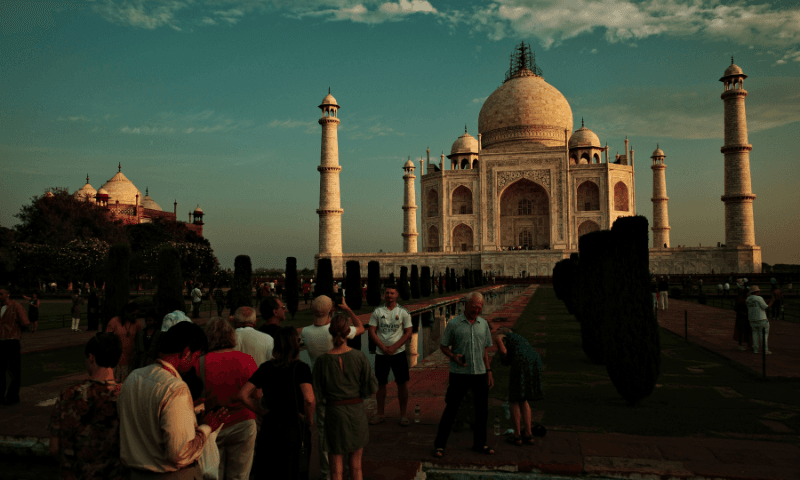
Americans are often worried that the Taj Mahal will be overhyped. It is not. Seeing it at sunrise as the marble changes from a pale grey to a warm gold is a truly arresting experience. The Taj belongs to a much wider Agra circuit, which also includes Agra Fort and Fatehpur Sikri, a ghost Mughal city some 40 kilometers to the west of the city.
Plan a full day in Agra. Do not attempt to squeeze it into a half-day Delhi day trip.
The Pink City is everything its name suggests. Jaipur’s old walled city is painted in terracotta pink, its markets are overflowing with block-printed textiles and silver jewellery, and the Amber Fort on its ridge above the city is one of the most dramatic Rajput structures in the country. Hawa Mahal and the City Palace are an addition to a dense heritage itinerary.
Jaipur is also a gateway to Rajasthan. Travelers who wish to venture further into the desert state often use it as a base from which to set off to Jodhpur, Udaipur and Jaisalmer.
Delhi, Agra, and Jaipur make up what is called the Golden Triangle and it is still the most logical introduction to northern India for international visitors. Our Golden Triangle tour packages explore this circuit with structured tours crafted for first-time visitors.
No destination in India can be quite like Varanasi. Situated on the western bank of the Ganga, it has been a non-stop center for Hindu religious life for several thousand years. The morning boat ride along the ghats, with pilgrims bathing in the river and priests conducting rituals on the steps above, is an experience that lingers in the minds of visitors well after they come home.
Varanasi is not a light or easy place to go. It is visceral, loud, and deeply moving simultaneously. American travelers with an interest in world religions, philosophy, or just the realities of human life find it unlike any other place they have traveled.
Rajasthan’s desert city is a medieval fort town in which residents still live within the sandstone walls. The Jaisalmer Fort, which can be seen for miles around from a mirage above the Thar Desert, is one of the few living forts in the world. A standard item on the itinerary here is a camel safari into the Sam Sand Dunes at sunset, and it is worth every grain of sand.
Jaisalmer can best be done as part of a longer Rajasthan circuit than as a standalone visit, given its distance from Delhi. Plan at least two nights.
Southern India has a culture, a cuisine, and climate that have little to do with the north. Kerala is the easiest point of entry for American visitors attempting to understand this difference. The backwater houseboat experience in Alleppey, where you float down through a network of canals and lagoons in a converted rice barge, is truly unique and something that you cannot get in the US or Europe.
Munnar’s tea plantations in the Western Ghats, Kochi’s colonial fort district, and Thekkady’s wildlife sanctuary complete a good week in the state. Kerala is always ranked as one of the best visitor-friendly regions in India.
Goa is reduced to its beaches in the international coverage, but the state has a unique architectural and gastronomic identity due to its Portuguese colonial history. The churches of Old Goa, including the Basilica of Bom Jesus is a UNESCO World Heritage Site. The cuisine is a blend of Portuguese influence over four centuries and coastal fishing traditions, which is unlike any other regional food in India.
For Americans accustomed to Caribbean destinations or Southeast Asia, however, Goa is a natural fit, with its combination of sea, colonial heritage, and relaxed atmosphere. The best season is from November to February.
Karnataka’s royal city, once known as Mysore, is centred around the Mysuru Palace, one of the most ostentatious buildings in India. The palace is spectacular at any time, but is extraordinary during Dasara, the ten-day festival of October, when it is lit with thousands of lights.
Mysuru is a manageable and pleasant city with good food, a famous silk market and easy access to the wildlife reserves of Nagarhole and Kabini. It works well as a part of a South India circuit along with Bangalore, Coorg and Hampi.
The twin towns of Rishikesh and Haridwar in Uttarakhand are located at a point where the Ganga breaks through the Himalayas onto the plains. Rishikesh has been attracting people from around the world since the 1960s, when it became known internationally as a place for yoga, meditation, and spiritual tourism. The ashrams, the river views, the suspension bridges across the green Ganga make it a natural stop-off point before or after a trek in the Himalayas.
Haridwar 24 kilometers downstream, hosts the Ganga Aarti at Har Ki Pauri every evening, which is a practice of ritual fire on the river and one of the most photographed events in India. Both towns are reachable either by train or by road from Delhi.
The holiest site in Sikhism, the Golden Temple, is one of the most architecturally striking buildings in the world. It is located in the middle of a huge sacred pool at Amritsar, and everyone comes to visit this place irrespective of their faith and background. The Langar, the free community kitchen which feeds tens of thousands of people every day, is a remarkable institution and gives visitors a first hand experience of Sikh values in action.
Amritsar is also located close to the Wagah Border, where the daily flag lowering ceremony between India and Pakistan attracts huge crowds and is a politically charged yet oddly festive event. History-minded American travelers find this kind of combination of spiritual depth and geopolitical weight genuinely compelling.
For Americans who are attracted to the dramatic wilderness, Ladakh delivers such a landscape that few places in Asia can match. Situated at the high altitude of the western Himalayas, it is a cold desert of brown mountains, turquoise lakes, and ancient monasteries built on the edge of cliffs. The area has borders with Tibet that are reflected in its cultural and architectural imprint of Tibetan Buddhism everywhere.
Leh, the main town, is the base for exploring Pangong Lake, Nubra Valley, Zanskar River, and a circuit of monasteries including Thiksey and Hemis. Ladakh is best visited between June and September, as the mountain passes are open. Given the altitude, it takes a period of acclimatization to arrive.
Trying to fit all eleven destinations into one trip is not a realistic goal, nor a recommended one. Most first-time visitors to India will work best with a focused itinerary for two weeks in one or two of the regions in depth, rather than rushing around the country.
A typical India itinerary for Americans on their first visit is 12 to 16 days. A circuit of North India, going from Delhi to Agra and then to Jaipur, Varanasi and Amritsar, is one good option. A contrasting South and West circuit could be a mix of Goa, Kerala, and Mysuru. Ladakh is best undertaken as a trip on its own or as an add-on for repeat visitors.
The best way is to select based on interest. History and architecture point towards the north. Beach and nature pointing in the south and coast. Mountains and adventure point towards Ladakh and Uttarakhand.
For travellers who are eager to book the structured best India tours for American travelers, our team at Memorable India designs personal India travel packages based on your travel dates, interests, and budget. Every itinerary is managed by regional specialists who know these destinations at ground level.
Q1. Is India Safe for American tourists?
Yes. India is an established international travel destination, and it receives a large number of visitors from the United States every year. Standard travel precautions apply, including reliable transportation, vetted accommodations, and traveling with a registered tour operator for first time visits.
Q2. What is the best time of year for an India tour for American tourists?
October to March is generally considered to be the best timing. Temperatures are comfortable in most parts of the country, visibility is perfect for sightseeing, and major festivals such as Diwali and Holi come during this time. Ladakh and the Himalayas are best visited between June and September.
Q3. How many days are ideal for Americans visiting India for the first time?
A minimum of 12 days is suggested to do justice to one region. Fourteen to sixteen days make for a slower pace for two regions. The effort to see the entire India in less than 10 days results in fatigue rather than experience.
Q4. Do American tourists need a visa for India?
Yes. US citizens are eligible for an e-Visa, which is applied for online before travel. It is normally issued within three to four business days. Make sure your passport is good for at least six months after your travel dates.
Q5. What are the best India tour packages for first-time American travelers?
The Golden Triangle that encompasses Delhi, Agra and Jaipur is the most recommended starting point. For those who have more time, carrying on into Rajasthan, Varanasi, or Kerala adds more depth. Memorable India offers fully customizable India tour packages designed specifically for international visitors, with dedicated support throughout the journey.
Ready to plan your trip? Share your travel dates and interests with our team at Memorable India and we will put together an itinerary built around what matters most to you.
20 Best Hill Stations in Uttarakhand for Family Vacation, Corporate Trips, Nature Lovers & Adventure
26 Aug 2026
15 Best National Parks and Wildlife Sanctuaries in North East India
25 Aug 2026
16 Best Romantic Hill Stations in India for Honeymoon Holidays
23 Aug 2026
Top 30 Must-See Forts and Palaces in Rajasthan
21 Aug 2026
Top 30 Krishna Temples in India: A Complete Pilgrim and Traveller Guide
21 Aug 2026


