 +919871148514
 info@memorableindia.com
The Char Dham Yatra through Uttarakhand’s Garhwal Himalayas covers Yamunotri, Gangotri, Kedarnath, and Badrinath across a circuit of roughly 1,200 kilometres from Haridwar and back. Most pilgrims approach the yatra as a temple-to-temple journey, focused entirely on the four sacred shrines. That approach is understandable, given the spiritual weight of the pilgrimage, but it also means many travellers pass through some of the most remarkable landscapes, confluences, and heritage sites in the Indian Himalayas without stopping to absorb them.
The route itself is part of the experience. Between the four Dhams sit ancient prayags (sacred river confluences) where Hindu mythology places creation-level events, hill stations that were retreat points for British administrators and Indian rishis alike, alpine meadows that rival anything in the European Alps, and villages that mark the very edge of Indian civilisation before the Tibetan plateau begins. This guide covers the best places to explore on the way to Char Dham Yatra, so you can plan a journey that honours both the spiritual intent and the extraordinary geography of the route. Memorable India’s Char Dham 2026 opening dates and registration guide covers the logistical essentials for planning your yatra dates.
Haridwar is the traditional starting point of the Char Dham circuit and one of the seven holiest cities in Hinduism. The evening Ganga Aarti at Har Ki Pauri is the single most atmospheric ritual most pilgrims will witness on the entire yatra. Hundreds of brass lamps are floated on the Ganges as priests chant in unison, and the reflected firelight on the water surface creates a scene that is both visually stunning and spiritually intense. Beyond the aarti, the Mansa Devi Temple (reached by cable car from the foothills) and the Chandi Devi Temple offer panoramic views of the town and the Ganges below. Most Char Dham itineraries allocate one night in Haridwar, but an additional half-day here allows you to visit the Shantikunj ashram and walk the riverfront ghats at a less hurried pace.
Rishikesh, 25 kilometres upstream from Haridwar, occupies a different spiritual register. Where Haridwar is about ritual and congregation, Rishikesh is about contemplation and practice. The Lakshman Jhula and Ram Jhula suspension bridges connect the two banks of the Ganges, and the eastern bank houses a dense cluster of ashrams, yoga centres, and vegetarian restaurants that cater to both Indian pilgrims and international seekers. The Beatles Ashram (formally Chaurasi Kutia), where the Beatles stayed in 1968, has been partially restored and is worth a visit for its graffiti-covered meditation cells and its quiet forest setting. The Triveni Ghat evening aarti, smaller and more intimate than Haridwar’s, offers a gentler spiritual start to the journey. For those interested in the spiritual depth of the Himalayan pilgrimage tradition, Memorable India’s guide to spiritual trekking in the Himalayas connects the Char Dham route to a broader network of sacred trails.
Mussoorie sits at approximately 2,000 metres, about 75 kilometres from Rishikesh, and can be included as a short detour before the route turns east toward Barkot. The hill station’s Mall Road, Gun Hill (accessible by cable car), and Kempty Falls are all manageable in a half-day stopover. For pilgrims travelling with elderly family members, Mussoorie’s relatively gentle terrain and well-developed infrastructure offer a comfortable acclimatisation point before the more demanding mountain roads ahead. The views of the Doon Valley from Camel’s Back Road, particularly at sunrise, are among the most photographed in Uttarakhand.
The route from Rishikesh to Barkot (the base for Yamunotri) passes directly over the Tehri Dam, one of the tallest dams in Asia at 260 metres. The reservoir it creates, Tehri Lake, stretches across a vast area of submerged valley and has developed into an adventure sports hub, with kayaking, jet skiing, and banana boat rides available between April and June. Even without participating in water sports, the visual impact of the dam and lake against the surrounding Himalayan terrain is striking. It is a natural photo stop that adds 30 to 45 minutes to the journey without requiring a separate detour.
Uttarkashi is both a transit town on the way to Gangotri and a sacred destination in its own right. The Vishwanath Temple here mirrors the more famous one in Varanasi and is believed to predate it. The Shakti Temple, housing an ancient trident, and the Maneri Dam on the Bhagirathi River add variety to a stopover. Uttarkashi also serves as a base for the Nehru Institute of Mountaineering, one of India’s premier climbing training centres. For pilgrims with a day to spare, the short drive to Nachiketa Tal, a small alpine lake named after the sage Nachiketa from the Katha Upanishad, offers a serene forest walk that contrasts with the road-heavy segments of the yatra.
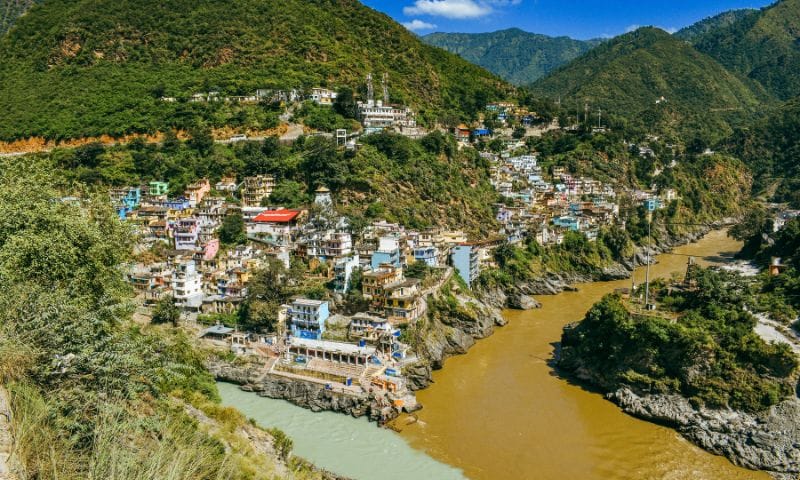
Devprayag is where the Bhagirathi and Alaknanda rivers merge to form the Ganga. This confluence (sangam) is visible from the town’s main bridge, and the contrast between the two river colours, one grey-green and the other blue-green, is clearly discernible even from a distance. In Hindu tradition, this is one of the Panch Prayag (five sacred confluences) of the Alaknanda, and a dip at the sangam is considered spiritually significant. Most Char Dham itineraries pass through Devprayag on the route between Rishikesh and Rudraprayag, but few pause here for more than a photograph. A 30-minute stop to walk down to the sangam and visit the Raghunath Temple (one of the 108 Divya Desams of Vaishnavism) is well worth the time.
Rudraprayag, where the Mandakini and Alaknanda rivers converge, is the junction from which the route splits toward Kedarnath (via the Mandakini valley) and Badrinath (via the Alaknanda valley). The town is named after Rudra, a Vedic form of Shiva, and the Rudranath Temple at the confluence dates to a period well before recorded local history. Rudraprayag functions as a natural rest stop on the yatra, and the view from the bridge over the two rivers merging is a quiet, meditative moment in what is otherwise a journey dominated by long drives.
Chopta, situated at approximately 2,680 metres between Rudraprayag and Guptkashi, is sometimes called the ‘Mini Switzerland of Uttarakhand’ for its expansive alpine meadows and 180-degree Himalayan panorama. For pilgrims with the fitness and the time, the 3.5-kilometre trek from Chopta to Tungnath Temple (the highest Shiva temple in the world at 3,680 metres) and onwards to the Chandrashila summit (4,000 metres) is one of the most rewarding spiritual side trips on the entire yatra. The trail is well maintained and can be completed in four to five hours round trip. Even without the trek, Chopta’s meadows offer a place to breathe, stretch, and absorb the scale of the Himalayas before the more demanding Kedarnath segment ahead. Memorable India’s places to visit on the Char Dham route includes Chopta alongside other en-route stops.
Joshimath (Jyotirmath) is one of the four cardinal mathas (monasteries) established by Adi Shankaracharya in the 8th century and serves as the winter seat of Badrinath. The Narsimha Temple and the ancient Shankaracharya Math are the primary cultural stops. Joshimath is also the gateway to the Valley of Flowers National Park (a UNESCO World Heritage Site, open July to September) and the ski resort of Auli. The ropeway from Joshimath to Auli, one of the longest in Asia, offers panoramic views of Nanda Devi, Kamet, and Mana Parbat even in summer when there is no snow. For pilgrims who want to break the drive to Badrinath with a meaningful stop, Joshimath delivers both spiritual heritage and mountain spectacle.
Mana, located just 3 kilometres beyond Badrinath, is the last Indian village before the Tibetan border. The village itself is home to the Indo-Mongoloid Bhotiya community, and its stone-and-wood architecture, narrow lanes, and wool-weaving tradition give it a character distinct from anything else on the yatra. The Vyas Gufa (cave where Sage Vyasa is believed to have composed the Mahabharata), the Bhim Pul (a natural rock bridge attributed to Bhima of Mahabharata fame), and the Saraswati River emerging briefly from underground before disappearing again are all within walking distance. The walk from Badrinath Temple to Mana Village and back takes roughly two hours and is flat enough for most pilgrims, including seniors. It is one of the most culturally rich short walks on the entire circuit.
A standard Char Dham Yatra takes 10 to 12 days from Delhi and back. Most of the stops described above sit directly on the route and require only an additional 30 to 90 minutes of travel time. Devprayag, Rudraprayag, and Tehri Dam are pass-through points that need no detour at all. Mussoorie, Chopta, and the Joshimath-Auli ropeway require short diversions of 30 to 75 kilometres each. Mana Village requires only a 3-kilometre walk from Badrinath.
The key is to build these stops into the itinerary from the planning stage, rather than trying to add them spontaneously on the road. A Char Dham Yatra package from Delhi designed by Memorable India can incorporate all of these en-route experiences without compromising the core pilgrimage schedule. The team accounts for driving times, altitude acclimatisation, temple darshan timings, and rest requirements for senior travellers when sequencing the itinerary. For pilgrims who want a condensed version, the 10-day Char Dham completion guide on the blog explains how to optimise time at each segment.
The Char Dham Yatra is, at its heart, a journey through some of the most sacred geography in Hinduism. But sacredness in the Garhwal Himalayas is not confined to temple walls. It lives in the confluences where rivers meet and the Ganga is born, in the alpine meadows where Shiva’s highest temple sits, in the last village where Indian civilisation meets the Tibetan plateau, and in the evening aartis where fire and water merge on the ghats of Haridwar and Rishikesh. Taking the time to notice these places, even briefly, transforms the yatra from a checklist of four temples into a complete Himalayan experience.
If you are planning your Char Dham Yatra and want an itinerary that includes these en-route experiences alongside the core pilgrimage, Memorable India’s pilgrimage tours and Char Dham packages are built to balance spiritual depth with logistical comfort. Reach out to the team with your travel dates, group size, and any specific stops you want to include.
The best places to explore en route include Haridwar (Ganga Aarti at Har Ki Pauri), Rishikesh (ashrams and suspension bridges), Devprayag (confluence where the Ganga is born), Mussoorie (hill station detour), Tehri Dam and Lake, Uttarkashi (Vishwanath Temple), Chopta (alpine meadows and Tungnath trek), Rudraprayag (sacred confluence), Joshimath (Shankaracharya Math and Auli ropeway), and Mana Village (last Indian village near Badrinath).
A standard Char Dham Yatra takes 10 to 12 days from Delhi. Adding en-route sightseeing stops like Mussoorie, Chopta, and Auli typically requires 12 to 14 days for a comfortable pace. Most stops (Devprayag, Rudraprayag, Tehri Dam, Mana Village) are directly on the route and require only 30 to 90 additional minutes, so they can be included without extending the trip.
The shrines typically open in late April or early May and close in October or November. May to June and September to October are the best months. July and August bring monsoon rains, which increase landslide risk and make mountain roads challenging. September offers the clearest post-monsoon skies and the greenest landscapes.
Yes, the Chopta to Tungnath trek is a 3.5-kilometre well-maintained trail that can be completed in four to five hours round trip. It is doable for moderately fit pilgrims and adds the experience of visiting the highest Shiva temple in the world (3,680 metres). It can be incorporated as a half-day side trip between Rudraprayag and Guptkashi without disrupting the main yatra schedule.
Yes. Mana Village, located just 3 kilometres from Badrinath, is the last Indian village before the Tibetan border. The walk is flat and manageable for most pilgrims, including seniors. Highlights include the Vyas Gufa (cave of Sage Vyasa), Bhim Pul (a natural rock bridge), and the briefly visible Saraswati River. The round trip takes approximately two hours and adds genuine cultural depth to the Badrinath visit.
Yes. Memorable India builds customised Char Dham Yatra packages that incorporate en-route stops like Devprayag, Chopta, Joshimath, and Mana Village alongside the core pilgrimage. The team handles registration, accommodation, transfers, meal logistics, and altitude acclimatisation planning. Packages are available from Delhi and other cities, with options for helicopter segments for senior travellers. Contact the team with your preferred dates and group details.

A Guide to Exquisite Indian Handicrafts and Where to Buy Them in India
26 Oct 2026
A Journey to Leh and Srinagar: Firsthand Travel Experience
25 Oct 2026
A Guide to Famous Temples in Himachal Pradesh
24 Oct 2026
9 Best Places to Visit in Lakshadweep, a Top Island Getaway in India
23 Oct 2026
7 Reasons Why One Should Travel by Indian Rail
22 Oct 2026


