 +919871148514
 info@memorableindia.com
Bhutan does not market itself the way most countries do. There are no beach resorts, no theme parks, no nightlife strips pulling in crowds. What the country does have is a kind of quiet authority over every traveller who visits. A monastery clinging to a cliff face 3,000 metres above sea level. A fortress built at the exact point where two rivers meet. A valley where endangered cranes return every winter, protected by villagers who consider them sacred. These are not attractions designed for tourism. They are the living fabric of a country that measures progress by the happiness of its people rather than the size of its economy.
For Indian travellers, Bhutan is one of the most accessible international destinations, with no visa required for entry and direct flights from Delhi, Kolkata, and Guwahati to Paro. For international visitors, the process involves a Sustainable Development Fee and a licensed tour operator. Either way, the effort is worth it. This guide covers the best places to visit in Bhutan and the most rewarding things to do once you are there, with practical details that help you plan rather than just daydream. If you are considering combining Bhutan with a broader Himalayan itinerary, our international tour packages include customisable options that cover Bhutan alongside India and Nepal.
Paro is where most travellers enter Bhutan, and it sets the tone immediately. The flight into Paro Airport is itself an event, with the aircraft banking sharply between mountain walls before touching down in a narrow valley surrounded by rice paddies and pine forests. The valley holds some of the country’s most important historical and spiritual sites.
Paro Dzong (Rinpung Dzong), built in the 17th century, is a fortress-monastery that still functions as a district administrative centre and monastic school. The National Museum of Bhutan, housed in the cylindrical Ta Dzong watchtower above the dzong, displays Bhutanese art, textiles, weapons, and religious artefacts spanning centuries. Kyichu Lhakhang, one of the 108 temples built in the Himalayas by Tibetan King Songtsen Gampo in the 7th century, is among the oldest religious structures in Bhutan and marks the formal introduction of Buddhism into the country. And then, of course, there is the Tiger’s Nest, which deserves its own section below. A detailed exploration of Paro and Thimphu is included in the 5 Days Thimphu Paro Bhutan holiday tour package, which covers the key cultural and spiritual highlights of western Bhutan.
Thimphu is one of the few national capitals in the world without a single traffic light. That oddity tells you something about the pace of life here. The city is compact, walkable, and manages to hold government buildings, Buddhist monasteries, art schools, and weekend farmers’ markets within the same few square kilometres. The Buddha Dordenma statue, standing 51 metres tall on a hilltop south of the city, is visible from most parts of Thimphu and houses over 100,000 smaller Buddha statues within it. Tashichho Dzong, the seat of Bhutan’s government and the central monastic body, is open to visitors in the evenings and during the annual Thimphu Tsechu festival. The National Memorial Chorten, built in honour of Bhutan’s third king, is a place where locals gather daily to pray and circumambulate. For a deeper look at the city, our blog on spectacular places to visit in Thimphu covers lesser-known spots like Wangditse Monastery and Simtokha Dzong.
The Institute for Zorig Chusum, Bhutan’s national school of traditional arts, is worth a visit for anyone interested in the 13 traditional crafts, from painting and wood carving to embroidery and silver work. Students train here for four to six years, and watching them work is a quiet, absorbing experience. The weekend market near the river is where you will find red rice, dried chillies, yak cheese, handwoven textiles, and local produce that reveals how closely Bhutanese daily life remains tied to agriculture and craft.
Punakha was Bhutan’s capital until 1955, and the Punakha Dzong remains arguably the most visually striking building in the country. Built in 1637 by Zhabdrung Ngawang Namgyal at the confluence of the Pho Chhu (father river) and Mo Chhu (mother river), the dzong served as the seat of Bhutan’s government for nearly three centuries. It still hosts the winter residence of the central monastic body. The jacaranda trees in the courtyard bloom purple in spring, and the dzong’s interiors hold some of the finest examples of Bhutanese woodwork, lacquer, and mural painting.
Beyond the dzong, Punakha is a gentler, warmer valley than Paro or Thimphu, with terraced rice fields stretching across the valley floor. Chimi Lhakhang, a small temple in the paddy fields dedicated to Lama Drukpa Kunley (the ‘Divine Madman’), is a 20-minute walk from the road through farming villages and is one of Bhutan’s most visited fertility temples. The suspension bridge over the Mo Chhu, one of the longest in Bhutan, connects the valley to hiking trails and village walks.
The road between Thimphu and Punakha crosses Dochula Pass at 3,100 metres, and on a clear day, the pass offers one of the finest panoramic views of the eastern Himalayas. The 108 memorial chortens (stupas) built here in 2005 are arranged on a hilltop and create one of the most photographed sites in Bhutan. The Druk Wangyel Lhakhang temple, dedicated to Bhutanese soldiers, sits alongside the chortens and is adorned with vivid interior murals depicting Bhutanese history and Buddhist cosmology. The pass is usually a transit stop on the Thimphu-to-Punakha drive, but it deserves at least an hour for the views, the prayer flags, and a cup of butter tea at the Royal Botanical Park nearby.
Phobjikha is a glacial valley in central Bhutan, broad and flat-bottomed, ringed by low pine-covered hills. It is one of the most important wildlife habitats in the country, serving as the winter home of the endangered black-necked crane, which migrates here from the Tibetan plateau between October and February. The Gangtey Monastery, a 17th-century Nyingmapa Buddhist temple, sits on a ridge overlooking the valley and is the spiritual anchor of the region.
Outside of crane season, Phobjikha is still worth visiting for its hiking trails, particularly the Gangtey Nature Trail, a three-hour walk that loops through farmland, bamboo forests, and small villages. The valley has no major commercial development, which is deliberate: power lines are buried underground to protect the cranes’ flight paths. For travellers who have already seen Paro, Thimphu, and Punakha, Phobjikha is the natural next step into a quieter, deeper Bhutan.
Haa is Bhutan’s smallest district and one of its least visited, which is precisely its appeal. The valley opened to tourists only in 2002 and retains a rural character that the more popular western valleys have partly outgrown. Traditional farmhouses with whitewashed walls and timber frames line the road, and the surrounding forests are dense with blue pine and fir.
The Haa Summer Festival, held annually in July, showcases traditional Bhutanese sports, cuisine, and nomadic culture. The Lhakhang Karpo (White Temple) and Lhakhang Nagpo (Black Temple), both built in the 7th century, are the valley’s primary spiritual sites. Haa is about a 90-minute drive from Paro over the Chele La Pass, the highest motorable pass in Bhutan at roughly 3,990 metres, and the drive itself is a highlight, with rhododendron forests and high-altitude meadows along the route.
Bumthang, in central Bhutan, is often called the spiritual heartland of the country. The region is actually four valleys (Chokhor, Tang, Ura, and Chumey), and it holds some of the oldest temples in Bhutan, including Jambay Lhakhang, believed to have been built in the 7th century. Kurje Lhakhang, where a body imprint attributed to Guru Rinpoche is preserved in rock, is one of the most sacred pilgrimage sites in the country. Beyond the temples, Bumthang is known for its buckwheat fields, apple orchards, and the Red Panda Brewery, which produces Bhutan’s only locally brewed beer. The valley requires a domestic flight from Paro or a full-day drive from Punakha, but for travellers with seven or more days, it adds a dimension to the trip that the western circuit alone cannot provide. For more on the lesser-known spiritual side of Bhutan, our guide on hidden monasteries in Bhutan covers retreats that sit well off the standard tourist trail.
No list of things to do in Bhutan is complete without the Tiger’s Nest. Paro Taktsang is perched on a cliff face at 3,120 metres above sea level, about 900 metres above the Paro Valley floor. The hike to the monastery takes most visitors between four and six hours round trip, depending on fitness level and pace. The trail climbs through blue pine forest, passes a small cafeteria with valley views at the halfway point, and reaches a viewpoint where the full monastery complex comes into view across a narrow gorge.
The monastery itself dates to 1692, built around the cave where Guru Rinpoche is believed to have meditated for three months in the 8th century. Inside, the temple rooms are small, dimly lit, and filled with the scent of juniper incense. Photography is not permitted inside, which keeps the atmosphere undisturbed. The hike is moderately strenuous and is manageable for most reasonably fit adults. Early morning starts (by 7 or 8 AM) are advisable to avoid the midday crowd and heat.
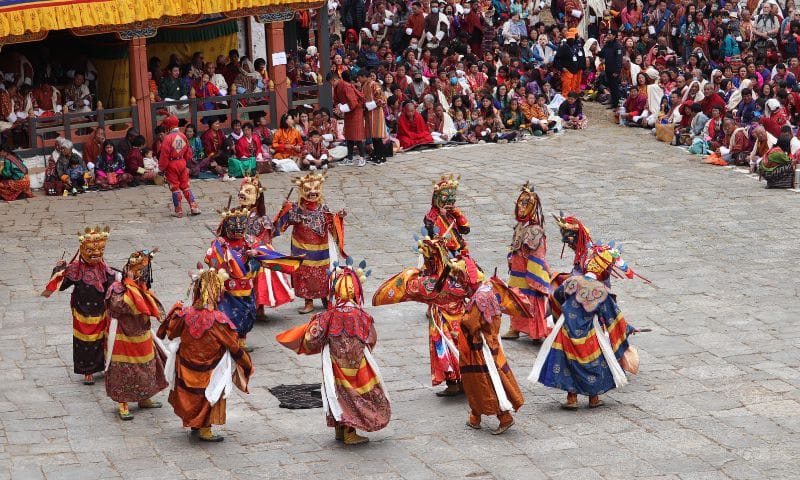
Tsechus are annual religious festivals held in dzongs and monasteries across Bhutan, featuring masked dances (cham) performed by monks and laypeople. The dances depict stories from Buddhist teachings, moral parables, and historical events, and each mask and costume carries specific spiritual meaning. The Paro Tsechu (usually in March or April) and the Thimphu Tsechu (September or October) are the largest, drawing thousands of locals dressed in their finest traditional clothing.
Attending a tsechu is one of the most immersive cultural experiences available in Bhutan. The atmosphere is festive but reverent, with families sharing food, children running between spectators, and monks performing with a precision that reflects months of preparation. Timing your trip around a tsechu is worth the scheduling effort if cultural immersion is a priority.
Archery (dha) is Bhutan’s national sport, and it is played with a seriousness and social significance that cricket holds in India or football in Brazil. Matches happen on weekends in villages and towns across the country, with teams standing at opposite ends of a field roughly 140 metres apart and aiming at small wooden targets. The atmosphere is competitive and loud, with teammates singing and dancing to distract opponents. Visitors are often welcome to watch, and some tour operators arrange informal sessions where travellers can try their hand with a traditional bamboo bow.
Bhutan’s valleys are defined by terraced agriculture, and village walks are one of the best ways to understand daily life outside the dzongs and temples. In Punakha, the walk to Chimi Lhakhang passes through rice paddies where farmers work by hand. In Phobjikha, the Gangtey Nature Trail winds through potato fields and bamboo groves. In Haa and Bumthang, trails connect traditional farmhouses where families still dry chillies on the roof and weave textiles at home. These walks require no special fitness and offer the kind of quiet, unstructured engagement with a place that no monument visit can replicate.
Many tour itineraries in Bhutan include a farmhouse visit, and it is one of the most grounding experiences on offer. Traditional Bhutanese homes are three-storey structures built from rammed earth and timber. The ground floor typically houses livestock, the first floor is the family’s living area, and the top floor is a shrine room. A farmhouse visit usually includes butter tea (suja), a meal of red rice and ema datshi (Bhutan’s chilli-and-cheese national dish), and a chance to see how traditional life in Bhutan operates at the household level. These visits are arranged through licensed tour operators and contribute directly to the host family’s income.
The best time to visit Bhutan depends on what you want to see. Spring (March to May) brings rhododendron blooms, clear skies, and several major tsechu festivals. Autumn (September to November) offers the sharpest mountain views and comfortable temperatures. Winter (December to February) is cold but quiet, with lower fees and no crowds. Summer (June to August) is monsoon season, with heavy rain in the southern foothills but relatively drier conditions in the central valleys.
Indian nationals do not need a visa to enter Bhutan. A valid passport or Voter ID card is sufficient for entry at the Phuentsholing land border or at Paro Airport. International visitors must book through a licensed Bhutanese tour operator or an authorised international partner, and the Sustainable Development Fee (SDF) of USD 100 per person per night applies to all non-Indian, non-Bangladeshi tourists. This fee covers a range of services and contributes to Bhutan’s conservation and development programmes. For those interested in combining Bhutan with a spiritual circuit, our Buddhist pilgrimage tour packages cover sacred sites across India and can be extended to include Bhutan.
Flights to Paro are operated by Druk Air and Bhutan Airlines from Delhi, Kolkata, Guwahati, Bagdogra, Kathmandu, and Bangkok. The Paro approach is weather-dependent, and delays or diversions are not uncommon, so building a buffer day at either end of the trip is strongly recommended. The overland entry via Phuentsholing from Siliguri or Kolkata is a budget-friendly alternative, though the drive takes a full day from the border to Thimphu.
For travellers planning a multi-country trip through the Himalayan region, a Bhutan leg pairs naturally with India and Nepal. Our India Nepal tour package can be customised to include Bhutan, creating a three-country itinerary that covers heritage, spirituality, and mountain landscapes in a single journey. For a broader overview of Bhutan’s highlights, the guide on must-visit places in Bhutan for first-time travellers is a useful starting point.
Bhutan is not a country you tick off a list. It is a country that recalibrates how you think about travel. The places in this guide, from the fortress-monasteries of Paro and Punakha to the open meadows of Phobjikha, each carry a specific weight and character that no photograph fully captures. The things to do in Bhutan, from the Tiger’s Nest hike to a quiet farmhouse meal, are not manufactured experiences. They are encounters with a culture that has chosen, deliberately, to preserve itself. For travellers ready to see what that looks like in practice, Bhutan rewards every day spent within its borders. To start planning your itinerary, get in touch with our travel specialists for a customised Bhutan tour package built around your interests, schedule, and group size.
Q: What are the best places to visit in Bhutan for first-time travellers?
A: First-time visitors should focus on western Bhutan, covering Paro (Tiger’s Nest Monastery, Paro Dzong, National Museum), Thimphu (Tashichho Dzong, Buddha Dordenma, Memorial Chorten), and Punakha (Punakha Dzong, Chimi Lhakhang). A five to seven day itinerary comfortably covers these three destinations with a stop at Dochula Pass in between.
Q: What are the top things to do in Bhutan?
A: The top things to do in Bhutan include hiking to Tiger’s Nest Monastery, attending a tsechu festival, visiting ancient dzongs and temples, walking through terraced farming villages, trying archery with locals, and spending time in the Phobjikha or Haa valleys for nature and rural culture. A farmhouse visit with a traditional meal is also a highlight.
Q: When is the best time to visit Bhutan?
A: Spring (March to May) and autumn (September to November) are the best seasons. Spring offers rhododendron blooms, clear weather, and major festivals like the Paro Tsechu. Autumn provides the clearest mountain views and comfortable daytime temperatures. Winter is cold but uncrowded, while summer brings monsoon rain to the lowlands.
Q: Do Indian citizens need a visa to visit Bhutan?
A: No. Indian nationals do not require a visa to enter Bhutan. A valid Indian passport or Voter ID card is sufficient for entry at both Paro Airport and the Phuentsholing land border. Indian citizens are also exempt from the Sustainable Development Fee that applies to most other international visitors.
Q: How many days are enough for a Bhutan trip?
A: A minimum of five days covers the western circuit of Paro, Thimphu, and Punakha. Seven to ten days allow time for additional valleys like Phobjikha, Haa, or Bumthang. Travellers with two weeks can explore central and eastern Bhutan, including Trongsa and Trashigang, for a deeper cultural experience.
Q: How do you get to Bhutan from India?
A: By air, Druk Air and Bhutan Airlines operate flights to Paro from Delhi, Kolkata, Guwahati, and Bagdogra. By road, the most common entry point is Phuentsholing on the India-Bhutan border, accessible from Siliguri (about 170 km) or Kolkata (about 700 km by road to the border, then a full-day drive to Thimphu).
A Family Trip to Uttarakhand, For the Love of Mountains!
27 Oct 2026
A Guide to Exquisite Indian Handicrafts and Where to Buy Them in India
26 Oct 2026
A Journey to Leh and Srinagar: Firsthand Travel Experience
25 Oct 2026
A Guide to Famous Temples in Himachal Pradesh
24 Oct 2026
9 Best Places to Visit in Lakshadweep, a Top Island Getaway in India
23 Oct 2026


