 +919871148514
 info@memorableindia.com
Most travellers racing between Udaipur and Jodhpur treat the stretch of highway connecting the two cities as little more than a transit corridor. The GPS says three hours, the driver pushes through, and the Aravalli countryside rolls past in a forgettable blur. That is a missed opportunity, because roughly midway along this route, tucked into the folds of the Pali district, sits Narlai, a compact Rajasthani village that has quietly become one of the most rewarding stopovers in the state.
Narlai does not shout for attention. There is no towering fort dominating the skyline (though a granite monolith shaped as a reclining elephant comes close), no world-famous museum, and no neon-lit bazaar. What it offers instead is something increasingly rare in Rajasthan: an authentic rural landscape where heritage, spirituality, and daily village rhythms coexist without a trace of tourist fatigue. For travellers who have grown weary of Rajasthan being reduced to fort-palace-desert-repeat, Narlai delivers a refreshing counterpoint.
Narlai is a village in the Desuri tehsil of Pali district, positioned approximately 125 km from Udaipur and 135 km from Jodhpur. The drive from either city takes around two and a half to three hours, placing Narlai almost exactly at the midpoint of one of Rajasthan’s busiest tourist corridors. Its geography adds further value: the Jain temple complex at Ranakpur is just 36 to 40 km away, and Kumbhalgarh Fort sits within a 50 km radius. This makes Narlai an intelligent base for exploring the Godwar region without doubling back on long drives.
The village itself is nestled in the lower folds of the Aravalli Hills, surrounded by scrubby forest, seasonal lakes, and patchwork farmland. Unlike the arid plains of western Rajasthan, Narlai’s landscape carries a gentle green softness during and after the monsoon months, making it visually distinct from the desert imagery many travellers associate with the state.
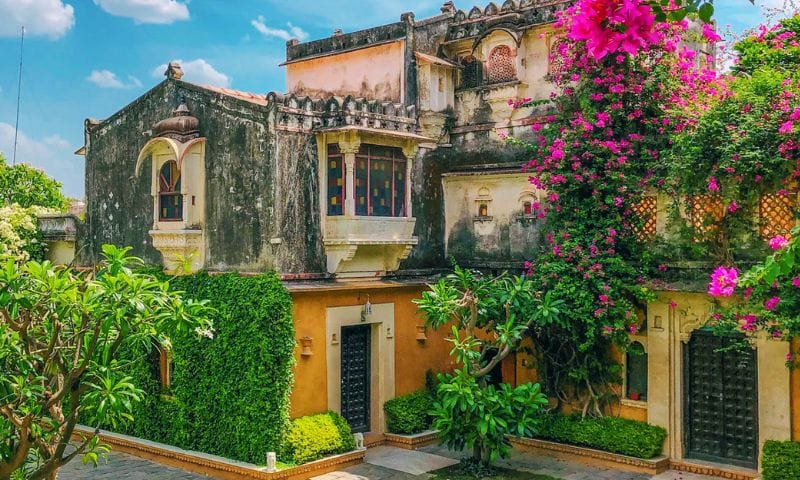
Narlai’s historical roots are intertwined with the Jodhpur royal family, the Rathores, who used the village as a hunting retreat. A 17th-century royal lodge stands at the heart of the settlement, its courtyards and frescoed walls is a reminder that even a small village in Rajasthan can carry centuries of aristocratic memory. This lodge has since been converted into a heritage hotel, Rawla Narlai, which now serves as both a hospitality landmark and a cultural anchor for the entire village.
Beyond its royal connections, Narlai holds significance as a pilgrimage stop. The village is home to several caves and rock-cut temples, including the revered Narad cave temple, which draws devotees and curious visitors alike. Hindu pilgrims have long included Narlai on their spiritual circuits through this part of Mewar, giving the village a layered identity that blends the secular and the sacred.
The defining physical feature of Narlai is a large granite monolith that rises above the village, topped with a white elephant statue visible from a considerable distance. Locals call it Elephant Hill, and it functions as both a spiritual site and a natural viewpoint. A stone stairway of roughly 700 steps leads to the summit, where you are rewarded with sweeping views of the surrounding Aravalli landscape, scattered lakes, terraced fields, and the red-tiled rooftops of the village below. The climb is moderate enough for most fitness levels, and the best time to attempt it is either at sunrise or just before sunset, when the light transforms the Aravalli palette into deep golds and burnt oranges. Small shrines and resting platforms dot the path, giving you excuses to pause and catch your breath without feeling like you are falling behind.
Rajasthan has some of the finest stepwells (baoris) in India, and Narlai’s own stepwell dates back several centuries. While it is smaller and less architecturally ornate than the famous Chand Baori in Abhaneri, Narlai’s stepwell has become renowned for a different reason, as it serves as an atmospheric open-air dining venue after dark. On select evenings, hundreds of earthen oil lamps and lanterns are arranged along the stone steps and ledges, creating a glowing, almost cinematic setting for a traditional Rajasthani meal. A local Jogi musician often performs devotional songs on a tambura during dinner, adding an acoustic layer that no restaurant playlist can replicate. Even if you do not dine there, visiting the stepwell during daylight hours is worth the short walk for its architectural detail alone.
Narlai’s lanes are narrow, whitewashed, and pleasantly chaotic. Women in bright odhnis (veils) carry water pots from communal wells, cattle saunter unhurried through the main paths, and men in vivid pagdis sit outside tea stalls exchanging the day’s news. The village is compact enough to explore on foot in a couple of hours, yet every turn reveals something worth pausing for: a carved wooden doorway, a crumbling haveli, or a small shrine daubed in vermillion. For travellers interested in rural Rajasthan and its craft traditions, our 15 days Rajasthan holiday tour package includes a guided village walk that offers direct interaction with local artisans, potters, and weavers. These walks can be arranged through your accommodation and typically include a visit to local homes, giving you a window into the rhythms of daily life that are impossible to access from a moving vehicle.
The Aravalli Hills around Narlai fall within a known leopard corridor, and sightings will never be guaranteed, but they are a genuine possibility for travellers who spend a night or two in the area to get a glimpse of them. Local wildlife safaris, typically conducted by jeep in the early morning or late afternoon, venture into the scrub-covered foothills where leopards, nilgai, chinkaras, and a variety of birdlife have adapted to the semi-arid terrain. Narlai is not a national park and the experience is less structured than a Ranthambore or Sariska safari, but that informality is precisely the appeal. The drives feel exploratory rather than regimented, and the landscape is photogenic regardless of animal encounters.
The Godwar region around Narlai has long been associated with the Marwari breed of horse, known for its inward-curving ears and resilient temperament. Several stables in and around the village offer guided horseback rides through the countryside, ranging from hour-long trots along farm tracks to full-day excursions covering the route between Narlai and Ranakpur. These are not theme-park pony rides. The terrain is real, the horses are spirited, and the experience is grounded in the region’s equestrian heritage. Even riders with limited experience are accommodated with well-trained, calm horses and experienced local guides who know the trails intimately.
One of Narlai’s strongest practical advantages is its proximity to two of Rajasthan’s most impressive heritage sites. The Ranakpur Jain Temple complex, located roughly 36 km from the village, is a masterwork of 15th-century architecture. Its 1,444 individually carved marble pillars, no two of which are identical, make it one of the finest Jain temples anywhere in the world. The sheer intricacy of the stone carving is breathtaking, and the forested setting in a remote valley adds to the sense of discovery.
Kumbhalgarh Fort, a UNESCO World Heritage Site, lies roughly 50 km from Narlai. Its perimeter wall stretches for 36 kilometres, making it the second-longest continuous wall in the world after the Great Wall of China. The fort sits at an elevation of roughly 1,100 metres above sea level and contains over 360 temples within its boundaries. A half-day visit from Narlai is comfortable, and combining both Ranakpur and Kumbhalgarh in a single day trip is entirely feasible with an early start.
Accommodation in Narlai is centred around the heritage hospitality model. The restored 17th-century royal lodge, Rawla Narlai, is the village’s most established property, offering 32 individually decorated rooms split between a historic wing and a more contemporary wing. The older rooms feature original frescoes, carved archways, and antique furniture, while the newer rooms incorporate local limestone and textile motifs in a cleaner, modern layout. Common areas include tropical courtyards, a swimming pool, and a spa.
Beyond Rawla Narlai, options are limited but growing. A handful of smaller guesthouses and homestays have begun to appear, catering to budget-conscious travellers and backpackers looking for a more grassroots experience. Given Narlai’s size, booking ahead is advisable, particularly during the October-to-March peak season when the village sees its highest footfall.
The ideal window is October through March, when daytime temperatures are comfortable for walking, climbing, and outdoor safaris. Mornings can be cool, particularly in December and January, so layering is sensible. The summer months (April to June) bring intense heat that makes outdoor exploration uncomfortable, though the village itself remains functional year-round. The monsoon period from July to September has its own appeal: the Aravalli foothills turn lush, seasonal waterfalls appear in the gullies around Elephant Hill, and the village takes on a greener, more photogenic character. Crowds thin out considerably during the rains, making it a good option for travellers who prefer solitude over sunshine.
Narlai does not have its own railway station or airport, but connectivity from neighbouring cities is straightforward.
The most practical approach for most travellers is to hire a private car or include Narlai as a scheduled stop on a broader Rajasthan itinerary. This eliminates the uncertainty of local transport schedules and allows you to visit Ranakpur or Kumbhalgarh en route.
Most travellers who include Narlai in their plans allocate a single night, treating it as a comfortable break between cities. That is a reasonable minimum, but two nights unlock the village’s full potential. A second day allows you to split activities without rushing: Elephant Hill at sunrise, a village walk in the late morning, Ranakpur in the afternoon, and a stepwell dinner after dark. The pace of Narlai rewards those who slow down. It is one of those rare destinations where doing less yields more.
Rajasthan’s major cities offer extraordinary monuments, but they also come with crowds, touts, traffic, and sensory overload. Narlai functions as an antidote. It lets you absorb the texture of Rajasthani life, the morning rituals, the temple bells, the quiet pride of village craft, without the noise that often accompanies the state’s marquee destinations. For families, couples, solo travellers, and senior visitors alike, this offbeat Rajasthan experience fills a gap that no palace tour can.
Including Narlai in a Rajasthan itinerary requires the kind of route-level planning that a good travel partner handles seamlessly. Memorable India, a New Delhi-based travel company operating since 2005, specialises in customised Rajasthan tour packages that go beyond standard city circuits. Their team builds itineraries around each traveller’s pace, interests, and budget, which means incorporating offbeat villages like Narlai alongside established highlights such as Udaipur, Jodhpur, Ranakpur, and Kumbhalgarh becomes a natural part of the planning process rather than a logistical headache.
With 24/7 on-trip support, handpicked accommodation, and private transport, Memorable India ensures that the transition from city to village and back again is smooth. Their responsible travel ethos, including community engagement and eco-friendly practices, aligns naturally with the spirit of village tourism in Rajasthan.
Narlai is not trying to compete with Udaipur’s lakes or Jodhpur’s fort. It occupies a different register entirely: quieter, slower, more textured. For travellers willing to step off the main highway and spend a night or two in a place that has not yet been polished into a tourist product, Narlai delivers a version of Rajasthan that feels personal and unhurried. The granite elephant on the hilltop, the candlelit stepwell, the Jogi’s song drifting through the courtyard, these are the details that outlast the itinerary. And they are waiting, right there, halfway between two of India’s most celebrated cities.
Narlai is approximately 125 km from Udaipur and 135 km from Jodhpur, placing it almost exactly midway between the two cities. The drive from either side takes around two and a half to three hours by private car or taxi, making it a practical and scenic stopover on one of Rajasthan’s most popular travel corridors.
The ideal time to visit Narlai is October through March, when daytime temperatures are comfortable for trekking, Elephant Hill, village walks, and outdoor safaris. The monsoon months from July to September also have their charm, as the Aravalli foothills turn lush and green, and tourist crowds thin out considerably. Summers from April to June are best avoided due to intense heat.
Key activities in Narlai include climbing Elephant Hill for panoramic sunrise or sunset views, exploring the centuries-old stepwell, taking guided village walks to interact with local artisans and craftspeople, going on leopard safaris in the surrounding Aravalli foothills, and experiencing Marwari horse safaris through the Godwar countryside. The candlelit stepwell dinner, accompanied by live Jogi music, is one of the most distinctive dining experiences in Rajasthan.
Absolutely. Narlai offers authentic rural Rajasthan experiences that are increasingly rare in the state’s busier cities. From heritage stays in a restored 17th-century royal lodge and ancient rock-cut temples to leopard territory and horseback rides through open farmland, the village delivers depth and tranquillity without the crowds, touts, and sensory overload that often accompany Rajasthan’s marquee destinations.
Yes, and this is one of Narlai’s strongest advantages. The Ranakpur Jain Temple complex is only 36 to 40 km away, and Kumbhalgarh Fort lies within a 50 km radius. Both sites can be covered as comfortable day trips from Narlai, or combined into a single full-day excursion with an early morning start. This makes Narlai an intelligent base for exploring the wider Godwar region without doubling back on long drives.
A single night works well as a transit stop between Udaipur and Jodhpur, but two nights unlock the village’s full potential. A second day allows you to split activities without rushing: Elephant Hill at sunrise, a village walk in the late morning, a Ranakpur or Kumbhalgarh trip in the afternoon, and a stepwell dinner after dark. The pace of Narlai rewards those who slow down rather than rush through.
Narlai does not have its own railway station or airport, but it is well connected by road from both Udaipur and Jodhpur. The nearest railway stations are Falna, Jawai Bandh, and Pali. The nearest airports are Jodhpur Airport and Maharana Pratap Airport in Udaipur. The most practical approach is to hire a private car or include Narlai as a planned stop within a broader Rajasthan itinerary, which eliminates dependency on local transport schedules and allows flexibility for visiting Ranakpur or Kumbhalgarh en route.
A Journey to Leh and Srinagar: Firsthand Travel Experience
25 Oct 2026
A Guide to Famous Temples in Himachal Pradesh
24 Oct 2026
9 Best Places to Visit in Lakshadweep, a Top Island Getaway in India
23 Oct 2026
7 Reasons Why One Should Travel by Indian Rail
22 Oct 2026
6 Reasons to Visit Chopta Valley in the Himalayas
21 Oct 2026


