 +919871148514
 info@memorableindia.com
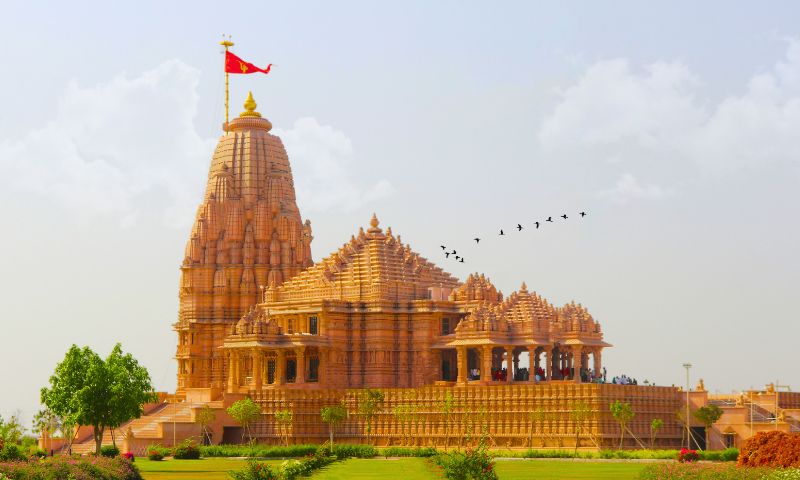
Gujarat’s spiritual geography is layered in a way few Indian states can match. A single circuit can carry you from a Jyotirlinga on the Arabian Sea to a Shakti Peeth near the Aravallis, from an eleventh-century Sun Temple to a Jain hill dotted with over 800 shrines. The state sits at the intersection of Krishna’s legendary kingdom, Shiva’s oldest self-manifested shrines, and centuries of Solanki and Chalukya patronage that produced some of India’s finest stone architecture.
What makes the state genuinely rewarding for pilgrims is proximity. Two Jyotirlingas, one of the four Char Dhams, and a globally recognised Shakti Peeth all sit within a manageable road circuit. Here is a considered list of ten temples, each chosen for religious weight, architectural value, and practical accessibility, to help you plan a meaningful spiritual journey through the state.
The first among the twelve Jyotirlingas, Somnath stands on the Saurashtra coast where the Arabian Sea meets the shrine’s western wall. Rebuilt several times through invasions, the present Chalukya-style structure was completed in 1951 under Sardar Patel’s initiative. The Shree Somnath Trust documents the Bana Stambha or Arrow Pillar in the complex, which points to an uninterrupted sea passage between the coast and Antarctica. Evening aarti at 7 pm draws steady crowds, and the sound and light show narrates the shrine’s history against an illuminated backdrop. Photography inside the sanctum is not permitted. Veraval is the nearest railhead, and Diu and Rajkot airports serve most visitors driving in.
Krishna’s mainland capital and one of the four Char Dhams established by Adi Shankaracharya, the Dwarkadhish Temple rises five storeys above the Gomti creek. Its current structure dates to the 16th century, supported by 60 carved columns, though the site is believed to be considerably older. Two entries, Swarg Dwar and Moksha Dwar, define the ritual approach. Aarti timings begin around 6:30 am and end past 10 pm, with the mangal aarti drawing the earliest crowds. Dress code is strictly enforced. Dwarka connects by direct trains from Ahmedabad, Rajkot and Jamnagar, and pairs naturally with Bet Dwarka, Rukmini Devi Temple, and Nageshwar for a complete Krishna circuit. Our 4-day Dwarkadhish with Jyotirlings tour is built around this stretch.
About 17 kilometres from Dwarka, Nageshwar is the second of Gujarat’s two Jyotirlingas and one of the twelve nationally. The Shiva Purana identifies this as the shrine of Darukavanam. A 25-metre seated Shiva statue outside the complex is visible from a distance, a modern addition that has become the temple’s most photographed feature. Queues here are usually shorter than at Somnath except during Mahashivratri and Shravan month. Abhisheka bookings can be made at the counter. The temple pairs well with a morning at Dwarkadhish, and full logistics for both shrines are covered in our complete guide to Jyotirlinga temple tours in Gujarat.
Set in the Aravalli foothills near the Gujarat-Rajasthan border, Ambaji is counted among the 51 Shakti Peethas, marking the site where Sati’s heart is believed to have fallen. The sanctum does not house an idol; the goddess is represented by a Vishvayantra, worshipped through symbolic geometry rather than iconography. Bhadarvi Poornima in September brings the largest annual fair, drawing lakhs of devotees walking in from across the state. Gabbar Hill nearby is considered the original Shakti site and is accessible by cable car. Ambaji is roughly 180 km from Ahmedabad and 45 km from Mount Abu, making it a natural detour on any Rajasthan-Gujarat cross-border pilgrimage. Cotton clothing suits the hot afternoons here even in the pilgrimage season.
Built in 1026-27 CE under Bhima I of the Solanki dynasty, the Modhera Sun Temple is one of only three surviving Sun temples of significance in India. The complex includes the Surya Kund, a stepped tank with 108 miniature shrines, the Sabha Mandap for assembly, and the Guda Mandap that houses the sanctum. Its most cited feature is the equinox alignment: sunrise on the two equinox mornings falls directly on the inner sanctum. The site is protected by the Archaeological Survey of India, so ritual worship no longer takes place, but the temple hosts the annual Uttarardh Mahotsav dance festival every January. Located about 100 km from Ahmedabad, Modhera is best combined with Patan’s Rani ki Vav for a full-day heritage circuit.
Palitana is not one temple but a city of them. Roughly 863 marble shrines cover the twin peaks of Shatrunjaya Hill near Bhavnagar, built over nine centuries beginning in the 11th. The main shrine is dedicated to Adinath, the first Jain tirthankara, who is said to have delivered his first sermon here. Reaching the summit involves climbing about 3,750 steps, a walk of two to three hours for a moderately fit visitor. Doli services are available at the base for those who cannot climb. The temples close at dusk, and no visitor may stay on the hill overnight, in keeping with Jain custom. The climb is easiest between November and February, ideally before 9 am to avoid the sun.
Consecrated in 1992, Akshardham in Gandhinagar is the first of the Swaminarayan Akshardham temples and the template for the larger Delhi complex. The pink sandstone monument houses a seven-foot gold-leafed statue of Bhagwan Swaminarayan and stands at the centre of 23 acres of gardens, water bodies, and exhibition halls. The Sat Chit Anand water show in the evening remains the most attended feature. Photography and mobile phones are not allowed inside the monument, and security screening is thorough. Timings run from 9:30 am to 7:30 pm, with the temple closed on Mondays. Ahmedabad is 30 kilometres away, making Akshardham an easy half-day trip out of the capital.
Standing roughly two kilometres outside Dwarka town, this 12th-century shrine to Krishna’s queen is architecturally striking for its intricate exterior carvings and richly painted interiors. Legend explains the temple’s distance from Dwarkadhish through the story of Sage Durvasa’s curse, which separated Rukmini from Krishna. Ritually, most pilgrims consider a Dwarka darshan incomplete without a visit here. The temple is usually less crowded than the main Dwarkadhish shrine, and its quiet setting makes it a good early-morning stop before the town’s main aarti begins. A short auto ride from central Dwarka is enough to cover the visit.
Six kilometres from Somnath, Bhalka Tirth is the site where Krishna is believed to have been struck by the hunter Jara’s arrow, ending his mortal life on the banks of the Hiran River. The temple complex here is modest, but its mythological significance is considerable, marking the closing act of the Krishna narrative that began in Mathura. Most pilgrims include Bhalka on the same day as Somnath, and the two sites together provide a natural narrative arc from Shiva’s first Jyotirlinga to Krishna’s final earthly resting site. A quiet stop, but a spiritually resonant one for those who value context alongside darshan.
The oldest Swaminarayan temple in the world, consecrated in 1822 in Ahmedabad’s old walled city, marks the origin of the Swaminarayan Sampraday. Its wooden architecture blends Rajasthani, Gujarati, and colonial-era Burmese teak carvings, making it one of the most detailed wooden shrines in western India. The temple sits within Ahmedabad’s UNESCO-listed historic city zone, and a visit pairs naturally with the surrounding pols and heritage walks. Darshan timings run in three sessions through the day. Modest dress is expected, and photography inside the main mandir is restricted. Kalupur railway station is a five-minute walk from the temple gate.
The pilgrimage window across Gujarat runs from October to March. Coastal shrines such as Somnath and Dwarka are pleasant through winter, with sea breezes offsetting the midday sun. Palitana’s climb is only advisable before 10 am even in winter. Inland sites like Ambaji and Modhera see cool mornings and warm afternoons in this window. April to June is challenging almost everywhere in the state, with temperatures crossing 40 degrees Celsius. The monsoon between July and September brings green landscapes but disrupts coastal aartis at Somnath and Palitana climbs on wet steps. Festival planners should note Mahashivratri at both Jyotirlingas, Janmashtami at Dwarka, and Bhadarvi Poornima at Ambaji as the year’s three biggest pilgrimage draws. Our curated Gujarat tour packages sequence these sites in a way that respects weather, temple timings, and travel distances.
A well-planned temple trip in Gujarat needs more than a list. Distances between shrines are longer than they appear on a map, darshan queues shift with festivals, and dress codes are enforced at every major site. Booking accommodation in Somnath and Dwarka in advance is advisable, particularly during Shravan and Kartik. For pilgrims who prefer a private-vehicle circuit with pre-vetted hotels and guided support at each shrine, get in touch with our team with your travel dates and group profile, and we will put together an itinerary matched to your pace and preferences.
Gujarat is home to two of the twelve Jyotirlingas mentioned in the Shiva Purana. Somnath, near Veraval, is traditionally listed as the first Jyotirlinga, and Nageshwar, about 17 kilometres from Dwarka, is the second. Both can be visited within a single Saurashtra-coast circuit of four to five days.
A focused Saurashtra-coast circuit covering Somnath, Dwarka, Nageshwar, Rukmini Devi and Bhalka Tirth needs four to five days. Adding Ambaji, Modhera, Palitana, and Ahmedabad’s Kalupur and Akshardham temples extends the trip to eight or nine days at a comfortable pace with reasonable driving hours each day.
Traditional or modest attire is expected at all major shrines. Sleeveless tops, shorts and short skirts are not permitted at Somnath, Dwarkadhish, Ambaji, and Palitana. Kurtas, sarees, or full-length trousers with covered shoulders work well. Leather items are not allowed inside Jain temples at Palitana.
The 3,750-step climb is demanding, but doli services (chair carriers) are available at the base and are used regularly by senior pilgrims. Starting the climb before sunrise, carrying water, and pacing the ascent with rest breaks makes it manageable. The descent is usually completed before the midday heat sets in.
A first-timer’s list should include Somnath, Dwarkadhish, Nageshwar Jyotirlinga, Ambaji, and Modhera Sun Temple. These five cover the state’s Shiva, Krishna, Shakti and Solanki-era architectural traditions, and can be sequenced into a single road trip beginning and ending in Ahmedabad.
Rules vary shrine to shrine. Somnath and Akshardham prohibit mobile phones inside the sanctum, with cloakroom facilities at the entrance. Dwarkadhish permits phones in the outer compound but not inside the inner shrine. Ambaji and most Jain temples at Palitana restrict photography inside the sanctum. Signage at the entrance is the reliable source at any given site.

A Guide to Exquisite Indian Handicrafts and Where to Buy Them in India
26 Oct 2026
A Journey to Leh and Srinagar: Firsthand Travel Experience
25 Oct 2026
A Guide to Famous Temples in Himachal Pradesh
24 Oct 2026
9 Best Places to Visit in Lakshadweep, a Top Island Getaway in India
23 Oct 2026
7 Reasons Why One Should Travel by Indian Rail
22 Oct 2026


