 +919871148514
 info@memorableindia.com
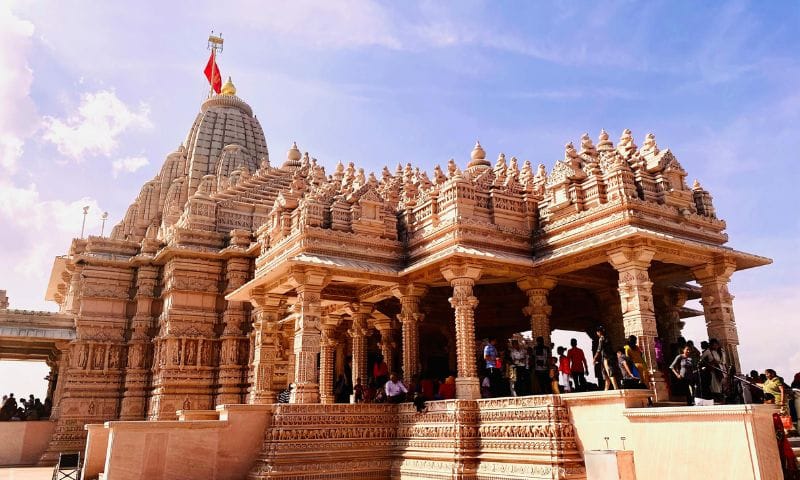
Of the twelve Jyotirlingas, the sacred self-manifested shrines of Lord Shiva described in the Shiva Purana, two are in Gujarat. That makes the state a concentrated pilgrimage destination for Shaivite devotees, with both temples reachable within a single tour circuit along the Saurashtra coastline. Somnath, the first of the twelve Jyotirlingas, sits on the shore of the Arabian Sea near Veraval. Nageshwar, the protector shrine associated with the ancient forest of Darukavanam, stands about 17 kilometres from Dwarka. Together, they anchor a spiritual corridor that also passes through Dwarkadhish Temple (one of the four Char Dhams), Bet Dwarka, and Bhalka Tirth.
This guide covers both Jyotirlingas in detail, along with the history, darshan logistics, nearby sacred sites, and practical planning advice for a complete Gujarat temple circuit. For pilgrims planning a broader Indian temple journey, our India pilgrimage tour packages cover circuits across Varanasi, Rishikesh, Rameshwaram, and the Char Dhams, and can be extended to include the Gujarat leg.
According to Hindu scripture, a Jyotirlinga is a devotional representation of Lord Shiva where the deity appeared as an infinite column of light (jyoti) to settle a dispute between Brahma and Vishnu over who was supreme. The twelve Jyotirlingas are spread across India, from Kedarnath in Uttarakhand to Rameshwaram in Tamil Nadu, and each is considered a site where Shiva’s presence is self-manifested rather than installed by human hands.
Gujarat holds two of these twelve: Somnath (near Veraval) and Nageshwar (near Dwarka). Their placement on the Saurashtra coast means they can be visited together in a single tour, which is relatively rare among Jyotirlinga groupings. Most other Jyotirlingas require separate trips to different states. This geographic proximity makes Gujarat one of the most efficient Jyotirlinga pilgrimage circuits in India, particularly when combined with the Dwarkadhish Temple, one of the four Char Dhams established by Adi Shankaracharya.
Somnath is traditionally listed as the first of the twelve Jyotirlingas. The name translates to ‘Lord of the Moon’, and the temple’s origin is linked to the legend of Chandra (the moon god), who was cursed by his father-in-law Daksha to lose his lustre. Chandra prayed to Shiva at Prabhas Patan, and Shiva restored his light, establishing the site as Somnath. The temple is believed to have been first built in gold by the moon god himself, then in silver by Surya (the sun god), then in wood by Lord Krishna, and finally in stone by Bhimadeva I of the Solanki dynasty in the 11th century.
Somnath’s history is also marked by repeated destruction and reconstruction. The temple was raided and demolished multiple times by invaders, most notably by Mahmud of Ghazni in 1026 CE, and was rebuilt each time. The current structure, completed in 1951 under the leadership of Sardar Vallabhbhai Patel and K.M. Munshi, is built in the Chalukya style of architecture with a shikhara (spire) that rises to roughly 50 metres. The temple stands on the western edge of the Indian subcontinent, with the Arabian Sea directly behind it. A stone arrow on the shore, called the Baansthambh, indicates that there is no landmass between this point and the South Pole.
Somnath Temple opens for darshan at 6 AM. The morning aarti (around 7 AM) is the most atmospheric, with the sunrise over the sea and the temple bells creating a distinctive setting that few other Jyotirlingas can match. The afternoon slot (12 PM to 3 PM) tends to have the longest queues, particularly on weekends and during Shravan month (July to August). The evening aarti at around 7 PM, conducted on the temple’s sea-facing platform, is another highlight. Dress code is modest: shoulders and knees should be covered, and shoes are removed before entering the sanctum.
The sound and light show at Somnath, held every evening (except during monsoon months), narrates the temple’s history from its mythological origins through its cycles of destruction and rebuilding. The show runs for about 45 minutes and is projected onto the temple’s sea-facing wall. It is one of the most well-produced heritage shows in India and adds a historical dimension to the pilgrimage experience.
Somnath is located near Veraval in the Gir Somnath district. The nearest railway station is Veraval (about 7 kilometres from the temple), connected to Ahmedabad, Rajkot, and Junagadh by regular trains. The nearest airport is Rajkot (about 200 kilometres) or Diu (about 90 kilometres). By road, Somnath is roughly 400 kilometres from Ahmedabad (about seven hours by car). Most pilgrims arrive from Ahmedabad or Rajkot and combine the visit with Dwarka and Nageshwar.
Nageshwar Jyotirlinga, also known as Nagnath Temple, is situated about 17 kilometres from Dwarka, between the main town and Bet Dwarka island. The name translates to ‘Lord of Serpents’, and the temple is associated with Shiva’s power to protect devotees from all forms of poison, both physical and spiritual. According to the Shiva Purana, the shrine marks the site of the ancient forest of Darukavanam, where a demon named Daruka imprisoned Shiva devotees. A devotee named Supriya continued chanting ‘Om Namah Shivaya’ despite captivity, and Shiva manifested as Nageshwar to destroy the demon and liberate the faithful.
The temple is relatively modest in scale compared to Somnath, but its spiritual significance within the Jyotirlinga tradition is equal. The most prominent external feature is a 25-metre-tall statue of Lord Shiva in a seated meditation posture, visible as you approach the temple entrance. The sanctum houses the Jyotirlinga, and the temple’s interiors are simple and focused on the devotional experience rather than architectural ornamentation. An old pond near the temple is home to turtles and an ancient tree, both of which pilgrims consider auspicious.
Nageshwar Jyotirlinga opens for morning darshan around 6 AM. Multiple aarti and abhisheka sessions take place throughout the day. The evening aarti is typically between 7 and 7:30 PM. Queues are generally shorter than at Somnath, except during Mahashivratri and Shravan month. Photography is permitted in the outer compound but not inside the sanctum. The temple’s proximity to Dwarka (about 20 minutes by car) makes it a natural half-day addition to any Dwarka itinerary.
The most practical base for visiting both Jyotirlingas is Ahmedabad, which has the best air and rail connectivity in Gujarat. A standard circuit runs Ahmedabad to Dwarka (about 450 km by road, roughly eight to nine hours), then Dwarka to Somnath via Porbandar (about 230 km, roughly five hours), and Somnath back to Ahmedabad (about 400 km, roughly seven hours). This loop takes four to five days at a comfortable pace, including half a day each at Nageshwar and Somnath, and a full day in Dwarka. The 4 Days Somnath and Dwarkadhish tour package covers this exact circuit with guided sightseeing, hotel stays, and air-conditioned transport from Ahmedabad.
The best time for this tour is October to March, when Gujarat’s coastal climate is pleasant, with daytime temperatures between 20 and 30 degrees Celsius and low humidity. Summers (April to June) are extremely hot along the Saurashtra coast, with temperatures regularly crossing 40 degrees. The monsoon (July to September) brings heavy rain and rough seas, and the Somnath sound and light show is typically suspended during this period. Shravan month (July to August) draws the largest pilgrimage crowds despite the heat, so plan for longer darshan queues if visiting then.
Dwarka is one of the four Char Dhams and one of the seven ancient holy cities (Sapta Puri) in Hinduism. The Dwarkadhish Temple, dedicated to Lord Krishna, is the primary pilgrimage site. The temple’s five-storey structure, supported by 60 columns, dates in its current form to the 16th century, though the site is believed to be far older. The Gomti Ghat adjacent to the temple is where pilgrims take a ritual dip before darshan. Our blog on religious towns around Dwarka covers the surrounding temple towns including Bet Dwarka, Mul Dwarka, and Suvarn Teerth.
Bet Dwarka (also called Shankhoddhar) is an island about 30 kilometres from Dwarka, reachable by boat from Okha. It is believed to be the original residential quarters of Lord Krishna, while the main Dwarka served as the capital. The island has several temples including the Dwarkadhish Temple of Bet Dwarka, Hanuman Dandi Temple, and shrines associated with Sudama and Mirabai. The boat ride across the creek and the island’s quieter, more intimate atmosphere make it a valuable addition to the Dwarka visit.
Bhalka Tirth, about five kilometres from Somnath, is the site where Lord Krishna is believed to have been struck by a hunter’s arrow, leading to his departure from the earthly realm. A temple marks the spot, with a footprint of Krishna preserved under a peepal tree. Gopi Talav, about five kilometres from Nageshwar Jyotirlinga, is a sacred pond associated with the Gopis of Krishna lore. Triveni Sangam at Somnath, where three rivers meet the Arabian Sea, is another ritual bathing spot that pilgrims traditionally visit before Somnath darshan. Porbandar, the birthplace of Mahatma Gandhi, and the Sudama Temple are practical stops on the Dwarka-to-Somnath road.
Ahmedabad is the best entry point, with direct flights from Delhi, Mumbai, Bangalore, Kolkata, and most major Indian cities. For the intercity circuit, hiring a private car with a driver is the most efficient option, given the distances involved and the flexibility needed for darshan timings. Our Gujarat tour packages include customisable pilgrimage options with transport, accommodation, and guided temple visits.
Carry modest clothing for temple visits. Both Somnath and Nageshwar require covered shoulders and knees, and shoes must be removed at the entrance. Lockers or shoe storage are available at both temples. Mobile phones are generally permitted but photography inside the sanctum is restricted. Both temples have free drinking water and basic prasad counters. Accommodation near Somnath ranges from dharamshalas and budget guesthouses to mid-range hotels in Veraval. Dwarka has a wider range, including heritage hotels and pilgrimage lodges. Booking in advance is essential during Shravan and Mahashivratri.
For travellers who want to combine the Jyotirlinga circuit with Gujarat’s wildlife and heritage, the Gir National Park (home of the Asiatic lion) is about 65 kilometres from Somnath, making a one-day safari extension practical. Our complete guide to Gujarat covers the full range of the state’s offerings beyond the pilgrimage circuit. To plan a customised Jyotirlinga tour itinerary, get in touch with our travel specialists.
Gujarat’s position on the Jyotirlinga map is unique. No other Indian state offers two of the twelve sacred Shiva shrines within a single, compact touring circuit, and no other Jyotirlinga sits directly on the coast of the Arabian Sea the way Somnath does. The proximity of Nageshwar to Dwarka, one of the four Char Dhams, adds a Vaishnavite dimension that makes the Gujarat pilgrimage route one of the most complete temple circuits in India for devotees of both Shiva and Vishnu. The temples are well-maintained, the darshan logistics are manageable, and the coastal setting gives the experience an atmospheric quality that inland shrines lack. For Shaivite pilgrims working through the twelve Jyotirlingas, Gujarat is among the most rewarding and efficient stops on the journey.
Q: How many Jyotirlingas are in Gujarat?
A: Gujarat has two of the twelve Jyotirlingas: Somnath (near Veraval in Gir Somnath district), which is traditionally listed as the first Jyotirlinga, and Nageshwar (near Dwarka in Devbhumi Dwarka district). Both are located on the Saurashtra coast and can be visited in a single tour circuit.
Q: What is the best time to visit the Jyotirlingas in Gujarat?
A: October to March is the most comfortable period, with pleasant coastal weather between 20 and 30 degrees Celsius. Shravan month (July to August) and Mahashivratri (February or March) are the most spiritually significant periods but also the most crowded. Summers (April to June) are very hot along the Saurashtra coast.
Q: Can Somnath and Nageshwar be visited in a single trip?
A: Yes. Nageshwar is about 17 kilometres from Dwarka, and Somnath is about 230 kilometres from Dwarka via Porbandar. A four-to-five day circuit starting and ending in Ahmedabad covers both Jyotirlingas along with Dwarkadhish Temple, Bet Dwarka, and Bhalka Tirth.
Q: What are the darshan timings at Somnath Temple?
A: Somnath Temple opens at 6 AM. The morning aarti is around 7 AM, and the evening aarti is around 7 PM. The temple remains open throughout the day with a brief closure between approximately 12 PM and 1 PM for rituals. The sound and light show takes place every evening (except during monsoon) on the temple’s sea-facing side.
Q: How do I reach Somnath and Nageshwar from Ahmedabad?
A: By road, Dwarka (for Nageshwar) is about 450 kilometres from Ahmedabad (eight to nine hours), and Somnath is about 400 kilometres (seven hours). By train, Veraval (near Somnath) and Dwarka both have railway stations connected to Ahmedabad. By air, Rajkot airport (about 200 km from Somnath) or Porbandar airport (about 130 km) are the nearest options. A hired car with a driver is the most flexible way to cover the circuit.
Q: What other temples should I visit on a Gujarat Jyotirlinga tour?
A: Dwarkadhish Temple in Dwarka (one of the four Char Dhams), Bet Dwarka island temples, Bhalka Tirth (where Krishna departed the earthly realm), Rukmini Temple near Dwarka, and Gopi Talav near Nageshwar are the most important additions. Junagadh Gate and Triveni Sangam near Somnath are also worth visiting.

A Guide to Exquisite Indian Handicrafts and Where to Buy Them in India
26 Oct 2026
A Journey to Leh and Srinagar: Firsthand Travel Experience
25 Oct 2026
A Guide to Famous Temples in Himachal Pradesh
24 Oct 2026
9 Best Places to Visit in Lakshadweep, a Top Island Getaway in India
23 Oct 2026
7 Reasons Why One Should Travel by Indian Rail
22 Oct 2026


