 +919871148514
 info@memorableindia.com
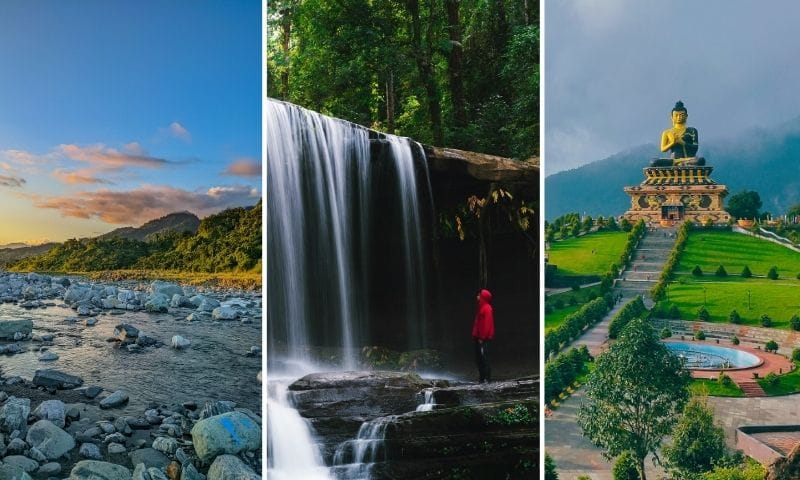
When you talk about the North East of India, it seems most people will come up with the same five or six destinations: Shillong, Gangtok, Tawang, Kaziranga, and perhaps Cherrapunji for a bit of a stretch. And they are all great places. But the eight states of this part of India hold far more than what fits into a typical travel itinerary or an Instagram reel.
There are lush subtropical jungles, high-altitude plateaus, river islands, mud volcanoes, and tribal settlements whose practices predate written records. It is mostly untouched by mass tourism, either because it is difficult to access or because most travel media like to go round in circles. This itinerary is curated around the lesser-known places of Northeast India that you cannot find in the mainstream blogs, travel vlogs, or itinerary lists. So, if you are the type of traveller who prefers discoveries off the beaten track over the obvious viewpoints, this one is for you.
Northeast India spans more than 262,000 square kilometres, including the states of Assam, Meghalaya, Arunachal Pradesh, Nagaland, Manipur, Mizoram, Tripura, and Sikkim. Yet, the tourism industry has tended to focus on a few gateway cities. But this is changing, with improved road links, more flights, and increasing domestic tourism. However, progress is slow, and vast tracts of this region remain little-visited.
The Protected Area Permits (PAP) and Inner Line Permits (ILP) in places like Arunachal Pradesh, Nagaland, and Mizoram also act as a sieve, allowing only a trickle of visitors to get through and keeping the places largely pristine. For those travellers willing to put in a little more effort, this makes these offbeat destinations in Northeast India so rewarding.
Ziro Valley is located at 1,500 metres above sea level in the Lower Subansiri district of Arunachal Pradesh. It is inhabited by the Apatani tribe, who have a unique rice-fish cultivation method that stretches back for centuries. Ziro Valley is a checkerboard of rice fields encircled by low hills covered in pine forests, and is on the UNESCO World Heritage tentative list.
The main reason Ziro is not on many travellers’ itineraries is because of its remote location from airports. The closest commercial airport is in Itanagar (110 km from Ziro), and it takes about 10 hours to drive down from Guwahati. But for the adventurous, it is a chance for a leisurely experience. Amble along the bamboo-lined trails of Hong, Hari, or Bulla. Talk to Apatani elders. Quell your hunger with local smoked fish and rice beer. This valley has also been put on the map by the Ziro Music Festival, held annually in September, which attracts musicians and tourists from across India.
Best time to visit: March to October. Or September for the music festival.
The Blue Mountain, or Phawngpui, is the highest peak in Mizoram at 2,157 metres. Located within the Phawngpui National Park near the Myanmar border, it provides a 360-degree view of Mizoram and the hills of Myanmar on a clear day. It is home to rare orchids, rhododendrons that flower in March to May, and birds such as the dark-rumped swift and Blyth’s tragopan.
It can be reached from the town of Lawngtlai, and the climb to the top is moderate but needs to be accompanied by a guide. Accommodation is scarce, so plan accordingly. Visitors to Mizoram need an Inner Line Permit, which can be obtained online. This is one of those offbeat destinations in North East India where you can go trekking for miles without bumping into another traveller.
Best time to visit: October to April for sunny skies and a pleasant trekking experience.
Majuli is located in the middle of the Brahmaputra River, in the state of Assam, and is the world’s largest river island. It also serves as a thriving hub of neo-Vaishnavite culture, with satras (monastic institutes) that have preserved music, dance, mask-making, and manuscript-making for centuries. Kamalabari, Auniati, and Dakhinpat satras are notable ones.
To reach Majuli, take a ferry from Jorhat, which takes approximately an hour, depending on the water level. Cycling or motorbiking is the preferred mode of transport. The only accommodation is bamboo cottages and eco-lodges. Monsoon flooding is a common occurrence, so plan to visit from November to March. Majuli is arguably the best place in India for those seeking cultural exploration rather than views.
Best time to visit: November to March. Do not go in July and August when it floods.
Dzukou Valley is the border point of Nagaland and Manipur, and is located at an elevation of 2,452 m. It has been compared to the Valley of Flowers in Uttarakhand, but without crowds. From June to September, the valley floor is covered with seasonal flowers of lilies, aconitums, and euphorbias, forming a sea of colours against a backdrop of green hills.
The valley is usually trekked from Viswema village, 20 km south of Kohima. It is a four to five-hour trek. A small rest house is available at the valley floor, but most people come with tents. No shops, no tarmac, no railings. Dzukou is unspoilt, and that is how we like it.
Best time to visit: June to September for wildflowers. October to December for good trekking.
Longwa is a Konyak Naga village in Mon district, Nagaland, on the India-Myanmar border. The village chief’s living room is in India, while his kitchen is in Myanmar. This is no hyperbole. It is a village where you can literally stand in two countries.
Longwa is home to the last of the Konyak headhunting traditions, although head-hunting stopped long ago. Here you can still find older people with traditional facial tattoos and brass ornaments, and have the chance to meet and talk to them to learn about this disappearing culture. The road to Longwa is a drive from Mon town (42 km) and is better done in the dry season.
Best time to visit: November to March. April for the Aoling Festival.
Mechuka (also spelt Menchuka) is a small town located in the Shi-Yomi district, Arunachal Pradesh, situated at an altitude of 1829 metres, between hills and the Siyom River. It was a military station during the India-China war of 1962, and it is one of the remotest inhabited places in the state. Tibetan-style Buddhist monasteries, dense forests, and vast, flat river valleys are intermingled.
It is a six-hour drive from the nearest well-connected town of Along on mountain roads. A small airstrip at Mechuka operates Pawan Hans helicopters, but services can be irregular. Samten Yongcha Monastery and nearby tribal settlements are prominent landmarks. If you are looking for hidden places in Northeast India that are still untouched, Mechuka is one of the best choices.
Best time to visit: March to June and September to November.
Tamenglong district in Manipur is home to some spectacular waterfall formations, including the Barak waterfall, which drops 60 metres into a pool. It is home to dense tropical and subtropical forests, and a habitat to the Amur falcon, which migrates from Siberia to Southern Africa. Each October and November, thousands of these birds congregate in the Tamenglong region, making for one of the most spectacular bird events in Asia.
The district is accessible by road in five to six hours from Imphal, and the drive is one of the most beautiful in the state. The local Zeliangrong Naga people are welcoming, and tourism is in its infancy. For birding, waterfalls, and just being away from the beaten track, Tamenglong has it all.
Best time to visit: October to March. October and November for Amur falcon sightseeing.
Venturing to the offbeat destinations of Northeast India is not the same as going to Shimla or Goa. Here are some travel tips to keep in mind before you travel.
The best time for most offbeat destinations in Northeast India is from October to April. This time of year, this state offers clear skies, dry conditions, and moderate temperatures around most altitudes. The monsoon season runs from June to September, and roads are often impassible in Arunachal Pradesh and parts of Manipur and Mizoram. But the monsoon is also the time when many valleys are in full bloom, and waterfalls are roaring, so it can have its own merits for adventurers.
If you are hoping to see wildflowers in Dzukou Valley or rhododendron flowers in Mizoram, June to September or March to May are good times to visit, respectively. Festivals such as the Hornbill Festival in Nagaland (December), the Aoling Festival in Mon (April), and the Ziro Music Festival (September) can also be great focal points.
It is possible to plan a “hidden” travel route in Northeast India independently, but the intricacies of travel permits, road networks, and lack of accommodation options can be vexing. An experienced travel agency like Memorable India is a great help. Memorable India has been in operation since 2005 and is committed to sustainable, ethical travel practices. Their itineraries allow for much more than the usual tourist circuit.
Check out their specialist North East India Tour Packages for itineraries in Arunachal Pradesh, Meghalaya, Assam, and Sikkim. The packages include permit processing, local itineraries, and full-service ground transportation.
For those interested in Arunachal Pradesh, the 12 Days Arunachal Tour Package includes prominent regions, lesser-visited valleys, and tribal areas that are hard to reach on your own.
For those interested in Meghalaya, they can look at the 5 Days Meghalaya Tour Package for a dedicated itinerary that includes both popular and not-so-popular destinations around the Khasi and Jaintia hills.
For the Sikkim-Darjeeling area, the Splendor of Eastern Himalaya Tour offers a balanced mix of Gangtok, Kalimpong, and Darjeeling, with visits to monasteries and views of the Himalayas.
Northeast India is not a destination that can be conquered in one go. It is a destination that you discover gradually, valley by valley, village by village, and river by river. The destinations you will find here are not the usual suspects, which is why they are here. They require a bit more effort and a bit more courage to venture out of the comfort zone.
For every Gangtok, there is a Mechuka. For every Cherrapunji, there is a Tamenglong. The allure of the Northeast is the fact that it is still its own. If you want to swap convenience for content, you will find it here.
Looking for an alternative Northeast India itinerary? Speak to the team at Memorable India and create a holiday that takes you off the beaten track.
Q1. What are the most hidden gems of Northeast India that tourists rarely visit?
Ziro Valley (Arunachal Pradesh), Phawngpui Peak (Mizoram), Longwa village (Nagaland), Mechuka (Arunachal Pradesh), Tamenglong (Manipur), Dzukou Valley (Nagaland-Manipur border), and Majuli Island (Assam) are some of the most under-visited places. These destinations are home to minimal tourism despite their cultural and natural beauty.
Q2. Do I need a permit to visit offbeat destinations in Northeast India?
Yes. Arunachal Pradesh, Nagaland, and Mizoram require Indian citizens to obtain an Inner Line Permit (ILP). It can be obtained online via the state government’s website. Non-Indians need a Protected Area Permit (PAP) for some areas in Arunachal Pradesh and for restricted areas. It is advisable to make 2 weeks’ prior bookings to avoid any hassles.
Q3. What is the best time to visit unexplored destinations in North East India?
The ideal time is from October to April, when the weather is dry, and the roads are clearer. The flowering season for treks in Dzukou Valley is June to September. Mizoram’s rhododendron flowering season is from March to May. Popular festivals like the Hornbill Festival (December) and the Ziro Music Festival (September) are also good options for trip planning.
Q4. How do I reach remote destinations like Ziro Valley or Mechuka?
Guwahati is the gateway to most of the Northeast destinations in India. Ziro Valley is about a 10-hour drive from Guwahati via Itanagar. The six-hour drive from Along leads to Mechuka in Arunachal Pradesh. There are also domestic flights to cities such as Dimapur, Imphal, and Aizawl, which are well connected with land transport to most offbeat destinations. It is best to hire a local vehicle with a driver.
Q5. Is it safe to travel to offbeat parts of Northeast India?
Most offbeat places in the Northeast are safe for travellers, including solo travellers and children. Tribal communities are usually friendly and welcoming. The difficulty lies more in the logistics: limited infrastructure, inconsistent phone connectivity, and lack of basic accommodation. A travel company such as Memorable India takes care of all planning and arrangements, and provides local support.
Q6. Can I visit Northeast India on a budget?
Absolutely. Homestays, government guest houses, and basic lodges in non-tourist areas are much more affordable than hotels in tourist towns. Street food is cheap and delicious. The highest costs are transportation (hiring cars and Sumos) and permits. It is cheaper to plan with a tour operator as transport, accommodation, and permits can be combined into a single package.
Q7. What should I pack for an offbeat Northeast India tour?
Bring warm clothes, do not forget that the temperature drops as you go up in altitude, sturdy shoes, a raincoat, a power bank, a torch, a first aid kit, and sufficient cash for regions with limited ATMs. It is best to download maps as mobile networks are patchy in remote areas. Bring a reusable water bottle and eco-friendly toiletries to reduce waste.
What’s It Like to Travel in Rajasthan, India? A Grounded Look at the Land of Kings
18 Sep 2026
Where to Stay in 15 Most Popular Indian National Parks
15 Sep 2026
Top Buddhist Pilgrimage Sites in India: A Complete Circuit Guide
10 Sep 2026
Top 6 Tiger Reserves to Visit in India for a Bucket-List Safari
05 Sep 2026
Top 30 Must-Visit Hill Stations in South India
01 Sep 2026


