 +919871148514
 info@memorableindia.com
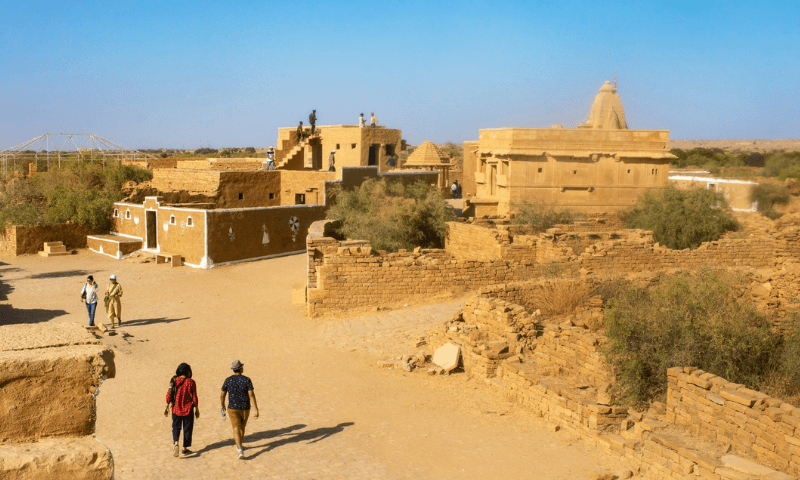
About 18 kilometres southwest of Jaisalmer, tucked into the arid terrain of the Thar Desert, there is a village that nobody has called home for over two centuries. Kuldhara Village is not your typical Rajasthani tourist stop. There are no colourful bazaars here, no folk musicians setting up for evening performances, and no chai stalls competing for your attention. What you will find instead are rows of roofless sandstone houses, narrow lanes that once connected a thriving community, and a complete silence that practically demands explanation. The village has been empty since the early 19th century, abandoned under circumstances that historians and storytellers still argue about. Some call it a ghost village. Others see it as an open air museum of desert ingenuity. The truth, as you will find, sits somewhere in between.
For travellers planning a trip to Jaisalmer, Kuldhara offers a compelling detour into a part of Rajasthan that most itineraries overlook. This is a place where history, folklore, and architecture collide, and where the desert itself becomes the narrator.
To understand Kuldhara, you first need to understand the people who built it. The Paliwal Brahmins were a community that migrated from the town of Pali (in present day Rajasthan) to the Jaisalmer region. Their name itself carries that origin. They settled in Kuldhara around the 13th century and, over generations, turned a patch of inhospitable desert into a functioning, prosperous settlement.
What made the Paliwals remarkable was not their religious scholarship alone but their practical mastery over desert survival. In a landscape where water was the scarcest resource, they engineered stepwells, underground channels, and rainwater collection systems that allowed them to farm successfully in arid conditions. These were not rudimentary techniques. Modern researchers have acknowledged the sophistication of Paliwal water conservation methods, which sustained agriculture for centuries in one of the driest regions of the subcontinent.
The community was also known for its involvement in trade. Positioned along historic caravan routes near Jaisalmer, the Paliwal Brahmins benefited from commerce passing through the region. They were strict vegetarians, valued education deeply, and maintained a tightly knit social structure centred around shared courtyards and communal worship. At its peak, the village is believed to have supported well over a thousand residents.
Every abandoned place needs a good story, and Kuldhara has one that has been passed down through oral tradition for generations. The most widely repeated version centres on Salim Singh, the powerful Diwan (minister) of the Jaisalmer State during the early 19th century. According to local folklore, Salim Singh was notorious for his arrogance and oppressive governance. He allegedly became fixated on the daughter of the village chief and issued an ultimatum: hand over the girl or face crushing taxation and harassment.
Rather than submit, the Paliwal Brahmins of Kuldhara chose collective resistance. The legend states that the entire village packed up and left overnight. Some versions of the story claim that not just Kuldhara but as many as 83 surrounding Paliwal villages were emptied at the same time. Before leaving, the villagers are said to have placed a curse on the land, ensuring that no one would ever be able to settle in Kuldhara again.
It is a dramatic story, and one that has made Kuldhara one of the most talked-about heritage sites in the Jaisalmer region. But is it historically accurate? That is a more complicated question.
The overnight evacuation narrative makes for compelling tourism marketing, but scholarly research suggests the decline was likely more gradual. Historical records, including the 1899 text Tawarikh i Jaisalmer by Lakshmi Chand, indicate that Kuldhara’s population fell from an estimated peak of over 1,500 during the 17th and 18th centuries to around 800 by 1815. By 1890, the count had dropped to just 37 residents.
The primary cause appears to have been environmental. By the early 19th century, most of Kuldhara’s wells had dried up. The stepwell, commissioned in 1757 CE, was one of the last functional water sources, but even that could not sustain the community indefinitely. Without water, agriculture collapsed. And without agriculture, the economic foundation of the village crumbled.
Some scholars also point to shifting trade routes and political instability as contributing factors. A 2017 study published in Current Science proposed that an earthquake may have destroyed the water table beneath Kuldhara and other nearby Paliwal settlements, forcing abandonment.
The Salim Singh legend likely contains a kernel of truth. Oppressive taxation was real, and the diwan was widely documented as a heavy-handed ruler. But the romantic version of a single night’s departure oversimplifies what was probably a drawn out economic and environmental decline spread over decades.
Kuldhara is now a government protected heritage site managed by the Archaeological Survey of India. The ruins are spread across a rectangular area and remain surprisingly well preserved considering centuries of desert exposure.
The settlement followed a planned design with three main longitudinal roads cut through by smaller lanes. Sandstone houses line both sides of these roads, most now roofless but with walls that are still standing. The architecture reflects practical desert engineering: thick walls to insulate against extreme heat, small windows for ventilation, and narrow alleyways that provide natural shade and wind protection. Many doorframes still carry faint traces of carved detailing, a sign of the craftsmanship the Paliwals were known for.
The village was centred around a temple dedicated to a mother goddess, believed to be Devi Hinglaj. Fragments of other temple structures also remain, along with shared courtyards that point to a community built on collective living. Three cremation grounds with memorial stones, known as devalis, sit on the outskirts. Two inscriptions from these grounds date to 1235 CE and 1238 CE, confirming human settlement as early as the 13th century.
The stepwell, commissioned by a Kuldhara Brahmin named Tejpal, is one of the most fascinating structural remnants. Though dry now, it illustrates how the Paliwals adapted to the harsh desert water cycle. These were not just functional structures but feats of planning that modern visitors often find as impressive as any fort or palace in Rajasthan.
Kuldhara’s association with ghost stories has grown steadily over the years, fuelled by television features, Bollywood productions, and social media. Visitors occasionally report hearing unexplained sounds, feeling sudden temperature shifts, or experiencing an uneasy sense of presence in the empty lanes. These reports have earned Kuldhara the label of a haunted village in Rajasthan.
From a practical standpoint, most of these experiences can be attributed to desert acoustics. Wind channelling through narrow stone corridors and roofless structures creates unusual auditory effects. The isolation and visual starkness of the site also play on the imagination, particularly at dusk.
That said, the ghost village reputation is part of what draws visitors, and there is nothing wrong with a bit of atmospheric tension when you are walking through a place with this much history. Just do not expect jump scares. Kuldhara’s eeriness is the quiet, contemplative kind.
Kuldhara is located roughly 18 km away from Jaisalmer city. The drive takes around 30 to 40 minutes by taxi or private vehicle. There is no public bus service directly to the village, so hiring a cab or arranging transport through your tour operator is the most reliable option. Most Jaisalmer tour packages include a Kuldhara visit as part of the itinerary, often combined with a trip to the Sam Sand Dunes later in the day.
The village is open daily from 8:00 AM to 6:00 PM. Entry fees are nominal, with Indian citizens paying Rs 10 per person and an additional Rs 50 for vehicles. It is advisable to visit during the morning hours, particularly in summer, when afternoon temperatures in the Thar can become intense.
The ideal window for Kuldhara Village is October through March, when the Jaisalmer region enjoys pleasant daytime temperatures between 10 and 25 degrees Celsius. This is also the peak season for Rajasthan tourism, so combining Kuldhara with a wider Rajasthan tour is a practical and rewarding approach. Summers should be avoided unless you are accustomed to extreme heat. Monsoon months bring minimal rainfall to this part of the desert, but limited tourist infrastructure makes the visit less comfortable.
Pack water, sunscreen, a hat, and comfortable walking shoes. There are no shops, restaurants, or shade structures inside the heritage site. Photography is freely allowed, and the golden light of early morning makes for particularly striking images against the sandstone ruins.
A trip to Kuldhara pairs naturally with several other Jaisalmer highlights. The Sam Sand Dunes, located about 40 km from Jaisalmer, offer camel safaris and overnight desert camping. Jaisalmer Fort, one of the few living forts in the world, is a UNESCO World Heritage Site and a must for any Rajasthan itinerary. The ornately carved Patwaon Ki Haveli and Nathmal Ki Haveli in the old city showcase the merchant era craftsmanship that thrived in this region. Gadisar Lake offers a quieter alternative for those looking to slow down between fort visits and desert excursions. If you are planning a longer trip, the 15 day Rajasthan tour package covers Kuldhara along with Jaisalmer, Jodhpur, Udaipur, and other key destinations.
It would be easy to reduce Kuldhara to a haunted attraction or a photo opportunity among desert ruins. But the village represents something more valuable: a record of human resilience, community engineering, and the fragile relationship between civilisation and environment. The Paliwal Brahmins built a life in one of the most challenging landscapes on earth. They innovated with water, sustained agriculture where it seemed impossible, and maintained a cultured, educated society for centuries. Their departure, regardless of whether it happened overnight or across decades, is ultimately a story about what happens when the environment can no longer support the community it once sustained.
For travellers who look beyond surface level attractions, Kuldhara in Rajasthan is a must-try. No gilded interiors, no curated palace tours, just sandstone, silence, and a story that refuses to be fully told.
If you are ready to explore this side of Rajasthan, Memorable India offers customised Jaisalmer and Rajasthan itineraries that include heritage stops like Kuldhara alongside the region’s celebrated forts, deserts, and cultural landmarks. With over 20 years of travel planning expertise, personalised itineraries, and 24/7 support, the team ensures your Rajasthan journey is as thoughtful as the land itself. Reach out to plan a trip that balances history, adventure, and authentic desert experiences.
Frequently Asked Questions
Q1: What is the story behind Kuldhara Village near Jaisalmer?
Kuldhara Village was a prosperous settlement of Paliwal Brahmins, established around the 13th century near Jaisalmer. According to local legend, the villagers abandoned their homes in the early 19th century to escape oppression by Salim Singh, the Diwan of Jaisalmer. Historians suggest the decline was more gradual and driven by dwindling water supply and heavy taxation.
Q2: Is Kuldhara Village really haunted?
Kuldhara is often referred to as a haunted village in Rajasthan, with visitors reporting unusual sounds and an eerie atmosphere. Most of these experiences are attributed to desert wind acoustics and the isolated setting rather than paranormal activity. The site is safe to visit during operating hours.
Q3: How far is Kuldhara Village from Jaisalmer?
Kuldhara Village is located approximately 18 km southwest of Jaisalmer city. The drive takes around 30 to 40 minutes by taxi or private vehicle.
Q4: What are the visiting hours and entry fee for Kuldhara?
Kuldhara is open daily from 8:00 AM to 6:00 PM. The entry fee for Indian citizens is Rs 10 per person, with an additional Rs 50 for vehicles entering the site.
Q5: What is the best time to visit Kuldhara Village?
The best time to visit Kuldhara is between October and March, when temperatures in the Jaisalmer region are pleasant and comfortable for outdoor exploration. Summer visits are not recommended due to extreme heat.
Q6: Can Kuldhara be included in a Jaisalmer or Rajasthan tour package?
Yes, most Jaisalmer tour packages include Kuldhara as a half day stopover, often combined with a visit to Sam Sand Dunes. It can also be included in a broader Rajasthan tour covering Jaisalmer, Jodhpur, Udaipur, and other major destinations.
A Guide to Famous Temples in Himachal Pradesh
24 Oct 2026
9 Best Places to Visit in Lakshadweep, a Top Island Getaway in India
23 Oct 2026
7 Reasons Why One Should Travel by Indian Rail
22 Oct 2026
6 Reasons to Visit Chopta Valley in the Himalayas
21 Oct 2026
5-Step Guide to Plan a Jungle Safari Trip to Corbett National Park
20 Oct 2026


