 +919871148514
 info@memorableindia.com
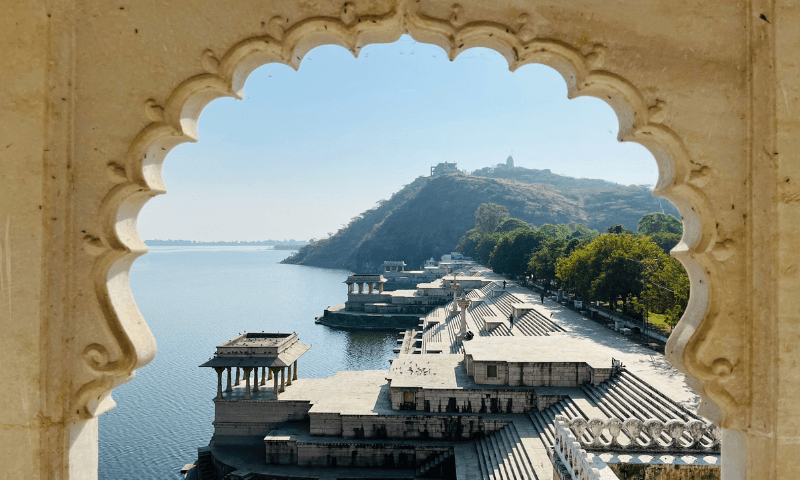
Most travellers passing through Rajasthan’s Mewar belt make the journey between Udaipur and Jodhpur without pausing in the district that sits quietly between the two. Rajsamand, roughly 67 kilometres north of Udaipur, is named after a 17th century artificial lake that was born not from royal vanity but from a famine relief effort. That fact alone sets the tone for what this region offers: heritage grounded in purpose rather than mere spectacle.
Maharana Raj Singh I commissioned the lake between 1662 and 1676 AD, damming three rivers to create a water body that would serve both agriculture and community welfare. What he also left behind was one of the most remarkable marble embankments in India, inscribed with the longest Sanskrit engraving known in the country. But the lake is only the starting point. The Rajsamand district also holds the UNESCO-listed Kumbhalgarh Fort, the legendary battlefield of Haldighati, the pilgrimage town of Nathdwara, and a cluster of temples and craft villages that reward slow, deliberate exploration.
This guide covers Rajsamand Lake and the heritage attractions that make this district one of Rajasthan’s most quietly rewarding destinations.
Rajsamand Lake, also known as Rajsamudra Lake, stretches approximately four miles in length and 1.7 miles in width, reaching depths of about 60 feet. It was created by constructing dams across the Gomati, Kelwa, and Tali rivers during a period when a devastating drought in 1661 had left the local population in severe distress. Maharana Raj Singh I designed the project with a dual purpose: to manage future water crises and to generate employment for affected communities. This is widely considered one of the earliest documented public relief works in Rajasthan’s history.
The lake’s southern embankment is where its architectural significance becomes immediately visible. Built entirely of white marble, this embankment features terraced stone steps (ghats) that descend into the water, along with five toranas (weighing arches) where the rulers of Mewar once performed the Tuladan ceremony, weighing themselves in gold and distributing the equivalent value among their subjects.
The centrepiece of the embankment is the Nauchowki Rajsamand, a series of nine intricately carved marble pavilions. The name draws from the number nine, which holds deep significance in Indian philosophy (linked to the concept of the nine planets). The dam itself was designed around the number: it originally measured 999 feet in length and 99 feet in breadth, with each step measuring nine inches. The pavilions are adorned with carvings of deities, the Sun God with his chariot, birds, and elaborate floral patterns.
Inscribed on 27 marble slabs along the lakeside ghats, the Raj Prasasti contains 1,017 stanzas detailing the history and lineage of the Mewar dynasty. It is recognised as the longest Sanskrit inscription in India. Princess Charumati, who belonged to another branch of the Sisodia family, commissioned the ornamental arches and pavilions as a gesture of gratitude towards Maharana Raj Singh I. The story behind this is notable in its own right: Raj Singh married Charumati to prevent her forced marriage to Mughal Emperor Aurangzeb, an act of political defiance that cemented his reputation across the region.
For readers exploring Rajasthan’s broader architectural heritage, the historical sites in India blog provides additional context.
Rajsamand district packs a remarkable concentration of heritage sites into a relatively compact area. Several of these are accessible as half-day or full-day trips from the lake.
Located approximately 84 kilometres north of Udaipur within the Rajsamand district, Kumbhalgarh Fort is the second most important citadel in the Mewar region after Chittorgarh. Built in the 15th century by Rana Kumbha, the fort is a UNESCO World Heritage Site and is most famous for its perimeter wall, which stretches roughly 36 kilometres and is often cited as the second longest continuous wall in the world after the Great Wall of China. The fort is also the birthplace of Maharana Pratap, Mewar’s most celebrated warrior king.
Inside the complex, visitors find palaces, temples, water storage structures, and the Badal Mahal at the fort’s highest point, offering sweeping views of the Aravalli hills. The Kumbhalgarh Wildlife Sanctuary surrounds the fort and shelters leopards, sloth bears, hyenas, and a wide variety of bird species. The annual Kumbhalgarh Festival, typically held in December, brings the fort alive with traditional performances and illuminations.
For a deeper look at Kumbhalgarh’s history and significance, the Kumbhalgarh Fort blog on Memorable India covers the fort in detail.
Roughly ten kilometres southeast of Rajsamand town lies Haldighati, the mountain pass where one of India’s most iconic battles took place in 1576. Maharana Pratap, with a smaller Rajput force, confronted the vastly superior Mughal army led by Man Singh on behalf of Emperor Akbar. The pass gets its name from the yellow soil that resembles turmeric (haldi), and walking through the valley today, you can still see the distinctive colouring of the terrain.
Near the battlefield stands the Chetak Smarak, a memorial to Maharana Pratap’s legendary horse Chetak, who carried his wounded master to safety before collapsing and dying at this spot. The Maharana Pratap Museum nearby brings the battle to life through weapons, armour, paintings, and dioramas. Haldighati is not a place of grand monuments. Its power lies in the landscape itself and the story it carries.
About 48 kilometres northeast of Udaipur sits Nathdwara, one of the most important Vaishnavite pilgrimage towns in India. The Shrinathji Temple, built in 1672, houses a black marble idol of Lord Krishna that is believed to be self-manifested. The idol was originally at Mathura and was brought to Mewar to protect it from the Mughal emperor Aurangzeb. According to local tradition, the chariot carrying the idol got stuck in the mud at Sihad village (now Nathdwara), which was interpreted as a divine signal that Lord Krishna wished to reside here.
The temple conducts eight daily darshan sessions, each presenting the deity in a different attire and ornaments. Nathdwara is also the birthplace of Pichwai paintings, intricate textile artworks depicting scenes from Krishna’s life, which are still produced by local artisans.
Situated on the banks of Rajsamand Lake itself, the Dwarkadheesh Temple at Kankroli is dedicated to Lord Krishna and is considered the third peeth (spiritual seat) of the deity after Dwarka and Nathdwara. Maharana Raj Singh I had the temple constructed in 1676, and it offers a peaceful alternative to the busier Nathdwara shrine. The temple’s location overlooking the lake makes it especially atmospheric during evening hours.
Those planning a wider Rajasthan pilgrimage or heritage circuit will find useful itinerary options on the Rajasthan tour packages.
Beyond forts and temples, the Rajsamand district has a thriving craft tradition that adds depth to any visit. Molela, a small village roughly 50 kilometres from Udaipur, is renowned for its terracotta art. Local potters here create detailed clay plaques depicting deities and folk motifs using techniques passed down through generations. Watching the artisans work and purchasing directly from them supports a craft tradition that is genuinely community-sustained rather than commercially staged.
Nathdwara itself functions as a craft hub for Pichwai paintings, which are created on cloth using natural pigments and fine brushwork. The town’s narrow lanes house workshops where artists produce these works for both devotional and decorative purposes.
Rajsamand is also India’s largest marble-producing district, and the landscape is dotted with quarries and processing units. While the marble industry is primarily commercial, it provides context for the region’s deep historical connection with stone craftsmanship, visible in the Nauchowki pavilions and the carved temples across the district.
Travellers interested in Rajasthan’s rural heritage will also appreciate the villages of Rajasthan blog on Memorable India.
Rajsamand shares the semi-arid climate of the broader Mewar region, so timing your visit for comfort and experience matters.
October to March is the ideal period. Temperatures during these months range from approximately 10 to 28 degrees Celsius, making fort climbs, lakeside walks, and temple visits pleasant. This window also coincides with the migratory bird season around the lake and the Kumbhalgarh Festival (usually in December), which adds a cultural highlight.
April through June brings intense heat, with temperatures routinely exceeding 40 degrees Celsius. The fort trek at Kumbhalgarh and outdoor exploration become strenuous during these months.
July through September is monsoon season. The Aravalli foothills turn green, and the lake swells, lending a different beauty to the landscape. Kumbhalgarh and its surrounding sanctuary look particularly lush during this period, though some outdoor plans may be disrupted by rain.
For most travellers, a visit between November and February offers the best balance of weather, access, and cultural events.
The nearest airport is Maharana Pratap Airport in Udaipur (Dabok), approximately 77 kilometres from Rajsamand town. The airport is connected to Delhi, Mumbai, Jaipur, and other major cities through domestic flights. From the airport, a hired car or taxi takes roughly an hour and a half.
Kankroli Railway Station is the nearest railhead, located about six kilometres from Rajsamand Lake. Udaipur and Nathdwara are also well-connected railway stations. Trains from Jaipur, Ahmedabad, and Delhi serve these stations.
National Highway 8 passes through Rajsamand, connecting it to Udaipur (67 kilometres south), Jodhpur, and Jaipur. Rajasthan State Road Transport Corporation operates regular bus services, and the drive from Udaipur takes roughly an hour via NH58. The road passes through typical Mewar terrain with Aravalli views and occasional glimpses of rural Rajasthani life.
Travellers building a multi-destination Rajasthan itinerary can explore structured options through the Rajasthan historical forts and palaces tour.
A few details that will help you plan a smoother visit to the heritage attractions in Rajsamand:
Two to three days is a comfortable duration to cover Rajsamand Lake, the Dwarkadheesh Temple, Haldighati, and either Kumbhalgarh or Nathdwara. If you want to cover all major sites, including Molela village, plan for four days.
Dress modestly at all temple sites, especially the Shrinathji Temple in Nathdwara and the Dwarkadheesh Temple at Kankroli. Photography is restricted inside most temple sanctums.
The climb to Kumbhalgarh Fort requires sturdy footwear and water. Start early to avoid midday heat, especially between October and March when mornings are cool but afternoons warm up.
Carry cash for smaller establishments, village markets, and temple offerings. Digital payment penetration is improving but remains inconsistent in rural areas.
Udaipur serves as an excellent base for exploring the Rajsamand district. Most sites are accessible as day trips, though an overnight stay in Kankroli or Nathdwara adds depth to the experience.
Rajsamand does not announce itself the way Rajasthan’s bigger cities do. There are no pink walls or blue lanes to photograph from a distance. What it offers instead is a concentration of heritage, devotion, and natural beauty that rewards travellers who choose depth over checklists. A lake built to save a community from famine. A fort wall that rivals the Great Wall of China. A battlefield that still carries the colour of its name. And a temple town where artisans paint Krishna’s stories on cloth the way their ancestors did centuries ago. Rajsamand is Mewar at its most layered and least hurried.
To build a custom itinerary that includes Rajsamand Lake and the surrounding heritage circuit, reach out to the team at Memorable India.
Frequently Asked Questions
Q1: What is Rajsamand Lake famous for?
Rajsamand Lake is famous for its 17th century white marble embankment called the Nauchowki (Nine Pavilions), which features intricate carvings of deities, the Sun God, and birds. The lakeside ghats also hold the Raj Prasasti, a 1,017-stanza Sanskrit inscription on 27 marble slabs, recognised as the longest such inscription in India. The lake was built by Maharana Raj Singh I as a famine relief project between 1662 and 1676 AD.
Q2: How many days are enough to explore Rajsamand and its heritage attractions?
Two to three days are sufficient to cover Rajsamand Lake, the Dwarkadheesh Temple at Kankroli, Haldighati, and one of the major sites such as Kumbhalgarh Fort or Nathdwara. To cover all key attractions including craft villages like Molela, four days is recommended.
Q3: What is the best time to visit Rajsamand?
The best time to visit Rajsamand is between October and March, when temperatures are pleasant and outdoor exploration is comfortable. The Kumbhalgarh Festival in December and migratory bird activity around the lake add seasonal highlights during this window.
Q4: How far is Rajsamand from Udaipur?
Rajsamand is approximately 67 kilometres north of Udaipur. The drive takes roughly one hour via NH58 and passes through scenic Mewar terrain with Aravalli hill views.
Q5: Can Rajsamand Lake and Kumbhalgarh Fort be visited together?
Yes, Rajsamand Lake and Kumbhalgarh Fort can be combined in a single itinerary, though they are best spread across two days for a more relaxed experience. Kumbhalgarh is located about 84 kilometres from Udaipur and roughly 50 kilometres from Rajsamand town.
Q6: What is the significance of Nauchowki at Rajsamand Lake?
The Nauchowki at Rajsamand Lake is a series of nine marble pavilions built on the lake’s southern embankment by Maharana Raj Singh I. The design is based on the sacred number nine in Indian philosophy, linked to the concept of the nine planets. The dam’s original measurements, step heights, and pavilion angles all follow multiples of nine. The pavilions are decorated with carvings of gods, celestial imagery, and ornamental patterns.
A Journey to Leh and Srinagar: Firsthand Travel Experience
25 Oct 2026
A Guide to Famous Temples in Himachal Pradesh
24 Oct 2026
9 Best Places to Visit in Lakshadweep, a Top Island Getaway in India
23 Oct 2026
7 Reasons Why One Should Travel by Indian Rail
22 Oct 2026
6 Reasons to Visit Chopta Valley in the Himalayas
21 Oct 2026


