 +919871148514
 info@memorableindia.com
Gir is one of those rare corners of India where the forest still writes its own rules. The dry deciduous woodland covers roughly 1,400 square kilometres of Saurashtra, and it holds a distinction no other habitat on the planet can claim: it is the last natural home of the Asiatic lion. That single fact draws wildlife lovers, but travellers who plan a broader route quickly realise the region rewards curiosity well beyond the safari gate. Sacred groves, medieval forts, coastal temples and a crocodile rearing centre all sit within comfortable driving distance of Sasan Gir village.
This guide walks through ten places worth building your Gir itinerary around, along with practical planning notes for a smoother trip.
The park core zone is the reason most travellers make the journey. Safaris run in shared open-top gypsies through six permit routes, each cutting through teak thickets, dry riverbeds and grassy openings where lions rest during the day. Sightings are not guaranteed, but the Asiatic lion population has recovered steadily, and most morning drives produce at least one big cat encounter along with sambar, chital, nilgai and marsh crocodile. Permits must be booked in advance through the official Gujarat forest department portal since walk-in slots rarely open during season.
Best time: mid October to early June (park closed 16 June to 15 October)
For travellers with tight schedules or those who miss out on core zone permits, Devalia is a strong backup. The 4.12 square kilometre enclosure sits about 12 kilometres from Sasan and functions as a fenced interpretation area holding lions, leopards, blackbuck and nilgai. Bus safaris last around 40 minutes and sighting probability is close to guaranteed, which makes this park a favourite for families with young children and senior travellers. It also stays open on Wednesdays, when the main sanctuary shuts.
Locals call it the lifeline of Gir. This reservoir sits inside the sanctuary and is one of the best places in the region to spot marsh crocodiles basking on the banks. Migratory water birds arrive in strong numbers between November and February, including painted storks, pelicans and various ducks. The dam is only accessible during permitted safari routes, so ask your driver to include it if your zone allocation covers this stretch. Photographers should carry a longer lens because most sightings happen across water.
Deep inside the sanctuary, roughly 25 kilometres from Sasan, sits Kankai Mata Temple. This is one of the very few working shrines within a protected forest in India, and Maldharis, the semi nomadic pastoral community that has coexisted with lions for generations, frequent it. The drive is bumpy and you need special permission, but the setting is unlike anything else on the itinerary: teak canopies, distant lion calls at dusk and simple temple meals served to visitors. Overnight stays are typically restricted, so plan a day trip.
About 60 kilometres from Sasan Gir, on the eastern edge of the sanctuary, Tulsishyam is a Krishna temple surrounded by natural sulphur hot springs. Three small kunds are separated by temperature, and pilgrims bathe here before darshan. The road passes through the buffer forest, and it is common to spot spotted deer and langurs along the way. The site is quiet outside major festivals, and the drive itself is an experience worth adding for travellers interested in a mix of pilgrimage and forest.
Right on the edge of Sasan village, the crocodile rearing centre is small, easy to visit and useful for context. It houses marsh crocodiles at various life stages and was established to strengthen wild populations in Kamleshwar Dam and connected water bodies. A quick visit takes about 30 minutes, and it fits neatly between morning safaris and afternoon rest. Entry fees are minimal, and it is one of the few Gir attractions open through the monsoon closure period.
Roughly 45 kilometres from Sasan Gir along the coast, Somnath is the first of the twelve Jyotirlingas and one of the most visited pilgrimage sites in western India. The current temple was reconstructed in 1951 and stands directly on the Arabian Sea. Evening aarti at around 7 pm is the most atmospheric slot, followed by the sound and light show that narrates the temple story of destruction and rebuilding. Triveni Sangam, where three rivers meet the sea, is a short walk away and adds a quiet counterpoint to the main complex. Travellers combining wildlife with faith often add Somnath through a curated route like the Gujarat temples with safari tour.
Junagadh sits about 60 kilometres north of Sasan and rewards a full day. Uparkot Fort, believed to have been founded during the Mauryan period, holds ancient stepwells (Adi Kadi Vav and Navghan Kuvo), Buddhist rock cut caves and cannons that have watched over the plateau for centuries. The Ashokan Rock Edicts, carved on a large boulder along the road to Girnar, are among the oldest surviving inscriptions in India. Mahabat Maqbara, an Indo Islamic mausoleum with spiralling minarets, is worth stopping for, especially in soft afternoon light.
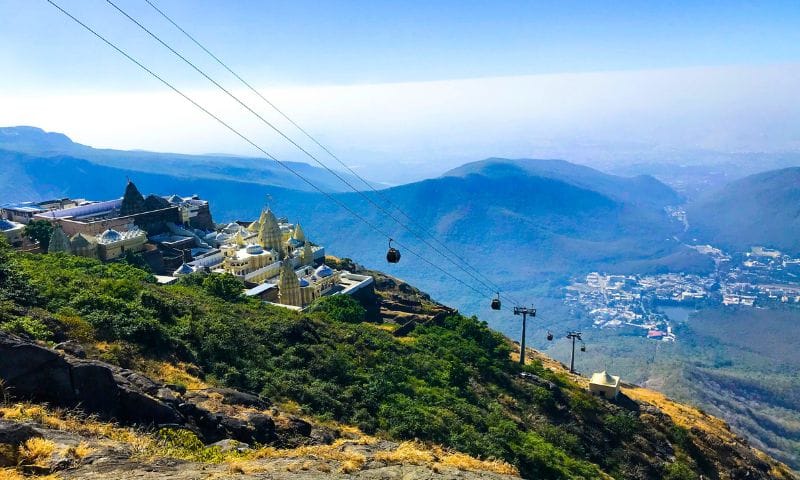
Girnar rises just outside Junagadh and holds significance for both Jain and Hindu pilgrims. The climb up nearly 10,000 stone steps takes traditional pilgrims around five to seven hours one way, but a ropeway now covers the main stretch and reduces the effort dramatically. The summit rewards clear views of the Saurashtra plains, and the cluster of Jain temples on the fifth peak is architecturally stunning. Start early because the site gets warm and crowded after mid morning, and carry water even if you plan to use the cable car.
For monsoon and post monsoon travellers, Zamzir Waterfall near Jamvala village is a rewarding detour about 20 kilometres from Sasan. The falls run strong between August and November, cutting through basalt rock in a small canyon. The last stretch involves a short walk across uneven terrain, so wear grippy footwear. This is not a heavily promoted spot, which is exactly why it works well for travellers who want a quieter half day away from the safari circuit.
A three to four night stay in Sasan Gir is usually the right length to cover the core sanctuary, Devalia, the crocodile centre and one or two coastal or heritage additions. Travellers with more time often extend into a wider Saurashtra loop covering Somnath, Junagadh, Diu and even Dwarka. A ready made Gujarat wildlife tour package can help stitch these together without the planning fatigue.
Key practical points to keep in mind:
For a broader picture of what to combine on a Saurashtra trip, our guide to the best places to visit in Gujarat offers a state wide overview.
Gir works best when travellers give it room to unfold. The lions are the obvious pull, but the surrounding landscape holds enough spiritual, historical and natural depth to fill three to five unhurried days. Combine a couple of safaris with a coastal aarti at Somnath, a slow morning at Uparkot Fort and a monsoon detour to Zamzir, and the region delivers a rounded picture of Saurashtra rather than a single sighting story. To plan a tailored Gir tour itinerary that fits your dates and interests, get in touch with our team through the Memorable India contact page.
The most reliable window is December to March when the weather is comfortable and lion sightings peak around waterholes. April and May are hotter but sighting probability is highest of the year. The park is closed from 16 June to 15 October for the monsoon.
Three nights and four days is the sweet spot. That gives you two to three core safaris, a Devalia visit, the crocodile centre and one day for either Somnath or Junagadh. Add a night if you want to cover both.
Yes. Devalia Safari Park is particularly good for young children and seniors since sightings are near guaranteed and bus safaris are shorter and more comfortable than open gypsy drives. Sasan Gir also has a range of accommodation from budget stays to premium resorts.
Yes. Permits are issued online through the Gujarat forest department portal and often sell out during peak months. Book at least 60 days ahead for December to March travel to secure your preferred zone and slot.
Somnath is about 45 to 50 kilometres from Sasan Gir by road, roughly a one hour and fifteen minute drive. It works comfortably as a half day or full day extension from your Gir base.
The core sanctuary is closed from 16 June to 15 October. During this period, Devalia Safari Park, the crocodile breeding centre, Somnath, Junagadh and Zamzir waterfall remain accessible, so a shorter monsoon itinerary in the Gir region is still workable.
12 Top Tourist Destinations in Jammu and Kashmir for a Memorable 2026 Trip
13 Oct 2026
12 Tips to Remember Before Holidaying in the Northeast Indian States
11 Oct 2026
10 Things to Do on a Family Vacation in Shimla, Himachal Pradesh
09 Oct 2026
10 Days in India: Where to Go and What to See
05 Oct 2026
10 Best Places in North India for Corporate Outings to Recharge and Build Team Spirit
01 Oct 2026


