 +919871148514
 info@memorableindia.com
Tripura is the third-smallest state in India, wedged between Bangladesh on three sides and the Indian states of Assam and Mizoram on the fourth. That geographic squeeze gives it a density of culture and landscape that larger northeastern states spread more thinly. Within a state smaller than many Indian districts, you find a royal Mughal-style palace in the capital, a water palace floating on a lake, 7th-century rock carvings on a jungle hillside, tribal villages where Kokborok-speaking communities maintain weaving traditions unchanged for generations, and a hill station at 1,000 metres where the orange orchards bloom in November.
Tripura’s tourism infrastructure is developing but still modest. That modesty is part of the appeal. Visitor numbers are a fraction of what Meghalaya or Assam receive, which means that the state’s most remarkable sites, particularly Unakoti and Neermahal, are experienced without crowd management or ticket queues. For travellers who have already covered India’s mainstream circuits and want something genuinely off the standard map, Tripura delivers with a quiet confidence.
The Ujjayanta Palace, built in 1901 by Maharaja Radha Kishore Manikya, is Agartala’s most prominent landmark. The white Indo-Saracenic structure, named by Rabindranath Tagore, sits in the centre of the city surrounded by Mughal-style gardens with musical fountains and artificial lakes. The palace now houses the Tripura Government Museum, whose galleries cover the state’s tribal heritage, royal history, and archaeological finds in over 1,400 artefacts, from terracotta plaques to copper plates to gold ornaments.
The museum is a strong first stop because it provides the cultural context that makes the rest of Tripura’s sights more legible. The tribal gallery, in particular, introduces the 19 indigenous communities whose traditions you will encounter in the villages and hill stations outside Agartala.
Heritage Park, adjacent to the palace grounds, is the first heritage park in India’s Northeast. It displays miniature replicas of Tripura’s key monuments, including Neermahal, the Unakoti carvings, and the Chaturdash Devta Mandir, alongside tribal sculptures, bamboo installations, and landscaped gardens. The Jagannath Temple within the Ujjayanta Palace compound blends Hindu and Islamic architectural elements and is one of Agartala’s most visited religious sites.
A day in Agartala covering the palace, museum, Heritage Park, and the Battala Market (the city’s main commercial area) provides a grounded introduction before heading to the rural and archaeological sites.
For a broader understanding of how Agartala fits within a northeast India itinerary, the existing Tripura cultural guide covers the state’s food, festivals, and local character in detail.
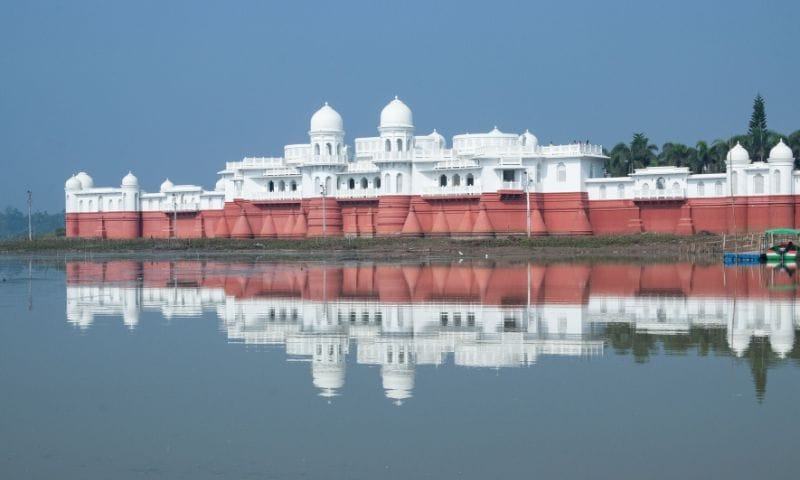
Neermahal, 53 kilometres south of Agartala near Melaghar, is a palace built in the middle of Rudrasagar Lake. Constructed in 1930 by Maharaja Bir Bikram Kishore Manikya as a summer residence, it combines Hindu and Mughal architectural styles across two wings: a rounded tower section (the Andar Mahal, or inner quarters) and a flat-roofed open wing (the dance hall and reception areas).
Access is by motorboat from the lakeshore, and the approach across the water, with the palace growing larger against a backdrop of palm trees and distant hills, is one of the more cinematic arrivals at any Indian monument. The palace is partially restored, and some wings remain closed, but the open sections and the roof terrace offer views across the lake and surrounding wetlands. The annual Neermahal Tourism Festival in August or September adds boat races and cultural performances.
Rudrasagar Lake itself was designated a Ramsar Wetland of International Importance in 2005 and supports a population of migratory birds during winter months.
Unakoti, 178 kilometres northeast of Agartala near Kailashahar, is the site that most clearly separates Tripura from the standard northeast India itinerary. The hillside here holds massive rock-cut reliefs and stone sculptures of Shiva, Ganesha, Nandi, and other Hindu deities, some dating to the 7th century. The largest carving, a face of Shiva known as Unakotiswara Kal Bhairava, measures roughly 30 feet in height and emerges directly from the rock face, flanked by smaller figures.
The name Unakoti translates to “one less than a crore” (9,999,999), a reference to the legend that the site holds that many images. The actual count is far smaller, but the scattered carvings, spread across a forested hillside with natural springs and waterfalls, create an atmosphere that is simultaneously archaeological, spiritual, and wild. The site is on India’s tentative UNESCO World Heritage list. Visiting requires a full-day trip from Agartala or an overnight stay in Kailashahar.
Pilak, in the Belonia subdivision of south Tripura, is an archaeological site where Hindu and Buddhist artefacts coexist, dating from the 8th and 9th centuries. Stone and bronze sculptures of Avalokiteshvara, Narasimha, and other figures have been excavated here, suggesting that the region was a meeting point of Hindu and Buddhist cultures during the Pala period. The site is small and undeveloped, which means you are essentially walking through rice paddies and bamboo groves to reach scattered ruins. That rawness is part of its character.
Chabimura, also called Devtamura, is a riverside cliff on the Gomati River in Amarpur subdivision where rock-cut panels depict Shiva, Vishnu, Kartik, and other deities carved directly into the cliff face above the waterline. Access is by boat along the Gomati, and the approach by water, with the carved panels appearing gradually as the boat rounds a bend, is one of the more memorable arrival sequences at any archaeological site in India. The carvings are less monumental than Unakoti but more atmospheric due to the river setting.
Jampui Hills, roughly 220 kilometres north of Agartala on the Mizoram border, is the highest hill range in Tripura at approximately 1,000 metres. The hills are home to the Lushai and Reang tribal communities and are known for their orange orchards, which bloom in November and draw visitors for the annual Orange and Tourism Festival.
The climate at Jampui is distinctly cooler than the lowlands, and the sunrise and sunset views from the ridge, looking across rolling hills into Mizoram, are consistently described as the most beautiful vistas in the state. The village of Vanghmun, the main settlement on the ridge, has basic guesthouses and a hospitality that reflects the region’s isolation. Jampui is the part of Tripura that feels most like a hill station, though it operates at a pace and scale far removed from the commercial hill stations of Himachal or Uttarakhand.
Located 25 kilometres south of Agartala, Sepahijala is a compact wildlife sanctuary that houses primates (including the spectacled langur and capped langur), clouded leopards, and a significant bird population. The sanctuary also has a zoo section, botanical gardens, and a lake. For visitors who are not planning a trip deeper into the state, Sepahijala offers a manageable half-day nature outing from the capital.
Dumboor Lake, 115 kilometres from Agartala in the Amarpur subdivision, is a natural lake surrounded by hills and 48 small islands. The lake is sacred to the Reang tribal community, and the annual Garia Puja festival, held on the lake’s shores in April, involves traditional dances, boat races, and community feasting. Outside festival season, Dumboor is quiet, scenic, and largely unvisited by tourists.
The Tripura Sundari Temple in Udaipur, 55 kilometres south of Agartala, is one of the 51 Shakti Peethas and one of the most important Hindu temples in the northeast. The temple sits on a hilltop above Kalyan Sagar lake, and its red-painted kul (sanctum) has a distinct architectural style found only in Tripura. The temple draws pilgrims year-round, and the Diwali celebrations here are among the most attended in the state.
The Chaturdash Devta Mandir (Temple of Fourteen Gods), six kilometres from Agartala in Old Agartala, is the principal temple of the Manikya dynasty. The rectangular temple houses 14 deities worshipped by the royal family, and the annual Kharchi Puja in July, a week-long festival involving animal sacrifice and tribal rituals, is one of Tripura’s most significant cultural events.
Tripura’s 19 indigenous tribal communities, including the Tripuri, Reang, Jamatia, Chakma, and Halam, maintain distinct traditions in weaving, bamboo craft, and cuisine. The Tripura State Tribal Museum in Agartala provides an introduction, but the living experience comes from visiting tribal villages in the Jampui, Amarpur, and Dhalai districts. Traditional Tripuri food centres on fermented fish (sidol), bamboo shoot preparations, and rice-based dishes that differ markedly from the Bengali cuisine dominant in Agartala’s restaurants.
Travellers interested in tribal culture across the northeast can explore Memorable India’s tribal tours in India, which cover indigenous communities across Arunachal Pradesh, Nagaland, and other northeastern states.
Maharaja Bir Bikram Airport in Agartala has direct flights from Kolkata (1 hour), Delhi (via Kolkata or Guwahati), and Guwahati. Agartala is also connected by rail on the Lumding-Sabroom line, though train journeys from Kolkata take over 20 hours. The most efficient approach for out-of-state visitors is to fly into Agartala and use road transport within the state.
October to March is the most comfortable window, with temperatures between 10 and 28 degrees Celsius, dry weather, and clear skies. November is particularly rewarding if you are heading to Jampui Hills for the Orange Festival. The monsoon (June to September) brings heavy rain that can disrupt road travel to northern and southern Tripura.
Five to seven days covers Agartala, Neermahal, Unakoti, and Jampui Hills at a comfortable pace. Adding Pilak, Chabimura, and Dumboor Lake extends the trip to 10 days. The distances within Tripura are not large (the state is roughly 180 kilometres north to south), but road speeds on hill routes are slow, averaging 30 to 40 kilometres per hour.
The Northeast India tours page covers multi-state itineraries that combine Tripura with Meghalaya, Assam, and other northeastern states.
Tripura does not compete for attention in the way that India’s mainstream destinations do. It has no marketing machine, no Instagram-famous viewpoint, and no international flight connection. What it has is a concentration of historical, archaeological, and cultural interest that is disproportionate to its size and almost entirely undiluted by mass tourism. The water palace at Neermahal, the hillside carvings at Unakoti, and the tribal village life at Jampui Hills are experiences that belong on a serious India itinerary, and the fact that most serious India itineraries do not yet include them is precisely the opportunity.
Memorable India’s northeast specialists design customised Tripura itineraries with guides, private transfers, and extensions to Meghalaya, Assam, and Mizoram. Get in touch to start planning.
Tripura is generally safe for tourists, including solo travellers. The state has seen significant improvements in infrastructure and connectivity in recent years. Standard travel precautions apply. Agartala and the main tourist routes are well connected and regularly patrolled.
Indian citizens do not need any special permit. Foreign nationals should check current Inner Line Permit (ILP) requirements with the Ministry of Home Affairs before travelling, as regulations for northeast India can change.
October to March offers the most comfortable weather. November is ideal for Jampui Hills (Orange Festival and pleasant hill temperatures). Avoid June to September if possible, as heavy monsoon rain can disrupt road travel, particularly to northern and southern Tripura.
Five to seven days covers the main sights: Agartala (2 days), Neermahal (half day), Unakoti (1 to 2 days including travel), and Jampui Hills (2 days). Ten days allows for southern Tripura additions like Pilak, Chabimura, and Dumboor Lake.
Bengali cuisine dominates Agartala’s restaurants: fish curry, rice, and sweets. Tribal Tripuri food is distinct and worth seeking out: sidol (fermented fish paste), berma (dried fish), bamboo shoot dishes, and rice beer (chuak). The pineapple from Kumarghat and oranges from Jampui Hills are seasonal highlights. Sherawali Travels in Agartala operates a sweet shop with over 50 varieties.
Tripura combines naturally with Meghalaya (via Guwahati flights) and Mizoram (road connection from Jampui Hills or Aizawl). A two-week northeast circuit covering Tripura, Meghalaya, and Assam is a well-tested route. Flights from Agartala to Guwahati or Kolkata provide easy onward connections.
The northeast India trekking and nature trails guide covers adventure options across the region.
15 Amazing Temple Fairs in India: A Traveller’s Guide to Faith, Colour and Living Tradition
30 Sep 2026
13 Best Places to Explore in the Youngest State of Telangana
29 Sep 2026
12 Less Explored Destinations in Maharashtra Worth Adding to Your Travel List
28 Sep 2026
11 Must-Visit Museums in India for Wildlife Lovers
27 Sep 2026
11 Best Places in India to Celebrate Christmas
26 Sep 2026


