 +919871148514
 info@memorableindia.com
Central India rarely tops the postcard shortlist, and that is largely why it rewards the traveller who actually shows up. Madhya Pradesh and its neighbours hold three UNESCO World Heritage Sites, a cluster of the country’s finest tiger reserves, a caravan geography of forts and river towns, and prehistoric rock shelters older than most written histories. The circuit is compact enough to plan across two weeks and varied enough that no two days feel similar. This guide covers ten places to visit in central india that consistently deliver on the reasons travellers come here in the first place: dense sculpture, working temples, dependable wildlife, and heritage that has not been over-restored into a theme park. Distances are honest, seasons matter more than in most Indian regions, and a mixed itinerary works better than one built around a single theme. What follows is the shortlist that regularly earns its place on our Madhya Pradesh circuits.
The Khajuraho Group of Monuments is a UNESCO World Heritage Site and the reason most heritage travellers begin their Central India route here. Built by the Chandela dynasty between 950 and 1050 CE, only around 20 temples survive of an original 85. The Western Group holds the star attractions, including Kandariya Mahadev, the tallest and most finely carved. Give it a full day: an unhurried morning walk through the Western Group, the archaeological museum before lunch, and the Eastern Group of Jain temples in the afternoon. The evening sound and light show inside the complex is worth attending once. Khajuraho has a small domestic airport with flights from Delhi and Varanasi, and is well-connected by road to Orchha and Panna. Winter, October through February, is the sensible window. The annual Khajuraho Dance Festival in February stages classical performances against the temple facades and is worth planning around if the dates align.
Ujjain sits on the Shipra river and holds Mahakaleshwar, one of the twelve Jyotirlingas. The Bhasma Aarti performed before dawn is the most sought-after ritual in the temple’s daily cycle, and slots require advance booking through the temple trust. Beyond Mahakal, walk to Kal Bhairav temple, Harsiddhi Shakti Peeth, and the Ram Ghat at sunset. Ujjain also hosts the Simhastha Kumbh Mela every twelve years, which draws millions of pilgrims and returns in 2028. Two working nights are usually enough. The city is 55 kilometres from Indore, which has the closest major airport and rail hub, making Ujjain a natural bookend for travellers doing an Indore, Mandu, and Maheshwar loop through western Madhya Pradesh.
Orchha, founded in the 16th century as the Bundela capital, sits on the banks of the Betwa and remains one of the more atmospheric heritage towns in Central India. The Jehangir Mahal, Raj Mahal, and Rai Praveen Mahal cluster inside the fort complex, and the chhatris (royal cenotaphs) along the river are best photographed at first light. Ram Raja Temple is unusual for being a functioning palace-turned-temple where Lord Ram is worshipped as a king, and the daily armed guard change is a genuine ritual, not staged for visitors. Orchha sits 15 kilometres from Jhansi railway station, which puts it within reach of the Bhopal Shatabdi from Delhi. Most travellers pair it with Khajuraho as part of a broader circuit. Our 5-day Orchha, Khajuraho and Panna itinerary handles the logistics for anyone travelling on limited time.
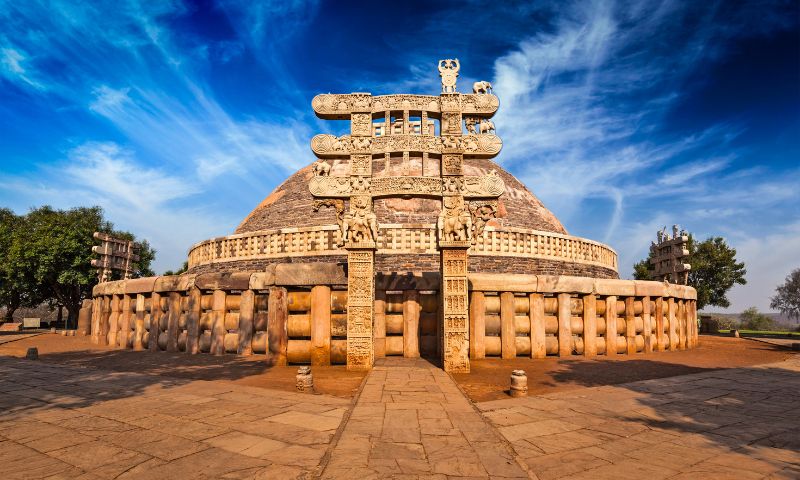
Sanchi’s Great Stupa was commissioned by Emperor Ashoka in the 3rd century BCE, and the site is now a UNESCO World Heritage listing. The four toranas (gateways) carved with Jataka scenes are the reason to make the detour, and the site remains one of the least crowded major heritage complexes in the country. Half a day covers the main stupa, the associated monasteries, and the small archaeological museum. Sanchi is 46 kilometres from Bhopal, which has good rail and air connectivity and works as a base. Combine it with a day trip to Bhimbetka, which sits on the opposite side of Bhopal, to make the driving time worthwhile.
Gwalior Fort dominates the sandstone plateau above the old city and was famously called the pearl amongst fortresses in India by Mughal chroniclers. Man Singh Palace inside the fort, with its glazed tile facade, is the standout, followed by the Sas Bahu temples and Teli ka Mandir. The Jai Vilas Palace museum, still partly occupied by the Scindia family, holds enormous chandeliers and a functioning silver train that once served royal dinners. Tansen’s tomb in the old town is a quieter stop, and the Sarod Ghar museum offers useful context on Gwalior’s role in Hindustani classical music. Gwalior is on the Delhi to Bhopal rail corridor with fast Vande Bharat and Shatabdi services, making it a logical first stop for travellers building a north-to-south heritage route.
The Bhimbetka rock shelters sit 45 kilometres south of Bhopal and contain paintings that span the Mesolithic period to the medieval era. UNESCO lists Bhimbetka among the oldest continuously used sites of human occupation on the subcontinent. Around 15 shelters are open to visitors, with the well-known Zoo Rock and the Auditorium Cave among the highlights. It works well as a half-day trip from Bhopal, ideally paired with a stop at the 11th-century Bhojeshwar temple nearby. Wear closed shoes, carry water, and go early to avoid the midday sun on the exposed sandstone.
Pachmarhi sits at around 1,067 metres in the Satpura range and works best as a slower, greener counterpoint to the heavier heritage days. The main draw is a mix of colonial-era churches, waterfalls (Bee Falls, Rajat Prapat), viewpoints (Dhupgarh is the highest point in Madhya Pradesh), and Buddhist caves linked to the Pandava legend. Jata Shankar cave, a natural rock shrine dedicated to Shiva, sees genuine pilgrim traffic. The town connects to Piparia railway station, roughly 47 kilometres away, and the drive up gains elevation quickly. Two full days cover the main sights. Monsoon is dramatic but many trails close, so October through March is the more reliable window.
Kanha spreads across 940 square kilometres of sal and bamboo forest and remains one of the best-managed reserves in India. It is home to the endemic Barasingha (hard-ground swamp deer), pulled back from near-extinction here through decades of protection work by the forest department. Tiger sightings are more consistent between March and June, when water sources shrink and animals move predictably, but the forest is at its most photogenic just after the reserve reopens in October. Book jeep safaris in advance through the official MP Forest Department portal, as permits are limited by zone. The nearest airports are Jabalpur (160 kilometres) and Nagpur (300 kilometres). Kanha pairs naturally with Bandhavgarh or Pench on a longer wildlife loop.
Bandhavgarh is smaller than Kanha but holds one of the highest densities of Bengal tigers of any reserve in India, according to the National Tiger Conservation Authority. The Tala zone historically produces the most consistent sightings, though Magadhi and Khitauli have delivered strongly in recent seasons. Beyond the tigers, the reserve contains a 2,000-year-old hilltop fort and a set of 1st-century AD rock-cut caves that most visitors miss. Three nights, minimum, is the honest recommendation, with morning and afternoon safaris booked across different zones. The park stays open from mid-October to June 30 and closes fully during monsoon. For a deeper breakdown, our Bandhavgarh National Park guide covers zones, timings, and seasonal patterns.
Pench straddles the Madhya Pradesh and Maharashtra border, and inspired Rudyard Kipling’s Jungle Book landscape. The Turia gate on the MP side is the more established entry, though the Maharashtra side has developed strongly over the past decade. Sightings include tiger, Indian gaur, wild dog, and over 285 recorded bird species. Pench works well as an add-on for travellers already on the Kanha or Bandhavgarh route, and Nagpur airport, 90 kilometres away, offers the easiest access. Two nights are usually enough. Book safaris through the official MP Tourism portal to avoid third-party markups.
The main practical decisions come down to season, sequence, and pace. October to March covers heritage and wildlife comfortably. April to June is hot but the best window for tiger sightings. Monsoon (July to September) closes most reserves but suits Pachmarhi, Mandu, and the Betwa river towns.
For sequencing, most travellers do well running north to south: Gwalior, Orchha, Khajuraho, Bandhavgarh, Kanha, then either Pench or a westward turn towards Bhopal, Sanchi, Bhimbetka, Ujjain, and Indore. Two weeks covers this cleanly. Ten days requires cuts.
Fly into Delhi or Mumbai, exit from Nagpur, Jabalpur, or Indore. Internal transfers work best by private car with an experienced driver, as highways are generally good but signage can be inconsistent once you leave the arterial routes.
The strength of these central india tourist destinations lies in how well they combine. A single itinerary can move from Chandela sculpture to Mughal-era forts, from Ashokan stupas to prehistoric caves, and then into tiger country without ever feeling rushed. That range is unusual, and it is what makes the region a genuine alternative to the more travelled circuits of Rajasthan and the south. Memorable India has been building these routes for two decades. For a route tailored to your dates, group, and interests, get in touch with our team or browse our full range of Madhya Pradesh tours to see how a working itinerary comes together.
October to March is the most reliable window for heritage sites, with cool mornings and clear skies. For wildlife, extend into April, May, and early June, when tiger sightings peak as animals gather at shrinking water sources. Monsoon (July to September) closes most reserves but suits hill stations like Pachmarhi and heritage river towns such as Mandu.
A well-paced first visit needs 12 to 14 days to cover the main heritage sites (Gwalior, Orchha, Khajuraho, Sanchi, Bhimbetka) alongside two wildlife parks. Ten days is possible with tighter cuts. For a heritage-only or wildlife-only trip, seven to eight days works.
Bandhavgarh has higher tiger density and typically produces sightings faster, while Kanha has larger forests, better-managed zones, and a broader ecosystem including the endemic Barasingha. Serious wildlife travellers usually visit both, spending three nights at each reserve.
Most are. Mahakaleshwar in Ujjain, Ram Raja in Orchha, and the Kandariya Mahadev in Khajuraho all see daily rituals. Dress modestly, remove shoes at the entrance, and follow photography restrictions where posted. Sanchi and Bhimbetka are archaeological sites rather than active places of worship.
The main tourist circuits are considered safe, and heritage towns such as Orchha, Khajuraho, and Sanchi are used to independent visitors. Standard precautions apply: avoid isolated areas after dark, book verified accommodation, and use registered transport. Wildlife lodges and heritage hotels along the main routes have good safety records.
It depends on your entry point. Bhopal serves Sanchi and Bhimbetka, Khajuraho has its own domestic airport, Jabalpur and Nagpur serve the tiger reserves, and Indore is the western gateway for Ujjain and Mandu. Delhi is the most common starting point for full circuits, connecting to Gwalior by fast train in around three hours.

A Guide to Exquisite Indian Handicrafts and Where to Buy Them in India
26 Oct 2026
A Journey to Leh and Srinagar: Firsthand Travel Experience
25 Oct 2026
A Guide to Famous Temples in Himachal Pradesh
24 Oct 2026
9 Best Places to Visit in Lakshadweep, a Top Island Getaway in India
23 Oct 2026
7 Reasons Why One Should Travel by Indian Rail
22 Oct 2026


