 +919871148514
 info@memorableindia.com
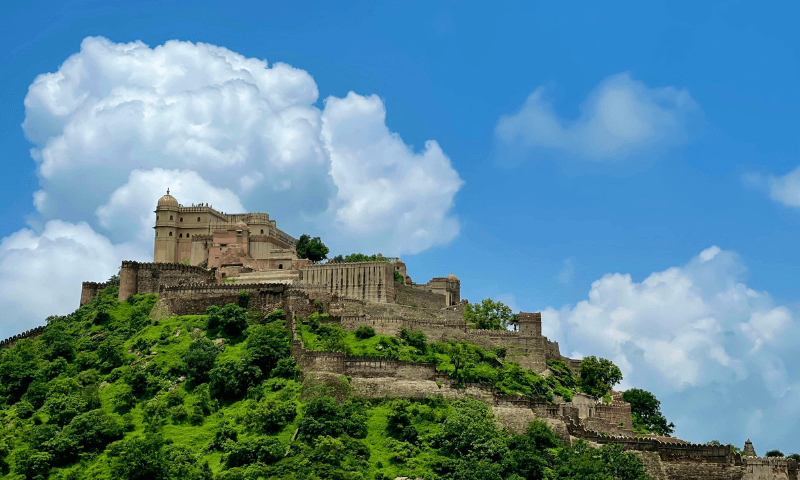
Roughly 84 kilometres north of Udaipur, cradled within the rugged folds of the Aravalli hills, Kumbhalgarh Fort commands attention long before you reach its gates. Its perimeter wall, often called the Great Wall of India, runs for approximately 36 kilometres across ridges and valleys, making it one of the longest continuous fortification walls anywhere in the world outside China. And yet, compared to the tourist traffic at Amber or Mehrangarh, Kumbhalgarh remains relatively unhurried, a fact that works entirely in a visitor’s favour.
Built in the 15th century by Rana Kumbha of Mewar, this fort served as both a military stronghold and a royal retreat. It is the birthplace of Maharana Pratap, one of the most revered figures in Rajput history. Today, the fort complex and its wall are part of the Hill Forts of Rajasthan UNESCO World Heritage Site, a designation shared with five other Rajasthani forts including Chittorgarh and Jaisalmer.
This guide walks you through the fort’s layered history, its architectural highlights, the surrounding wildlife sanctuary, and practical planning details so you can make the most of your visit to this underrated Rajasthan heritage fort.
Kumbhalgarh Fort was constructed during the reign of Rana Kumbha, the powerful Mewar ruler who is credited with building or reinforcing 32 of the 84 fortifications across Mewar. Construction began around 1443 and continued over a period of roughly 15 years. The fort takes its name directly from Rana Kumbha himself, and it quickly became the most important fort in the Mewar region after Chittorgarh.
The strategic location was not accidental. Perched at over 1,100 metres above sea level, the fort offered a natural defensive advantage. Its thick walls, steep approaches, and multiple gateways made it nearly impregnable. According to historical accounts, the Sultanate forces under Muhammad Khilji attacked the fort in 1458 and again in 1467, but failed to breach it on both occasions.
The fort’s military record remained formidable for over a century. It was only in 1567 that a combined force, reportedly involving armies of Akbar’s generals, managed to capture the fort. However, in 1585, Maharana Pratap recaptured Kumbhalgarh, reinforcing its place in Rajput lore as a symbol of resistance. The fort eventually came under Mughal control again in 1615, before being returned to the Udaipur state after the departure of the British.
Kumbhalgarh also holds deep personal significance for the people of Mewar. It is widely regarded as the birthplace of Maharana Pratap, who was born here in 1540. This connection between the fort and one of India’s most celebrated warriors adds a layer of emotional weight that most visitors feel even before they begin their exploration. For history enthusiasts planning a wider circuit, the Rajasthan Historical Tour covers several such heritage forts and palaces across the state.
The single most defining feature of Kumbhalgarh Fort is its massive perimeter wall. Stretching approximately 36 kilometres around the fort complex, the wall is broad enough in most sections for eight horses to ride abreast. At its widest, the wall measures roughly 15 feet across. This is the structure that has earned the fort the title of the Great Wall of India, and it remains the second longest continuous wall in the world after the Great Wall of China.
What makes this wall remarkable is not just its length but its engineering context. Unlike a flat boundary wall, the Kumbhalgarh Fort wall climbs and dips across the uneven terrain of the Aravallis, following ridgelines and descending into valleys. It encloses the entire fortified area, which houses over 360 temples, numerous palaces, gardens, and step wells within its boundaries.
The wall also incorporated seven fortified gateways, known locally as pols. Each gateway was designed as a defensive chokepoint, with sharp turns and narrow passages meant to slow any advancing army. These gateways were not merely architectural flourishes; they were calculated military features. Visitors today pass through these same gateways as they make their way up to the main citadel, and the experience of moving through those tight, angled passages still carries a sense of the fort’s original defensive purpose. If you are interested in how Rajasthan’s forts were engineered for warfare and governance, the Popular Forts in Rajasthan covers several notable examples across the state.
Positioned at the highest point within the fort complex, Badal Mahal is arguably the most visually striking structure inside Kumbhalgarh. Built by Rana Fateh Singh in the 19th century, this two-storeyed palace is divided into two distinct but interconnected sections: the Zanana Mahal, reserved for the royal women, and the Mardana Mahal, used by the male members of the royal household. From the upper terraces, the views extend across the Aravalli range in every direction. On a clear day, you can see the sand dunes of the Thar Desert to the west and the green expanse of the Kumbhalgarh Wildlife Sanctuary spread below.
The fort encloses over 360 temples, a number that surprises most first-time visitors. These include both Hindu and Jain shrines, reflecting the religious pluralism that characterised Mewar’s rulers. Among the most notable are the Neelkanth Mahadev Temple, dedicated to Lord Shiva, and the Vedi Temple, a significant Jain shrine. Many of these temples date back to the period of Rana Kumbha himself, and their carvings reveal a high degree of sculptural skill that rivals what you find at the more famous Ranakpur Jain Temple, located about 50 kilometres away.
One of the most fascinating yet frequently overlooked features of the fort is its ancient step well, or baoli. Hidden within the citadel, this step well was a critical water source during prolonged sieges. Reaching it requires a bit of scrambling and is not on the standard tourist path, which makes it all the more rewarding for those willing to explore. The step well was protected by its own fortified wall, a detail that speaks volumes about its strategic importance.
Each of the seven pols at Kumbhalgarh has its own name and history. The Aret Pol, Hulla Pol, Hanuman Pol, and Ram Pol are among the most prominent. Each gateway was designed to break the momentum of attackers, with sharp bends and elevated positions for defenders.
The fort sits within the boundaries of the Kumbhalgarh Wildlife Sanctuary, which covers a substantial area of the Aravalli hills. This sanctuary is home to wolves, leopards, sloth bears, chinkaras, nilgai, and a variety of bird species. The forest area surrounding the fort provides a green, scenic contrast to the arid desert landscape that dominates much of Rajasthan.
Visitors can explore the sanctuary through jeep safaris or guided treks. The best months for wildlife sighting are December through March, when animal activity is higher and vegetation is sparser, improving visibility. If you are planning to include the sanctuary in your visit, the Kumbhalgarh Wildlife Sanctuary guide provides detailed information on forest guest houses, safari options, and seasonal wildlife behaviour.
Combining a visit to the fort with a half-day safari in the sanctuary makes for a well-rounded day trip that balances history, architecture, and natural heritage. For travellers interested in broader Rajasthan wildlife circuits, the state also offers premier reserves like Ranthambore and Sariska, which are covered under Memorable India’s dedicated wildlife tour packages.
Every December, the Kumbhalgarh Festival brings the fort complex to life with folk music performances, traditional Rajasthani dance, artisan craft displays, and heritage walks. The festival is typically held over three days and draws performers from across Rajasthan. Against the dramatic backdrop of the fort’s floodlit walls, the festival offers a rare opportunity to experience Mewar’s living culture in an authentic, non-commercialised setting.
If your travel dates align with the festival, it is worth adjusting your itinerary to include it. The evening performances, in particular, are memorable. The fort walls serve as a natural amphitheatre, and the acoustics are surprisingly effective. For a broader look at December festivals across India, the Fairs and Festivals of India in December guide covers several options worth considering.
The most comfortable months to visit Kumbhalgarh are October through March, when daytime temperatures range between 10 and 25 degrees Celsius. Winter mornings can be cool, especially at the fort’s elevation, so carrying a light jacket is advisable. This period also coincides with the Kumbhalgarh Festival in December, adding a cultural dimension to your trip.
The summer months from April through June can be intensely hot, with temperatures crossing 40 degrees Celsius. While the fort is still accessible, the heat makes extended exploration tiring, particularly the climb to Badal Mahal.
The monsoon season from July through September brings lush greenery to the Aravallis and fills the sanctuary’s streams, making the landscape exceptionally scenic. However, some trails within the wildlife sanctuary may be restricted during heavy rains. If you are specifically interested in monsoon travel, visiting during late September offers a good balance of greenery and accessibility.
Udaipur is the nearest major city, approximately 84 kilometres from Kumbhalgarh. The drive takes roughly two hours via NH48 and state highways. Regular buses and shared taxis operate on this route, and private cabs can be arranged through most hotels. For visitors using Udaipur as a base, the fort works perfectly as a day excursion. Udaipur Tour Packages from Memorable India include options to combine Udaipur sightseeing with excursions to Kumbhalgarh and Ranakpur.
The nearest airport is Maharana Pratap Airport in Udaipur (also known as Dabok Airport), which has regular connections to Delhi, Mumbai, and Jaipur. From the airport, Kumbhalgarh is approximately a 90 minute drive.
Falna Railway Station, around 80 kilometres from the fort, is the nearest railhead on the Ahmedabad-Delhi broad gauge line. Alternatively, Udaipur City Railway Station offers wider connectivity and more frequent services. From either station, local taxis and buses are available to Kumbhalgarh.
For travellers planning a broader Rajasthan itinerary, Kumbhalgarh fits naturally into a circuit that includes Udaipur, Ranakpur, and Jodhpur. Udaipur Tour Packages from Memorable India offer several curated routes covering this region.
Wear sturdy, comfortable footwear. The fort involves a fair amount of walking on uneven stone surfaces and uphill paths, particularly the climb to Badal Mahal.
Carry water and light snacks. While there are a few vendors near the entrance, options inside the fort complex are limited.
Hire a local guide at the entrance. The fort’s history is layered and complex, and a knowledgeable guide makes a significant difference to the experience. Guides are available at reasonable rates near the main ticket counter.
Plan at least three to four hours for a thorough visit. Rushing through the fort means missing the step well, the smaller temples, and the panoramic views from Badal Mahal.
If you are combining Kumbhalgarh with the wildlife sanctuary, start with the sanctuary early in the morning, when wildlife is most active, and move to the fort by mid-morning.
Photography is permitted throughout the fort complex.
Most Rajasthan itineraries prioritise Jaipur, Jodhpur, and Udaipur, and for good reason. But Kumbhalgarh offers something these larger destinations cannot: a sense of scale and solitude that rewards the slightly longer drive. The fort’s wall alone justifies the visit. Still, the combination of Mewar history, Maharana Pratap’s legacy, the sanctuary, and the relatively smaller crowds makes it one of Rajasthan’s most complete heritage experiences.
For first-time visitors to Rajasthan, including Kumbhalgarh in a Udaipur-based itinerary is straightforward and adds significant depth. For returning travellers, the fort reveals details that are easy to miss on a hurried first visit: the carved lintels above temple doorways, the defensive logic of the gateways, the views from the western ramparts at sunset. To explore more top attractions across the state, the Top Tourist Attractions in Rajasthan guide is a useful starting point.
Kumbhalgarh Fort stands as one of Rajasthan’s most powerful reminders that the state’s heritage extends well beyond its most visited cities. The Great Wall of India is not a marketing phrase here; it is an architectural reality that continues to impress historians, architects, and travellers alike. If you are planning a trip to Rajasthan and want to go beyond the standard circuit, Kumbhalgarh is where the effort meets the reward. Memorable India’s team can help you build an itinerary that includes this remarkable fort alongside Udaipur, Ranakpur, and other Mewar highlights.
Q1: Why is Kumbhalgarh Fort called the Great Wall of India?
Kumbhalgarh Fort is called the Great Wall of India because its perimeter wall extends for approximately 36 kilometres, making it the second-longest continuous wall in the world after the Great Wall of China. The wall is broad enough for eight horses to ride side by side in most sections.
Q2: Who built Kumbhalgarh Fort and when was it constructed?
Kumbhalgarh Fort was built by Rana Kumbha of Mewar in the 15th century. Construction is believed to have begun around 1443, and the fort is named after its builder. It is the largest of the 32 forts attributed to Rana Kumbha’s reign.
Q3: Is Kumbhalgarh Fort the birthplace of Maharana Pratap?
Yes, Kumbhalgarh Fort is widely recognised as the birthplace of Maharana Pratap, who was born here in 1540. Maharana Pratap is one of the most celebrated Rajput warriors in Indian history, known for his resistance against the Mughal Empire.
Q4: What is the best time to visit Kumbhalgarh Fort?
The best time to visit Kumbhalgarh Fort is between October and March, when temperatures are pleasant and range from 10 to 25 degrees Celsius. December is especially rewarding as it coincides with the annual Kumbhalgarh Festival.
Q5: How far is Kumbhalgarh Fort from Udaipur?
Kumbhalgarh Fort is approximately 84 kilometres from Udaipur, which translates to roughly a two-hour drive. Udaipur serves as the most convenient base for visiting the fort, and the route passes through scenic Aravalli terrain.
Q6: What are the main things to see inside Kumbhalgarh Fort?
The main attractions inside Kumbhalgarh Fort include Badal Mahal (Palace of Clouds) at the highest point, over 360 Hindu and Jain temples, the ancient step well (baoli), seven fortified gateways, and panoramic views of the Aravalli hills and the Kumbhalgarh Wildlife Sanctuary.

A Journey to Leh and Srinagar: Firsthand Travel Experience
25 Oct 2026
A Guide to Famous Temples in Himachal Pradesh
24 Oct 2026
9 Best Places to Visit in Lakshadweep, a Top Island Getaway in India
23 Oct 2026
7 Reasons Why One Should Travel by Indian Rail
22 Oct 2026
6 Reasons to Visit Chopta Valley in the Himalayas
21 Oct 2026


