 +919871148514
 info@memorableindia.com
Vietnam has quietly moved from a bucket-list curiosity to the most talked-about international getaway among Indian travellers, and the shift has happened faster than most travel agents expected. A decade ago, a trip to Hanoi or Ho Chi Minh City still required layered planning, patchy connectivity, and a leap of faith around visas. That country no longer exists on the map. Today, e-visas clear in days, direct flights operate from major Indian metros, budget carriers keep return fares comparable to a domestic Delhi to Kochi ticket, and a week-long itinerary can be planned without breaking a monthly household budget. Even seasoned honeymoon planners at Memorable India report that enquiries for Vietnam have overtaken Thailand and Dubai in specific quarters through 2025 and 2026, driven mostly by younger couples and multi-generational families looking for a fresh alternative.
The reason the phrase “ASAP” belongs in this conversation is straightforward. Tourist numbers are climbing sharply after the pandemic reset, hotel rates in Da Nang and Phu Quoc are inching upward, and cruise slots on Ha Long Bay are booked out well in advance during peak months. If Vietnam has been sitting on your list for a while, this is the sweet spot to visit before mass tourism reshapes the experience. Below are ten grounded, editor-vetted reasons to move Vietnam up your calendar this year, along with a practical planning snapshot at the end.
Vietnam extended its e-visa scheme to Indian passport holders with multiple-entry validity of up to 90 days, and the application itself takes about fifteen minutes online. Approvals typically arrive within three to five working days, and the fee is modest by international standards. There is no in-person interview, no biometric appointment at an embassy, and no requirement to hand over your passport for weeks. For those planning short-notice international trips, this is one of the least painful visa processes for Indian citizens travelling anywhere in Southeast Asia. Compared with a Schengen appointment or a UK visa route, the ease of a Vietnam e-visa is on its own a solid reason to prioritise the country before rules potentially tighten again. Applications are made through the official portal maintained by the Vietnam Immigration Department, and most travellers we plan for receive approval well within the working week.
Delhi, Mumbai, Bengaluru, Kolkata, Chennai, and Hyderabad now have direct or single-stop connections to Hanoi and Ho Chi Minh City. Flying time is roughly five to six hours on the direct sectors, which is shorter than a Delhi to Kochi flight with a Mumbai halt. Carriers including Vietjet Air, IndiGo, and Vietnam Airlines have expanded capacity through 2025 and 2026, and return fares in the shoulder season often stay well below sixty thousand rupees for two travellers. When you weigh that against a comparable long-haul international trip to Europe or Australia, the maths of a Vietnam holiday works out favourably even for a compact five-day break. Multi-city travellers can also book open-jaw tickets, flying into Hanoi and out of Ho Chi Minh City, which saves a full day of backtracking on the ground.
The Vietnamese Dong is one of the few Asian currencies where the Indian Rupee holds serious purchasing power. A sit-down meal at a mid-range restaurant in Hanoi costs less than the same order in a Bengaluru mall. Boutique three-star hotels in Hoi An or Da Nang are available for what a business hotel in Jaipur would charge on a weekend. Domestic flights within Vietnam are inexpensive, and inter-city train travel remains a scenic and budget-friendly option. For families and honeymooners looking for international polish without the sticker shock of Europe or the Gulf, Vietnam consistently delivers strong value, and it does so without pushing travellers into hostel-grade accommodation to keep budgets in check. Even luxury properties on Phu Quoc and Con Dao sit at price points that most Indian travellers would associate with a mid-range Goa resort in peak season.
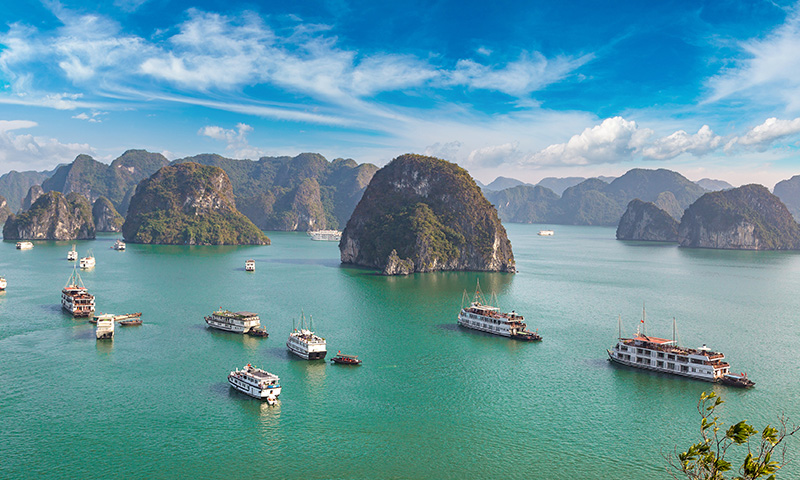
The photographs of Ha Long Bay do not exaggerate. Nearly two thousand limestone karsts rise vertically from emerald water, and the Bay has held UNESCO World Heritage status since 1994, recognised for its outstanding geological and aesthetic value. Overnight cruises are the way to see it properly, with kayaking, cave exploration, and sunrise on the top deck built into the itinerary. Ninh Binh, often called the inland Ha Long, adds rice paddies, sampan boat rides through cave tunnels, and cycling routes past ancient temples. Both sit within a few hours of Hanoi, making them easy additions to a first-timer’s route. For photographers and honeymooning couples, this stretch of northern Vietnam alone justifies the trip, and it remains one of the top-searched Vietnam tourist attractions for good reason.
Vietnamese food deserves its reputation. Pho, the herb-laden noodle soup, is only the beginning. Banh mi sandwiches, bun cha grilled pork, fresh rice paper rolls, and clay-pot fish dishes reward travellers who eat wide. Portions are light, ingredients are fresh, and prices at street stalls stay astonishingly reasonable. For Indian travellers worried about vegetarian access, cities like Hanoi and Ho Chi Minh City have dedicated vegan quarters known locally as com chay, and Jain-friendly options are increasingly available at established tourist stops. Hoi An’s cooking classes are worth building into the itinerary if you enjoy learning the craft rather than only tasting the outcome, and they double up as a memorable half-day for families. Da Nang has also seen a rise in Indian restaurants catering to the growing volume of visitors from Mumbai and Delhi.
Vietnam is the world’s second-largest coffee producer, and the domestic coffee culture reflects that scale and pride. Egg coffee, known locally as ca phe trung, in Hanoi, coconut coffee in the south, and salt coffee in Hue are three regional signatures worth working through in one trip. Independent cafes in the old quarters of Hanoi and Hoi An operate as unhurried social hubs, and the coffee shops of Da Lat come with pine-forest views that turn a morning cup into a two-hour affair. For anyone who plans their travel around good coffee and quiet cafes rather than tick-list monuments, few countries in Asia deliver as consistently or as affordably as Vietnam does. Coffee here is not a novelty add-on to a holiday; it is a legitimate reason to plan a trip in the first place, and travellers who cared little for the drink at home often return home planning their next Vietnam visit around a Da Lat plantation stay.
Vietnam’s historical layers run from the Cham civilisation and Chinese dynastic influence to French colonial architecture and the American War era. Hoi An’s Ancient Town, a UNESCO World Heritage Site since 1999, preserves a fifteenth to nineteenth century trading port with wooden merchant houses and a Japanese covered bridge intact. Hue’s Imperial Citadel, the Cu Chi Tunnels outside Ho Chi Minh City, and the War Remnants Museum together offer a serious and honest account of twentieth century Vietnam. This is not a country where history is sanitised for tourists. For travellers who want their sightseeing to carry real weight and prompt real conversation on the drive back, the historical circuit is a compelling reason to visit Vietnam ahead of a purely leisure destination.
Phu Quoc, Da Nang, Nha Trang, and Con Dao offer a range of coastal experiences that stand up to anything in Thailand or Bali. Phu Quoc has invested heavily in resort infrastructure and is easily reached by domestic flight from Ho Chi Minh City. My Khe Beach in Da Nang has featured on international lists of Asia’s best coastlines. For honeymooners and families seeking a beach layover after a stretch of inland sightseeing, the Vietnamese coast keeps the trip well balanced. Unlike some overrun Southeast Asian beaches, several Vietnamese coastal pockets still feel unhurried, and shoulder-season pricing keeps five-star resort stays within reach of a mid-range holiday budget. Con Dao in particular has become a favourite for travellers who want a quiet, low-crowd island stopover.
Vietnam handles adventure travel with a lightness that surprises first-timers. Sapa’s rice terrace trekking works for casual walkers and multi-day hikers alike. Phong Nha holds the world’s largest cave, Son Doong, along with several accessible alternatives suitable for a single-day trip. The Ha Giang loop, done by motorbike or private vehicle with a driver, is one of Southeast Asia’s most dramatic drives. Canyoning in Da Lat, kayaking in Ha Long Bay, and sandboarding in Mui Ne cover the mid-adrenaline bracket. You can build an entire trip around adventure or slot one or two experiences into a broader cultural itinerary. The infrastructure is safe, guides are affordable, and English is widely spoken at the operators that matter. Families with teenagers particularly benefit from this range, since Vietnam allows the parents to book a cultural day in Hoi An while the older children take a canyoning trip in Da Lat, and the two groups can meet on the coast the next evening.
Vietnam runs long from north to south, and its climate splits accordingly. The north, covering Hanoi, Sapa, and Ha Long, is best from October to April, when weather stays cool and dry. Central Vietnam, covering Hue, Hoi An, and Da Nang, works well from February to May. The south, covering Ho Chi Minh City, the Mekong Delta, and Phu Quoc, is at its best from December to April. This means every calendar month is peak season somewhere in the country, and a well-planned route can dodge monsoon rain almost entirely. For Indian travellers with fixed leave calendars around Diwali, Christmas, or the summer school break, this regional flexibility is genuinely valuable and rare in a single destination.
Most Indian travellers get the most out of a nine to twelve day route that lands in Hanoi, moves through Ha Long Bay and Hoi An, and exits from Ho Chi Minh City. Open-jaw flight bookings save both time and money. For a first trip, a private tour with pre-arranged transfers keeps logistics simple, particularly for families with older parents or seniors travelling on their own. If you would like a fully structured plan with hotels, transfers, and cultural experiences already worked out, our detailed guide on how to plan a Vietnam trip from India covers costs, itineraries, and season-by-season strategy in useful depth. First-timers benefit especially from a locally led private tour format, where dietary preferences and pace are baked into the plan from day one.
Travellers who prefer neighbouring Himalayan alternatives sometimes weigh Vietnam against Bhutan or Nepal. Both are excellent, but they answer different questions. A Bhutan honeymoon package leans spiritual and slow; a Vietnam trip leans varied, energetic, and coastal. Read both carefully before you decide, and if the leave window is generous, consider spacing them across two seasons rather than choosing one.
Vietnam earns the ASAP label because the window of value is real. Costs will keep rising, hotel availability during winter months is tightening, and the current e-visa regime is a policy privilege that could tighten in future years. The country genuinely offers something to a wider range of traveller types than most first-time international destinations, and the practical hurdles for Indian passport holders have never been lower. If you have been quietly holding a Vietnam trip in mind, this is the year to book it. Reach out to the travel desk at Memorable India for a customised, itinerary-first quote built around your leave window and travel style. Our team plans Vietnam holidays with the same care we bring to our domestic and international tours, and every plan is quoted with full transparency on inclusions and exclusions.
Yes. Vietnam is considered one of Southeast Asia’s safer destinations for international travellers, including solo Indian visitors. Standard urban precautions around petty theft in tourist areas apply, but violent crime rates are low, and the local hospitality culture is warm. Vegetarian food and Indian dietary preferences are increasingly well accommodated in cities.
A comfortable seven to ten day trip typically ranges between INR 65,000 and INR 1,20,000 per person, covering flights, mid-range hotels, transfers, and sightseeing. Costs vary with season, region, and inclusions. Travellers preferring luxury cruises on Ha Long Bay or five-star resorts in Phu Quoc should budget a higher band.
February to April and September to November work best for travellers covering multiple regions in one trip. Weather stays pleasant across most of the country, and rainfall is minimal. The exact ideal month depends on whether your route leans north, central, or south.
Yes, but the process is simple. Indian passport holders can apply online for a Vietnam e-visa with multiple-entry validity of up to 90 days. Approvals typically arrive within three to five working days, and no embassy visit is required. Applications are made through the official Vietnam Immigration Department portal.
Nine to twelve days work best for a first visit and cover Hanoi, Ha Long Bay, Hoi An or Da Nang, and Ho Chi Minh City comfortably. Travellers with only five to seven days can focus on either the north or the south rather than trying to cover the full length of the country.
Each destination answers a different brief. Vietnam offers more geographic and cultural range than Bali and more historical depth than Thailand’s beach circuits. Thailand still edges Vietnam for nightlife and Bali for boutique wellness. For a balanced first international trip, Vietnam holds its own strongly on value and variety.
15 Amazing Temple Fairs in India: A Traveller’s Guide to Faith, Colour and Living Tradition
30 Sep 2026
13 Best Places to Explore in the Youngest State of Telangana
29 Sep 2026
12 Less Explored Destinations in Maharashtra Worth Adding to Your Travel List
28 Sep 2026
11 Must-Visit Museums in India for Wildlife Lovers
27 Sep 2026
11 Best Places in India to Celebrate Christmas
26 Sep 2026


