 +919871148514
 info@memorableindia.com

Nepal keeps time in more ways than most countries. Its official calendar, Bikram Sambat, runs roughly 57 years ahead of the Gregorian one. The Newar community of the Kathmandu Valley follows its own Nepal Sambat. Most religious dates are then set by the moon and confirmed by astrologers each year. The result is a country where some celebration is almost always underway in a temple courtyard, a city square or a mountain monastery.
That is good news for anyone planning a trip. The famous festivals in Nepal are not staged for visitors. They unfold in working neighbourhoods, among families who have repeated the same rituals for generations. Watching one gives you a faster and more honest introduction to Nepali culture and traditions than any museum can.
This guide covers ten festivals worth planning around: what each one means, where to see it, and how to take part without getting in the way.
These draw the largest crowds and carry the deepest cultural meaning:
Since most dates follow the lunar calendar, they shift every year. Confirm the exact dates before you book flights.
Dashain is the emotional centre of the Nepali year. It celebrates the goddess Durga’s victory over the demon Mahishasura, a story of good overcoming evil that Indian travellers will recognise from Navaratri and Dussehra. In Nepal, though, the festival stretches over 15 days and brings the country’s longest holiday of the year.
The first day, Ghatasthapana, begins with barley seeds sown in a sacred vessel. Over the following days these sprout into pale yellow shoots called jamara. The tenth day, Vijaya Dashami, is the one everyone waits for. Elders place a red tika of rice, yoghurt and vermilion on the foreheads of younger relatives, tuck jamara behind their ears and bless them for the year ahead.
A practical tip: plan sightseeing around the main tika days rather than on them. Many restaurants in Thamel and Lakeside Pokhara stay open, but local guides and drivers will understandably want time at home.
Tihar arrives a few weeks after Dashain and lasts five days. It shares its timing with Diwali in India, yet it has a character entirely its own. As the Nepal Tourism Board explains, each day honours a being linked to Yama, the god of death, while Laxmi, the goddess of wealth, presides over the main night.
In the evenings, groups of young people go from house to house singing Deusi and Bhailo songs in return for sweets and small gifts. For most visitors, Kukur Tihar is the highlight. A garlanded street dog asleep on temple steps says a great deal about how Nepal sees its bond with animals.
Indra Jatra, known locally as Yenya, is the most important festival of the Newar community in Kathmandu. According to the Nepal Tourism Board’s festival page, this eight-day celebration falls in September and opens the long autumn festival season. It honours Indra, the god of rain, and gives thanks for the harvest.
Proceedings begin when a tall wooden pole, the yosin, is raised near Hanuman Dhoka in Kathmandu Durbar Square. Over the following days, masked dancers take over the streets. The red-faced Lakhey, a demon figure, is a favourite with children, who dare each other to get as close as possible.
The emotional peak is Kumari Jatra. The Living Goddess Kumari, a young girl believed to embody the goddess Taleju, leaves her palace and is pulled through the old city in a wooden chariot, followed by chariots carrying Ganesh and Bhairav. She appears in public only a handful of times each year, so every balcony and temple step along the route fills up early.
Arrive well ahead of the procession, keep valuables secure, and look for a raised spot on one of the temple plinths for a clear view.
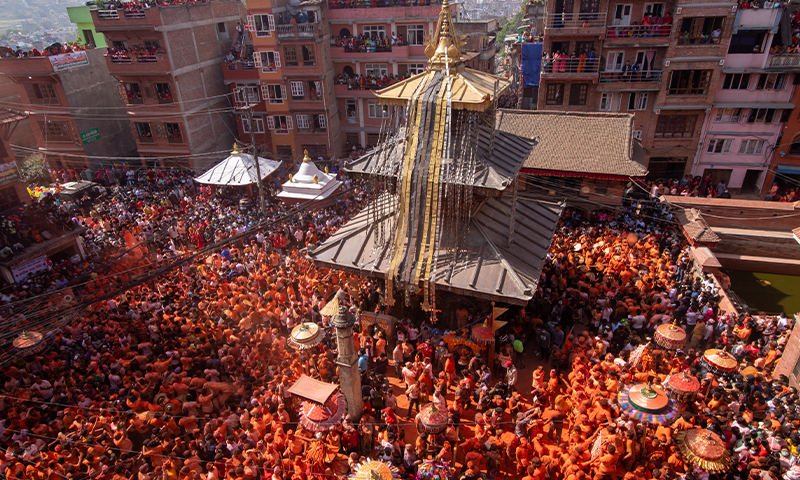
Bhaktapur, the best preserved of the Kathmandu Valley’s three old royal cities, welcomes the Nepali New Year with Bisket Jatra in mid-April. The festival runs for nine days and centres on a massive wooden chariot carrying the god Bhairav. As Republica describes, the opening day features a tug of war between the eastern and western halves of the town, each side pulling the chariot towards its own neighbourhood.
The other key ritual is the raising of a towering ceremonial pole, which is brought down on New Year’s Day to mark the turn of the year. Most of the action takes place around Taumadhi Square and the five-storey Nyatapola Temple. In nearby Thimi, Sindoor Jatra adds clouds of orange vermilion powder as palanquins of local deities are carried through the lanes.
Bhaktapur, Kathmandu and Patan all sit within the Kathmandu Valley, whose seven monument zones are inscribed on the UNESCO World Heritage List. A compact itinerary such as our Kathmandu, Patan and Nagarkot tour keeps you close to these heritage squares, and the dates can be aligned with a festival on request.
Holi in Nepal marks the end of winter. The hills and the Kathmandu Valley celebrate on the full moon of Fagun, while the Terai plains along the Indian border celebrate on a consecutive day. About a week earlier, a ceremonial pole called the chir is raised at Basantapur in Kathmandu Durbar Square, and its removal signals that the celebrations have begun.
Expect water balloons, coloured powder and plenty of good-natured mayhem. Wear old clothes, keep your phone in a zip-lock bag and protect your eyes with sunglasses. Women travelling alone may prefer joining a hosted event or a group from their hotel instead of heading into packed streets.
Buddha Jayanti falls on the full moon of Baisakh, usually in April or May, and marks the birth, enlightenment and passing of Gautam Buddha. Nepal holds a special place in this story, because the Buddha was born in Lumbini, a site UNESCO lists as the Birthplace of the Lord Buddha.
For Buddha Jayanti in Lumbini, pilgrims gather at the Maya Devi Temple. In Kathmandu, the stupas of Swayambhunath and Boudhanath fill with butter lamps, chanting monks and families walking clockwise around the dome. It is one of the calmest festivals to attend and suits senior travellers and families with young children. For more on the country’s heritage side, our guide to Nepal beyond trekking makes a useful companion read.
Teej arrives in late August or early September and belongs to Nepal’s Hindu women. Over three days, women dress in red saris and green glass bangles, sing, dance and fast for the wellbeing of their husbands and families.
The largest gathering takes place at Pashupatinath Temple on the banks of the Bagmati River, where long lines of women in red wait to offer prayers to Lord Shiva. Female travellers are often invited into the dancing circles. Men are welcome to watch, but should keep a respectful distance and ask before taking photographs.
Gai Jatra takes place the day after the full moon of Shrawan, in August or September. It begins as a remembrance of the dead. Families who have lost someone in the past year send a cow, or a child dressed as a cow, through the streets of Kathmandu, Patan and Bhaktapur, since the cow is believed to guide the departed soul.
Over time, the day also became a stage for satire. Comedians, cartoonists and street performers use it to poke fun at politicians and social issues, a custom said to trace back to a Malla king who wanted to lift his grieving queen’s spirits. Bhaktapur’s version is the most elaborate, with costumed processions that continue for days.
Nepal’s Buddhist and highland communities follow a festival rhythm of their own.
New Year is celebrated three times by different communities. The Gurung people mark Tamu Lhosar in late December, the Tamang community celebrates Sonam Lhosar in January or February, and Sherpa and Tibetan communities observe Gyalpo Lhosar in February or March. Boudhanath Stupa in Kathmandu is the best place to see Gyalpo Lhosar, with fresh prayer flags, monastic rituals and families in traditional dress.
Mani Rimdu is the defining festival of the Sherpa people. It is held at Tengboche Monastery in the Khumbu region, on the trail to Everest Base Camp, usually in October or November. After days of private monastic rituals, the closing days open to the public with masked dances that depict the triumph of Buddhist teaching over negative forces. Trekkers can time an autumn trek to arrive for it, though lodges around Tengboche fill up fast.
The festival year has two clear peaks. Autumn, from September to November, brings Indra Jatra, Dashain, Tihar and Mani Rimdu along with crisp mountain views. Spring, from February to May, offers Holi, Bisket Jatra and Buddha Jayanti, with warmer days and rhododendrons in bloom across the hills.
Timing a trip around a specific celebration means coordinating flights, hotels within walking distance of the main squares, guides who know the ritual calendar, and enough flexibility to absorb a date change. Our Nepal tour packages cover Kathmandu, Pokhara, Chitwan and more, and each itinerary can be adjusted to include the festival you most want to see.
The festivals of Nepal show what sightseeing alone often misses: how families gather, how Hindu and Buddhist faiths share the same courtyards, and how a small Himalayan country keeps centuries-old rituals alive on modern streets. A Dashain blessing or a garlanded dog on Kukur Tihar is often the memory travellers bring up first when they get home.
When you are ready to plan, talk to our Nepal travel specialists for a festival-timed itinerary built around your dates, pace and interests.
Dashain holds that title. It lasts 15 days in September or October and celebrates the goddess Durga’s victory over evil. The main day, Vijaya Dashami, is when elders give red tika and jamara blessings to younger family members.
October is usually the best single month. It often brings Dashain and Tihar together with clear skies and good trekking weather. April is the best spring option, with Bisket Jatra in Bhaktapur and, in some years, Buddha Jayanti.
Yes. Visitors are welcome at most public festivals, including Holi, Indra Jatra, Bisket Jatra and Tihar. Dress modestly, follow local cues at temples and ask before photographing people or private rituals.
Both are festivals of lights, but Tihar runs for five days and honours animals, with dedicated days for crows, dogs, cows and oxen. It ends with Bhai Tika, when sisters bless their brothers with a seven-coloured tika.
The Kumari lives in the Kumari Ghar at Kathmandu Durbar Square. Visitors may sometimes glimpse her at a courtyard window, but the best chance to see her is during the Kumari chariot procession at Indra Jatra in September.
Yes. Most festivals follow the lunar calendar, so their Gregorian dates shift each year, sometimes by several weeks. Bisket Jatra is an exception, as it is tied to the solar New Year in mid-April.
Famous Festivals in Nepal: A Traveller’s Guide to Its Rich Culture and Traditions
25 Nov 2026
Solo Backpacking in Nepal: My 10 Day Route Through Kathmandu, Pokhara and the Annapurna Foothills
25 Nov 2026
A Place Where I Found My Lost Self: Mechuka in Arunachal Pradesh
24 Nov 2026
Sikkim Travel Guide: Top Places, Things to Do, Permits, How to Reach and Best Time to Visit
24 Nov 2026
Best Places to Visit in Himachal Pradesh: A Practical Guide to the North India Himalayas
23 Nov 2026


