 +919871148514
 info@memorableindia.com
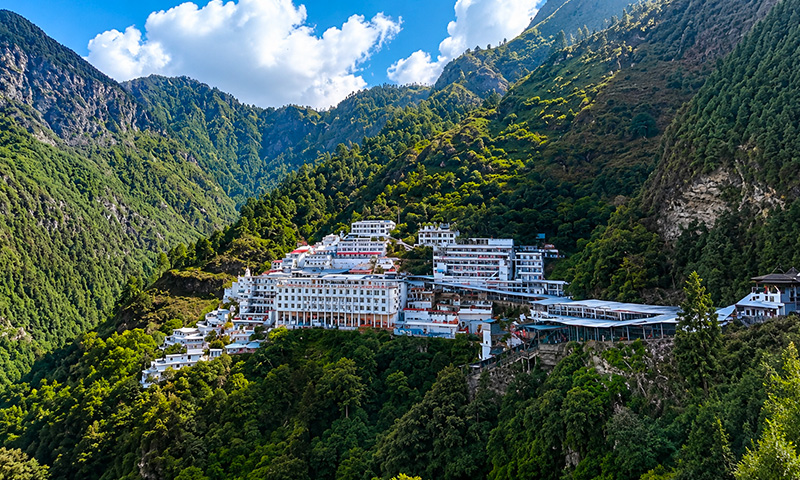
The Trikuta hills of Reasi wake up early. Long before the sun clears the ridgeline above Katra, the first batch of yatris are already on the paved climb, torches bobbing in the dark, cries of “Jai Mata Di” carrying up the valley in bursts. The Shri Mata Vaishno Devi shrine sits roughly 5,200 feet above sea level, tucked inside a cave at the end of a thirteen-kilometre trail. Faith at scale has its own texture.
Yet for all the numbers, what pulls people back is smaller and stranger: a natural cave, three unshaped rock formations known as pindis, and a resident deity with a story that stretches into pre-history. If you have been considering the journey, the ten facts about Vaishno Devi below should help you understand why the shrine keeps its hold on millions.
The shrine is inside a cave in the Trikuta mountains, near the town of Katra in Jammu and Kashmir. Katra is your base camp. Jammu, the nearest major city, is about 42 kilometres away and connected by train, road, and air. The trek to the cave temple is roughly 13 kilometres from Katra one way. Pony rides, palkis, battery-operated vehicles, and a helicopter service between Katra and Sanjhichhat cut the effort down for those who need it. The climb ends at the Bhawan, where the darshan of the three pindis takes place.
Inside the sanctum, there is no carved idol. The goddess is present as three natural rock formations called pindis, each representing one form of the mother goddess: Maha Kali on the right, Maha Lakshmi in the centre, and Maha Saraswati on the left. Together they represent the composite Shakti principle. This is one of the most distinctive elements of the shrine. The pindis are believed to have emerged on their own and have never been reshaped by human hands, which places the shrine in a category called swayambhu, or self-manifested.
Local lore and Puranic references place the origin of the shrine well before the compilation of most Hindu scripture. The Rigveda contains references to a mountain deity worshipped in the Trikuta region, which many scholars associate with this cave. The earliest known written mention of the shrine is thought to appear in the Mahabharata, where Arjuna prays to a mountain goddess before Kurukshetra. Even setting devotional literature aside, the cave has been in continuous ritual use for well over a thousand years.
Most pilgrims today enter through a newer, wider tunnel built to handle heavy footfall. The original cave, called the Adi Kumari cave, is narrow, low, and passes through cold running water. It is only opened for public darshan during specific low-traffic windows, usually in winter, when daily numbers drop enough to allow safe passage. According to the Shri Mata Vaishno Devi Shrine Board, the exact dates change each year based on weather and pilgrim count. Serious devotees track the announcements closely because entering through the original cave is considered spiritually significant.
The Vaishno Devi legend is not complete without Bhairon Nath, a tantric who pursued the goddess up the mountain. She sheltered for nine months inside the Ardhkuwari cave, then emerged and eventually beheaded him at the site now known as Bhairon Ghati. Before dying, he asked for forgiveness. The goddess granted him a boon: no yatra to her shrine would be considered complete without a subsequent visit to his temple, about 2.5 kilometres above the main Bhawan. This is why most pilgrims continue uphill after the main darshan instead of turning back.
The Ardhkuwari cave, roughly halfway up the trek, is where the goddess is believed to have meditated in hiding for nine months. Pilgrims crawl through this narrow, womb-like passage as a symbolic act of rebirth. The tunnel is genuinely tight, only large enough for one person at a time on hands and knees, and the crossing takes a few minutes. Regulars will tell you it is the most physically intimate moment of the whole yatra. Access is queue-managed to prevent bottlenecks.
The shrine draws close to 90 lakh visitors in an average year, with peak-year footfall crossing one crore. According to Wikipedia’s entry on Vaishno Devi Temple, it ranks as the second most visited Hindu pilgrimage site in India after Tirumala Venkateswara. During Navratri, daily footfall can touch 40,000 to 50,000 pilgrims. Crowd flow, medical posts, and food distribution at three altitudes are managed with the precision of a small city.
Opened to the public in 2024, the passenger ropeway between the main Bhawan and Bhairon Baba temple cut a demanding uphill trek down to a short cable-car ride. This has quietly changed the yatra for two groups: senior citizens who could complete the main darshan but not the extra climb to Bhairon Ghati, and families with young children. Wait times at Bhairon Baba have gone up, but so has the number of pilgrims who now actually finish the full circuit. If you are planning a trip with elderly parents, this alone is a reason to consider going now rather than waiting.
Every pilgrim must obtain a yatra parchi before beginning the climb from the Banganga check post at Katra. This is free and can be collected at counters in Katra or booked online through the official Shrine Board website. Aarti bookings, helicopter tickets, guest house reservations, and battery vehicle passes are all handled through the same digital ecosystem. Not knowing this catches out roughly one in five first-time yatris, who arrive expecting to just walk up.
The shrine never closes. Darshan continues through the night, and many experienced pilgrims deliberately begin the trek after 9 pm to reach the Bhawan by dawn. Reasons vary: cooler temperatures, thinner crowds, and the quiet magic of walking a lit-up mountain in the dark. Winter months, from December to February, see snow at the higher altitudes, and the ropeway or helicopter becomes especially useful. Even during heavy rain or occasional weather closures on the helicopter route, the walking trail is almost always kept open.
Free bhojnalayas run by the Shrine Board serve simple, hot sattvik meals at multiple points along the route, including Banganga, Adhkuwari, Sanjhichhat, and the Bhawan. During Navratri and other peak windows, meals served daily can cross fifty thousand. The kitchens run to strict hygiene standards and are open to every pilgrim regardless of what they can afford. For solo travellers on a tight budget, this is worth knowing in advance.
The facts above are the pull. The following is the practical layer that turns intention into a booked trip. This section works as a compact vaishno devi temple guide for first-timers and repeat visitors alike.
If you are combining the shrine with a wider Kashmir itinerary, our Kashmir with Vaishno Devi Special package pairs the pilgrimage with Srinagar, Gulmarg, and Pahalgam over a single trip. Full-service transfers and accommodation are handled end to end.
March to October is the primary window, with pleasant weather and clear trails. Navratri, in spring and autumn, is the most spiritually charged period but also the most crowded. December to February brings snow and thinner crowds, which many pilgrims prefer for the quiet. Monsoon months, particularly late July and August, can bring landslide risks on the highway and route closures on the helicopter service, so plan buffer days.
Many pilgrims plan a single-day up-and-down trip and miss the surrounding region entirely. Katra sits close to some genuinely underrated corners of Jammu, from Patnitop’s meadows to the Shiv Khori cave temple. If you are curious about what else the region holds, our guide to the hidden gems of Jammu and Kashmir covers spots most itineraries skip.
The shrine works for a wider range of travellers than most people assume. Senior citizens benefit from the palki, pony, helicopter, and now the ropeway. Families find the paved route manageable if paced over two days with an overnight at Sanjhichhat. Solo travellers appreciate the round-the-clock accessibility and the safety of the well-lit, patrolled trail. Even first-time pilgrims complete the yatra comfortably with the right planning.
If you would like end-to-end assistance with transfers, hotel stays in Katra, VIP darshan arrangements, and helicopter bookings, our three-day Vaishno Devi Yatra tour package covers the essentials without the hassle of booking each piece separately. For deeper spiritual itineraries that pair the shrine with other sacred destinations across India, explore our full range of pilgrimage tour packages.
The shrine rewards planning. It is one of the few pilgrimages in India where the logistics have kept pace with the tradition, and where a well-timed trip can be as restorative physically as it is spiritually. If you have been holding off for the right moment, the recent infrastructure upgrades and easier access options make this a strong window to actually book. For a customised itinerary that fits your dates, group size, and comfort preferences, reach out to our travel team and we will build the trip around what you actually need.
The shrine is called swayambhu, meaning self-manifested, because the three pindis inside the cave are natural rock formations rather than carved idols. Devotees believe they emerged on their own and have never been shaped by human hands, which is why the sanctum is treated as an original site of divine presence rather than a constructed temple.
A one-way trek from Katra to the Bhawan takes six to eight hours on foot at an average pace. With darshan, the extra climb to Bhairon Baba, and rest breaks, most pilgrims budget 12 to 16 hours for the full round trip. Helicopter users can complete the entire circuit in four to five hours.
Yes, with sensible planning. Ponies, palkis, battery-operated vehicles between Ardhkuwari and Sanjhichhat, and the helicopter to Sanjhichhat make the route accessible. The newly opened ropeway between the Bhawan and Bhairon Baba has further reduced physical strain. Consult a doctor before the trip if you have cardiac or respiratory conditions.
March to October is the most comfortable window in terms of weather. Navratri, in March-April and September-October, is spiritually significant but heavily crowded. Winter, from December to February, offers thinner crowds and the possibility of snow at higher altitudes.
Yes. A yatra parchi is mandatory and must be collected at the Banganga check post in Katra or booked online in advance through the Shrine Board portal. Entry to the track is not permitted without it. Registration is free.
Not usually. Helicopter and ropeway bookings sell out weeks in advance during Navratri, summer holidays, and long weekends. Advance booking through the official Shrine Board website is strongly recommended. Same-day slots occasionally open due to cancellations but should not be relied on.

7 Reasons Why One Should Travel by Indian Rail
22 Oct 2026
6 Reasons to Visit Chopta Valley in the Himalayas
21 Oct 2026
5-Step Guide to Plan a Jungle Safari Trip to Corbett National Park
20 Oct 2026
6 Popular Short Treks in Sikkim You Must Explore
19 Oct 2026
5 Jeep Safari Routes to a Paradise Called Leh
18 Oct 2026


