 +919871148514
 info@memorableindia.com

Ask any Bengali about a family wedding and you will hear about the food before you hear about the vows. In Bengal, a marriage is a long conversation between two families, carried out through rice, fish, turmeric, conch shells and plenty of teasing.
This guide walks you through the full sequence of rituals, from the first formal blessing to the reception at the groom’s home. For each one, you will learn what happens and why it matters. It is written for first-time guests, couples marrying into a Bengali family, and travellers heading to Kolkata in wedding season.
This guide follows Bengali Hindu tradition. Customs differ between families with roots in West Bengal (often called Ghoti) and families with roots in East Bengal, now Bangladesh (called Bangal). Treat what follows as the common framework.
A traditional Bengali Hindu wedding unfolds in three stages spread over several days:
Three things set Bengali wedding traditions apart from weddings elsewhere in India. The main ceremony usually takes place at night, timed to an auspicious moment (lagna) chosen from the Bengali almanac, the panjika. The bride is carried to the groom on a wooden stool instead of walking to him. And the sound of women ululating (ulu dhwani), along with blown conch shells, marks every important moment. The Bengali Hindu wedding entry on Wikipedia is a handy reference for regional terminology.
Paka Dekha is the formal fixing of the match. Elders from both families meet, the priest confirms the date from the panjika, and sweets change hands.
Ashirbad follows, usually a few days before the wedding. Elders from the groom’s side visit the bride and bless her by placing dhaan (unhusked paddy) and durba grass on her head. They also give her gold jewellery, often a necklace or bangles. The bride’s family later blesses the groom the same way. Each family is publicly accepting a new member.
Aiburobhat is a farewell feast held separately at the bride’s and the groom’s homes. Relatives cook the person’s favourite dishes, with rice, fish and payesh (rice pudding) at the centre of the plate. The name roughly translates to “the unmarried person’s rice”.
It looks like a party, but it carries real emotion, especially for the bride. Expect a few tears between the fish fry and the sweets. To understand why this meal matters so much, our guide to Kolkata cuisine beyond macher jhol explains the dishes that turn up on these menus.
Early on the wedding day, before sunrise, married women of the family take the bride for a ritual bath, traditionally at a pond or river. She then eats a light meal of curd (doi) and flattened rice (chire). This is Dodhi Mangal, and it is usually the last food she eats until the ceremony ends that night, because the bride and groom traditionally fast through the day.
Around the same time, the family performs Nandimukh, also called Briddhi, a ritual offering to ancestors. It seeks the blessing of earlier generations.
Gaye Holud means “turmeric on the body”, and the Bengali version follows a precise order. Turmeric paste is first applied to the groom at his home. The same paste, now carrying his touch, is sent to the bride’s home along with the tattva: trays of saris, cosmetics, sweets and a large rohu fish, often dressed up as a bride with a tiny sari and a dab of sindoor.
The bride is then anointed with that paste by the married women of her family. The shared paste symbolises two lives starting to blend. The decorated fish stands for fertility and prosperity.
On the morning of the wedding, the bride receives a pair of shankha (white conch shell bangles) and pola (red coral or lac bangles), traditionally dipped in turmeric water before she wears them. After the wedding, her mother-in-law adds a loha, an iron bangle often covered in gold. Together, these three bangles have long been the visible sign of a married Bengali woman, much as the mangalsutra is in other parts of India.
In the evening, the groom leaves home with family and friends in a procession called Bor Jatri. He wears a silk dhoti and panjabi, sandalwood patterns on his forehead, and the white topor on his head.
At the venue, the bride’s mother receives him with a baran dala, a tray holding a lit lamp, rice, durba grass and sweets. She touches the tray to his forehead, offers him sweets and water, and the women ululate and blow conch shells. This welcome is called Bor Boron.
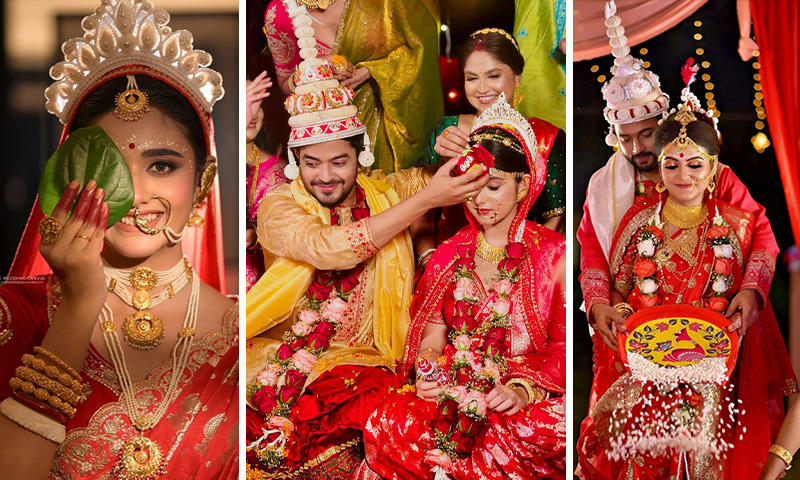
The groom stands on a low wooden stool (pidi) in the decorated ceremony area, known as the chhadnatala. The bride sits on her own pidi and is lifted by her brothers or male cousins. Holding two betel leaves over her face, she is carried around the groom seven times.
The seven circles symbolise the bride’s commitment and the lasting bond between the two. It is also where the playful rivalry begins, as the groom’s friends sometimes lift him higher so the bride struggles to reach.
After the seventh round, the bride lowers the betel leaves and looks at the groom. This is Shubho Drishti, the “auspicious first glance”. Traditionally, it was the couple’s first sight of each other on the wedding day.
Right after, the couple exchange garlands three times in Mala Bodol, a sign of mutual acceptance. Do not be surprised if the cousins raise and lower the pair to make the exchange tricky.
The couple then sit at the chhadnatala. In Sampradan, a senior male relative of the bride, usually her father, places her hand in the groom’s. The priest ties their hands with a sacred thread and covers them with a cloth while chanting Vedic mantras. In many modern families, the bride’s mother now shares this role.
The sacred fire (yagna) is lit, and the couple take their vows with Agni, the fire god, as witness. They walk around the fire, and in Saptapadi the bride takes seven steps that represent shared goals for married life, often touching betel leaves or small mounds of rice with her foot.
Next comes Anjali. The bride’s brother places khoi (puffed rice) in her hands. Standing in front of the groom, who holds her hands from behind, she offers the khoi into the fire. The offering asks for prosperity and a long life together.
The final and most emotional ritual of the night is Sindoor Daan. The groom applies vermilion (sindoor) to the parting of the bride’s hair, often using a ring, a coin or a small container. He then covers her head with a new sari called the lojja bostro. From this moment, she is considered married.
If you are a guest, this is the photograph the family will treasure most. Find your spot early.
The ceremony often ends well after midnight, yet the couple do not go to bed. They spend the rest of the night in the Basar Ghor, a room filled with the bride’s cousins and friends who sing, play games and tease the groom. Good humour is the right response.
The next morning, the couple perform Bashi Biye, a short set of rituals that repeat some of the previous night’s prayers. In many families, the groom applies sindoor again, this time in daylight.
Then comes Bidaay, the farewell. Before leaving, the bride performs Kanakanjali. She throws a handful of rice over her shoulder into the end of her mother’s sari, without looking back. The gesture symbolises repaying her parents for raising her.
At the groom’s home, the mother-in-law welcomes the bride in Bodhu Boron. The bride steps into a plate of milk and alta (red dye) and walks in, leaving red footprints that represent the goddess Lakshmi entering the home. In many families, she is also asked to catch a live fish with her hands, which usually ends in laughter.
That night is Kaal Ratri. The couple are kept apart and are not supposed to see each other. Many families see it as a night of rest for the bride.
Bou Bhaat, the bride’s rice ceremony, is the reception hosted by the groom’s family. During the day, the bride serves rice to her in-laws, her first symbolic act in her new kitchen. The groom presents her with a sari and a plate of food in a rite called Bhaat Kapor, a promise to provide for her. In the evening, a large reception introduces her to relatives, neighbours and friends.
The same night is Phool Shojja. The couple’s room is decorated with flowers, and the bride’s family sends gifts of clothes and sweets. Some families also observe Dwiragaman, when the couple visit the bride’s parents within a few days of the wedding.
Bengali wedding attire is instantly recognisable. The bride usually wears a red or maroon Banarasi silk sari with gold jewellery and a white mukut (crown). Her forehead is decorated with delicate chandan (sandalwood) patterns, and her hands and feet are painted with alta.
The groom wears a silk dhoti, a panjabi (long kurta) and the topor, the conical headgear of the Bengali groom). Both the topor and the mukut are made from sholapith, a light, spongy plant pith carved by artisans traditionally known as Malakars. The government handicrafts portal on sholapith craft notes how closely this craft is tied to Bengali weddings and Durga Puja. For a related side of the city’s craft heritage, Kumartuli, the clay idol makers’ quarter in north Kolkata, is one of the unique things to do in Kolkata for culture-minded travellers.
Bengali families are warm hosts, and nobody expects guests to know every ritual. A few pointers help:
Many weddings in Bengal fall in the cooler months, roughly November to February, when travelling around Kolkata is also most comfortable. Auspicious dates shift every year with the panjika, and some also fall in spring and early summer, so always check with the family first.
If you are flying in from abroad or another Indian city, add a day or two to see the city that shaped these Bengali wedding customs. Memorable India’s Kolkata day tour packages cover Victoria Memorial, the colonial quarter and heritage lanes in a single guided day, which fits neatly between wedding events. For background on the city’s landmarks, the Incredible India guide to Kolkata from the Ministry of Tourism is a reliable starting point.
Bengali wedding rituals reward the guest who pays attention. Each step, from the turmeric that travels between two homes to the rice thrown over a shoulder at Bidaay, tells you how Bengali families think about marriage: as a joining of households, sealed with food, humour and a great deal of happy noise.
Go with an open mind and an empty stomach. Ask the elders what each ritual means,, and they will happily explain. And if the celebrations take you to Kolkata, give yourself time to see the city properly. When you are ready, our travel experts can plan a Kolkata trip around your wedding dates.
The core rituals are Ashirbad, Aiburobhat and Gaye Holud before the wedding; Saat Paak, Shubho Drishti, Mala Bodol, Sampradan, Anjali and Sindoor Daan on the wedding night; and Bidaay, Bodhu Boron and Bou Bhaat afterwards. Most families keep these steps, with small regional variations.
Shubho Drishti means “auspicious first glance”. After the bride is carried around the groom seven times with betel leaves covering her face, she lowers the leaves and looks at him. It marks the couple’s first formal sight of each other during the ceremony.
During Saat Paak, the bride sits on a wooden stool called a pidi and her brothers carry her around the groom seven times. The circles symbolise a lasting bond, and the lifting shows that her family hands her over with honour and care.
Sindoor Daan is the ritual in which the groom applies vermilion to the parting of the bride’s hair and covers her head with a new sari, the lojja bostro. It is considered the moment the marriage is complete.
Women usually wear a silk or Banarasi sari, a lehenga or an anarkali. Men can wear a panjabi with a dhoti or churidar. Bright, festive colours work best, and many families prefer guests to avoid all-white or all-black outfits.
The full set of rituals usually spans three to five days. Pre-wedding rites start a few days before the main ceremony, the wedding takes place over one night, and post-wedding events such as Bou Bhaat follow within the next two days.
Bengali Wedding Rituals: All You Need to Know, Step by Step
22 Nov 2026
A Solo Trip to Jodhpur That Made Me Realise We Are Never Alone
22 Nov 2026
9 Most Popular Krishna Temples in Gujarat: A Practical Guide for Pilgrims
21 Nov 2026
9 Best Luxury Homestays Across Dehradun for Gorgeous Mountain Views
21 Nov 2026
19 Incredible Places for Wildlife Jungle Safari Holidays in Rajasthan
20 Nov 2026


