India’s royal palaces are living archives. They hold the ambition of Rajput courts, the refinement of Mughal patrons, the eclectic taste of the Wodeyars, and the pastel imagination of the Nizams. Some still house descendants of ruling families. Others have become museums, luxury hotels, or state residences. Together, they form one of the richest palace circuits anywhere in the world, and a serious traveller can spend weeks moving between them without repetition.
This guide gathers 30 famous palaces to visit in India, arranged by region so planning stays practical. Each entry earns its place through architecture, provenance, and travel value, not just reputation. Use the sections below to build a route that matches your pace, your season, and your appetite for royal history. A note on scope: this list focuses on palaces proper, not standalone forts. Where a fort complex contains significant palace apartments, such as Mehrangarh or Amber, we have prioritised the palace residences that were purpose-built for royal living.
Royal Palaces in Rajasthan
Rajasthan remains the definitive palace state. Its Rajput rulers competed in scale, sandstone, and sheer flourish, and their legacy anchors any serious itinerary. A well-planned Royal Rajasthan tour covers most of the palaces below across a fortnight.
City Palace, Udaipur. Rising above Lake Pichola, this sprawling complex began in 1559 under Maharana Udai Singh II and grew across four centuries. Its courtyards, the Peacock Hall in Mor Chowk, and rooftop views over the lake explain why Udaipur is often called the crown of Mewar.
City Palace, Jaipur. The seat of the Kachwaha dynasty since Sawai Jai Singh II founded the city in 1727. The Mubarak Mahal, Chandra Mahal, and the celebrated Pritam Niwas Chowk with its four seasonal gates remain in active use by the current royal family.
Hawa Mahal, Jaipur. Built in 1799 by Maharaja Sawai Pratap Singh, the five-storey pink sandstone screen carries 953 jharokhas designed to let royal women watch street processions in purdah. Best photographed from Wind View Cafe across the road at early light.
Umaid Bhawan Palace, Jodhpur. Commissioned in 1929 as a famine relief project and completed in 1943, this Art Deco and Rajput hybrid remains among the world’s largest private residences. It splits into three wings: the Maharaja’s home, a Taj-run heritage hotel, and a public museum of vintage cars.
Jal Mahal, Jaipur. The five-storey water palace floats in the middle of Man Sagar Lake, with four storeys submerged year-round. The Rajput and Mughal composition is best viewed from the Amer Road causeway, especially at dawn when the Nahargarh hills glow behind it.
Rambagh Palace, Jaipur. Once the home of Maharani Gayatri Devi and Maharaja Sawai Man Singh II, now a Taj heritage hotel widely regarded as one of India’s finest. Even non-guests can book high tea at the Suvarna Mahal or a peacock-flanked drink at the Polo Bar.
Taj Lake Palace, Udaipur. Built as Jag Niwas in 1746 by Maharana Jagat Singh II, the white marble pavilion covers all four acres of its island in Lake Pichola. Reachable only by boat, it now operates as a Taj hotel synonymous with royal indulgence.
Jag Mandir, Udaipur. The second island palace on Pichola, credited with sheltering the young Prince Khurram, later Emperor Shah Jahan, during his rebellion against Jahangir. Its Gul Mahal pavilion and rows of white marble elephants at the ghat are unmistakable from the shore.
Lalgarh Palace, Bikaner. Designed by British architect Samuel Swinton Jacob in Indo-Saracenic style for Maharaja Ganga Singh and completed in 1926. The red sandstone facade, the Sadul Museum, and the quiet lawns give a slower, less crowded palace experience.
Deeg Palace, Bharatpur. The 18th-century Jat pleasure palace of the Bharatpur rulers. Gopal Bhawan, Suraj Bhawan, and the 500-plus fountains around Gopal Sagar were once fed through an elaborate hydraulic system that ran only during festivals, and still does on a handful of monsoon evenings.
Royal Palaces in South India
The south’s palace story is quieter but no less compelling. Karnataka, Kerala, and Hyderabad each brought distinct sensibilities to their courts, from Wodeyar-era Indo-Saracenic grandeur to Travancore woodcraft.
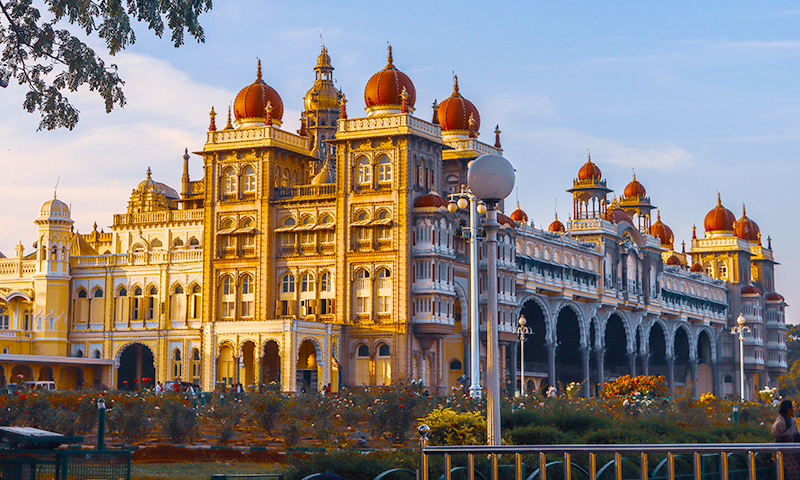
Mysore Palace (Amba Vilas), Karnataka. Rebuilt in 1912 after a fire, designed by Henry Irwin for the Wodeyar dynasty. The Durbar Hall’s stained glass and the Sunday illumination of roughly 97,000 bulbs make this one of the most visited royal residences in the country.
Bangalore Palace, Karnataka. Modelled on Windsor Castle and completed in 1878. Tudor Revival turrets sit oddly and beautifully in the middle of Bengaluru, and the interiors still hold Wodeyar-era portraits, furniture, and hunting trophies from the family’s Mysore days.
Tipu Sultan’s Summer Palace, Bengaluru. A two-storey teakwood palace completed in 1791 as Rash-e-Jannat, meaning envy of heaven. Its ornate arches, painted ceilings, and quiet colonnades survive in the older quarter of the city, near the busy KR Market.
Padmanabhapuram Palace, Tamil Nadu. The finest surviving example of Kerala’s traditional wooden palace architecture, built in the 16th century and expanded by successive Travancore rulers. Located in Tamil Nadu but maintained by the Kerala government, a quirk of state reorganisation in 1956.
Hill Palace, Tripunithura, Kerala. The former seat of the Kochi royal family, now an archaeological museum spread across 49 acres near Ernakulam. The collection ranges from the pooram thidambu of the royal deity to gold ornaments, Chera-era coins, and epigraphic records.
Chowmahalla Palace, Hyderabad. The official seat of the Nizams and the venue for their coronation ceremonies. Four palaces sit around a shared courtyard, with the Khilwat Mubarak durbar hall and its 19 Belgian crystal chandeliers drawing most of the attention.
Falaknuma Palace, Hyderabad. Perched 610 metres above the city and built in 1893 in Italian Palladian style. Now a Taj hotel, its 101-seat dining table is reputedly the world’s longest, and afternoon tea is open to non-residents with prior booking.
Mattancherry Palace, Kochi. Built by the Portuguese around 1555 and gifted to the Raja of Kochi, later renovated by the Dutch, hence its popular name Dutch Palace. The Ramayana murals in the royal bedchamber are among the finest surviving examples of Kerala mural art.
Royal Palaces in Western and Central India
The palaces of Gujarat, Maharashtra, and Madhya Pradesh sit at an interesting crossroads of Rajput, Mughal, European, and Maratha influence, and each site tends to surprise first-time visitors.
Laxmi Vilas Palace, Vadodara. Commissioned by Maharaja Sayajirao Gaekwad III and completed in 1890. At roughly four times the built-up area of Buckingham Palace, it remains the private residence of the Gaekwad family, with the Darbar Hall, Navlakhi stepwell, and Fatehsingh Museum open on scheduled tours.
Jai Vilas Palace, Gwalior. Built in 1874 by the Scindia rulers for the Prince of Wales’s visit. The Durbar Hall carries two of the world’s largest chandeliers, each weighing around 3.5 tonnes, and a solid silver toy train once ferried cigars and brandy around the dining table.
Aga Khan Palace, Pune. Built in 1892 by Sultan Muhammed Shah Aga Khan III as an act of famine relief. Mahatma Gandhi, Kasturba, and Mahadev Desai were interned here during the Quit India Movement in 1942, and Kasturba’s samadhi still stands quietly on the grounds.
Shaniwar Wada, Pune. The 1732 fortified palace of the Peshwas and once the political nerve centre of the Maratha Confederacy. Fire consumed much of the wooden interior in 1828, but the ramparts, Delhi Gate, and Sunday evening sound-and-light show still make it worth the visit.
Naulakha Palace, Gondal. The oldest palace in Gondal, dating to the 17th century and named for its reputed nine-lakh construction cost. Its museum holds silver caskets, brass fittings, and the weighing scale once used to weigh the Maharaja against gold. A Gujarat heritage tour pairs it neatly with Bhavnagar and Bhuj.
Royal Palaces in East, North, and Northeast India
The east and the north complete the picture with colonial-era neoclassical mansions, Himalayan Buddhist palaces, and the Dogra and Manikya legacies that rarely make it into standard itineraries.
Marble Palace, Kolkata. A neoclassical mansion built in 1835 by Raja Rajendra Mullick. Named for its 126 varieties of marble, the interiors hold sculptures, chandeliers, and paintings attributed to Rubens and Reynolds. Free passes must be collected in advance from the West Bengal Tourism office.
Cooch Behar Palace, West Bengal. Also called Victor Jubilee Palace, modelled on London’s Buckingham Palace and completed in 1887 for Maharaja Nripendra Narayan. The central dome rises 38 metres above the Durbar Hall, in a confident fusion of Renaissance and Mughal detailing.
Hazarduari Palace, Murshidabad. Literally the palace of a thousand doors, built in 1837 for Nawab Nazim Humayun Jah by architect Duncan McLeod. The three-storey structure now holds one of India’s most visited state museums, with over 4,000 artefacts on display.
Ujjayanta Palace, Agartala. The former royal residence of the Manikya dynasty of Tripura, completed in 1901 under Maharaja Radha Kishore. It served as the state’s Legislative Assembly until 2011 and now functions as a state museum devoted to Northeast Indian culture and craft.
Leh Palace, Ladakh. A nine-storey palace built by King Sengge Namgyal in the early 17th century, often compared in silhouette to Lhasa’s Potala. Ravaged by 19th-century Dogra invasions and later abandoned, the ruin is conserved by the Archaeological Survey of India and offers panoramic views of Leh.
Mubarak Mandi Palace, Jammu. Once the seat of the Dogra kings of Jammu and Kashmir, a complex that developed from the 1820s. It blends Rajasthani, Mughal, and European influences, and the Sheesh Mahal along with the Pink Hall stand out despite years of gradual restoration.
Rashtrapati Bhavan, New Delhi. Designed by Edwin Lutyens and completed in 1929 as the Viceroy’s House. Now the official residence of the President of India, with 340 rooms across four floors and a footprint larger than the Palace of Versailles. Public tours of the main building, the erstwhile Mughal Gardens (now Amrit Udyan), and the museum run on scheduled days with prior online registration.
How to Plan a Royal Palace Tour of India
Sequence by region: Rajasthan alone deserves 10 to 14 days. Add 4 to 5 days each for South India covering Mysore, Bengaluru, and Hyderabad, another 4 for Kerala, and 3 to 4 for a Kolkata to Murshidabad to Cooch Behar loop.
Best season: October to March across most of the country. Rajasthan and Gujarat peak between November and February. Ladakh and the Northeast are best from May to September.
Book stays inside heritage palaces: Rambagh, Umaid Bhawan, Taj Lake Palace, Falaknuma, and Laxmi Niwas in Bikaner allow you to live inside history rather than only tour it.
Consider rail journeys: The Palace on Wheels train covers Jaipur, Udaipur, Jodhpur, and Jaisalmer in a week if you prefer curated luxury over independent travel.
Respect access rules: Many palaces prohibit photography inside durbar halls, some close on specific weekdays, and a few such as Rashtrapati Bhavan and the residential wings of Rambagh need advance registration.
Budget realistically: Entry tickets across most state-run palaces stay under 300 rupees per person, while private trust palaces such as Mysore or Falaknuma charge more. Guided tours in English typically add 500 to 800 rupees. Factor in dedicated time for museums attached to Jai Vilas, Hazarduari, and Hill Palace, which reward at least 90 unhurried minutes each.
Pair with wider itineraries: Rajasthan palaces slot neatly beside Ranthambore or Bharatpur for wildlife, while Kerala and Karnataka palaces combine well with backwater cruises or coffee-country stays for a more textured trip.
Final Word
Royal palaces in India reward slow travel. A morning at the City Palace in Udaipur, an afternoon on Pichola, a night at Rambagh, or a Sunday evening under the Mysore lights leaves a stronger memory than any rushed checklist. If you would like help sequencing these across a single trip, our travel team can build a tailored luxury India itinerary around your dates, pace, and interests. Reach out through our Contact Us page and we will map a palace route that fits.
Frequently Asked Questions
Q1. Which is the most famous royal palace in India?
Mysore Palace in Karnataka and City Palace in Udaipur are the two most visited royal palaces in India, each drawing several million visitors annually for their architecture, museums, and living heritage.
Q2. Which is the largest palace in India?
Laxmi Vilas Palace in Vadodara, built by the Gaekwads in 1890, is widely considered the largest private residence in India and roughly four times the built-up area of Buckingham Palace.
Q3. Can tourists stay inside a royal palace in India?
Yes. Palaces such as Umaid Bhawan Jodhpur, Rambagh Jaipur, Taj Lake Palace Udaipur, Falaknuma Hyderabad, and Laxmi Niwas Bikaner operate as heritage hotels open to paying guests.
Q4. Which Indian palace is built on water?
Two well-known water palaces are Jal Mahal in Jaipur, which sits in Man Sagar Lake, and Taj Lake Palace (Jag Niwas) in Udaipur, which occupies an entire island in Lake Pichola.
Q5. What is the best time to visit royal palaces in Rajasthan?
October to March is ideal, with November to February offering the coolest, most comfortable weather for full-day sightseeing across Jaipur, Udaipur, Jodhpur, Bikaner, and Jaisalmer.
Q6. How many days are enough for a royal palace tour of India?
A focused Rajasthan palace circuit needs 10 to 14 days. A pan-India tour covering Rajasthan, South India, and select East and Central palaces needs 21 to 25 days for a comfortable, unrushed pace.
 +919871148514
 info@memorableindia.com