 +919871148514
 info@memorableindia.com
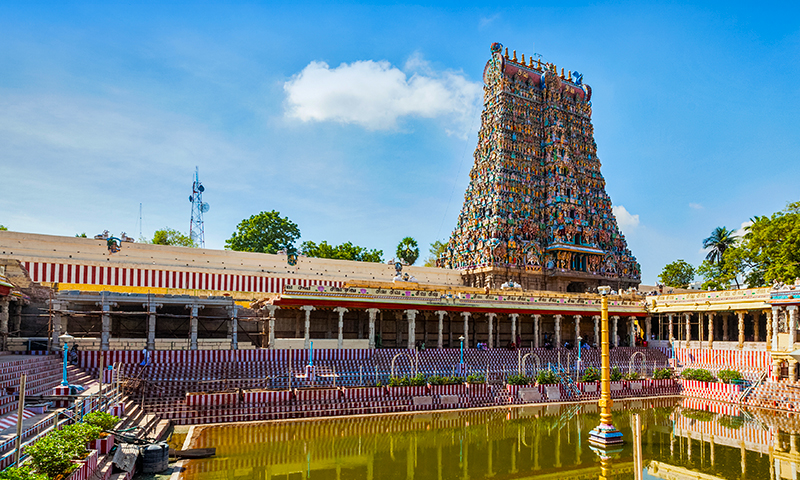
Madurai, Tamil Nadu’s cultural centre, has a 2,500-year history and is noted for its beautiful temples, vibrant festivals, and unique cuisine. It is a city steeped in history and culture, sometimes referred to as the “Athens of the East.” The city was once the capital of the powerful Pandya dynasty, who ruled South India for centuries. The city’s numerous historical monuments and architectural marvels serve as memories of its long past. Madurai’s cultural diversity extends to its culinary traditions, which include a variety of distinct dishes and specialities that satisfy one’s taste buds. The Madurai Malli (jasmine flower), famed for its seductive perfume, symbolizes the city’s floral heritage.
This is a city that celebrates and thrives on festivals. Throughout the year, the city comes alive with vibrant events, each with its traditions and customs. The most well-known festivals include Pongal (a harvest festival), Chitirai Festival (held at the Meenakshi Amman Temple), Avani Moola Festival, and Jallikattu (a bull-taming event). For millennia, the city has been the centre of Tamil culture and literature. It also held the third Tamil Sangam, an event for Tamil intellectuals and poets.
The city is a foodie’s paradise, known for its use of spices and fresh ingredients. Travellers exploring the wider region can pair Madurai with other pilgrimage circuits covered in our Madurai tour packages section.
For ages, the city has been the epicentre of Tamil culture and literature. It also hosted the third Tamil Sangam, a gathering of Tamil intellectuals and poets. The city is a foodie’s heaven. It is renowned for its use of spices and fresh ingredients. Madurai has a wide range of cuisines to satisfy your taste buds. Madurai Jigarthanda, a cool and refreshing milk-based beverage flavored with badam (almonds), ice cream, and nuts in rose syrup; Madurai idly and sambar (soft and fluffy steamed rice cakes served with a lentil stew); and mutton biryani (rice cooked with a variety of aromatic spices and herbs, such as star anise, bay leaves, cardamom, cinnamon, and cloves, stewed with succulent mutton pieces), which exemplifies the city’s fantastic culinary choices and is popular with both inhabitants and visitors.
Road upgrade and flyover works continue in phases across Madurai as part of the ongoing smart city programme, which may cause occasional traffic congestion and diversions. While this infrastructure project seeks to improve traffic flow in the coming years, unforeseen delays and route adjustments may occur on occasion without prior notice. Please inform the guests so that they are prepared.
The city has its airport, Madurai International Airport (IXM), one of Tamil Nadu’s busier regional airports in terms of passenger traffic and aircraft movements. The airport is situated 12 kilometres south of the city centre. It is easily accessible from several domestic cities, including Chennai, Bangalore, Mumbai, Delhi, Hyderabad, Kolkata, Ahmedabad, and Goa, as well as foreign locations such as Dubai, Singapore, and Colombo.
Airport facilities:
Airport upgrade works, including passenger terminal and airside improvements by the Airports Authority of India, continue in phases as the airport expands its capacity.
Madurai Junction (MDU) is a major railway station with trains connecting to most major cities in India including New Delhi, Mumbai, Kolkata, Chennai, Bengaluru, Nagpur, Bhopal and Hyderabad.
Madurai is well connected to neighbouring cities and states by National Highways NH 7, NH 45B, NH 208 and NH 49. State highways passing through the city include SH-33, SH-72, SH-72A, SH-73 and SH-73A which connect various parts of Madurai district and nearby towns.
The Meenakshi Amman Temple in Madurai is a vast maze of beauty and history situated in the heart of the city. The temple complex is devoted to Parvati (Meenakshi) and her consort Shiva (Sundareswarar). According to legends, the temple was built about 2,500 years ago. Malayadwaja Pandya, the Pandya monarch, is reported to have unearthed a divine Shiva lingam and dedicated a shrine to it. While the exact period is debatable, there is evidence that a temple has existed here since at least the 6th century BC.
The temple complex was originally built by the Pandya monarchs and has undergone various extensions during the reigns of many kingdoms. The most major changes took place during the reign of the Nayaka dynasty in the 16th and 17th centuries. The holy wedding of Parvati (Meenakshi) and Shiva (Sundareswarar), said to have occurred here, has mythological significance and the temple commemorates their sacred union. The temple encloses two shrines with four huge entrances facing four directions. Its distinctive feature is its colorful gateway towers (gopurams), each embellished with elaborate sculptures of mythological figures and goddesses. The tallest is the southern gopuram, which stands at 170 feet. The Golden Lotus Pond is a tranquil oasis within the complex, and the adjacent column features murals depicting Lord Shiva’s miracles in Madurai. The signature event is the night ceremony, which takes place every day for 45 minutes before the temple closes.
For a deeper look at the temple’s Dravidian architecture, its 4,500 pillars and its 33,000 sculptures, read our dedicated guide on the Meenakshi Amman Temple.
Temple details:
Special remark: Temple parking has been renovated, and coaches will not be able to reach the parking lot. Drivers will be asked to stop at specific points from where guests must walk 15 to 20 minutes to reach the temple.
Major upcoming event: The Meenakshi Amman Temple Kumbabhishekam (consecration ceremony), being held after 17 years, is scheduled for 17 September 2026. This is a landmark occasion expected to draw large crowds of devotees and pilgrims from across India and abroad, and access around the temple will be tightly managed during the run-up and on the day itself.
Estimated closure dates of Meenakshi Amman Temple:
Meenakshi Amman Temple is closed a few times each year for the float festival, the Puttu festival, and Lord Murugan’s heavenly wedding ceremony at Thiruparankundram Temple. For 2026, the temple is expected to be closed on 22 January 2026 (float festival), 1 April 2026 (Panguni Uthiram – Lord Murugan’s heavenly wedding at Thiruparankundram), and 24 August 2026 (Puttu festival). The temple is also closed during solar and lunar eclipses; we will notify you as the exact date approaches. Festival dates are determined by the lunar calendar as well as local traditions and customs, so dates may shift. We shall reconfirm the same closer to the festival date.
The Thirumalai Nayak Palace, a 17th-century palace in Madurai, provides a glimpse of the grandeur of the Nayaka dynasty’s power. It was built in 1636 by King Tirumala Nayaka, who reigned from 1623 until 1659. The structure standing today was the principal palace, where the monarch lived. The palace is a stunning example of Indo-Islamic architecture, combining Hindu, Islamic and Dravidian elements, characterised by arches, domes and ornate carvings. Its most outstanding feature is the Swargavilasa Mandapam (Hall of Heavenly Delight), which has a 60-foot high dome decorated with floral and geometric motifs. The hall was used for royal audiences and special occasions.
The Rangamandapa (Hall of Colours) was probably used for shows and amusement. The ceiling is adorned with vibrant paintings depicting themes from Hindu mythology. A majestic staircase with sculptured elephants borders each side. The palace is currently protected by the Archaeological Survey of India. It was constructed with a unique form of mortar that is supposed to be as robust as concrete, and its dome is reported to be influenced by the Gol Gumbaz dome in Bijapur, Karnataka. The palace is currently open to visitors as usual, and the daily sound and light show has resumed following earlier restoration works.
Details:
The Gandhi Memorial Museum in Madurai, inaugurated in 1959, pays tribute to Mahatma Gandhi, the father of the Indian independence movement. It is housed in a historic building that was formerly a palace. Built circa 1670 AD by Rani Mangammal of the Nayak dynasty, it served a variety of functions until being donated to the All India Gandhi Smarak Nidhi in 1955 to build a Gandhi Museum. The museum’s exhibits focus on various aspects of Mahatma Gandhi’s life and ideology.
Visitors can view a “Visual Biography of Bapuji” that includes images, paintings, sculptures, manuscripts and quotations tracing his life from his youth in Porbandar to his leadership in the Indian independence struggle. The museum also houses several poignant artifacts, including a portion of Gandhiji’s blood-stained garment worn when he was assassinated, an original letter written by Gandhi to Shri Narayanan Sathsangi of Devakottai, a congratulatory message sent by Gandhi to freedom fighter and poet Subramania Bharati, and a letter written by Gandhi to Adolf Hitler, famously addressed as “Dear Friend.”
Special note: parts of the museum may occasionally be inaccessible while phased upgrade works continue on the heritage building. Guests are permitted to visit, though certain galleries may be temporarily off-view.
The Thiruparankundram Murugan Temple, also known as the Subramanya Swamy Temple, is a Hindu temple devoted to Lord Murugan (also known as Kartikeya) and lies 8 kilometres from the city. It is considered one of the “Six Abodes of Murugan,” the six most sacred abodes. This remarkable rock-cut temple was constructed in the sixth century, most likely by the Pandyas, and is an excellent example of rock-cut design. The temple complex is carved into the side of a hill and contains numerous tunnels and shrines. According to mythology, Murugan killed the demon Surapadman and married his consort Devasena at this temple.
The primary shrine houses Lord Murugan’s idol, flanked by his consorts Valli and Devasena. The complex also houses Shiva, Vishnu, Vinayaka (Ganesha) and Durga. The most well-known celebration is Kantha Sashti during the Tamil month of Aippasi (October-November). Read our detailed piece on the Thirupparamkunram Murugan Temple for more on its rock-cut heritage.
The Alagar Temple, also known as the Kallalagar Temple, is a major Hindu temple dedicated to Lord Vishnu, located around 22 kilometres northwest of Madurai. It is one of the 108 Divya Desams, the sacred sites dedicated to Vishnu in the Alvar saint tradition, where Vishnu is revered as Kallazhagar. The temple was built in the Dravidian architectural style and features a five-tiered rajagopuram, a rectangular enclosure with granite walls, and beautifully carved mandapams whose pillars are embellished with mythological scenes and life-size sculptures.
Nestled amidst the Alagar Hills, the temple has a tranquil atmosphere. It plays an important role in Madurai’s Meenakshi Thirukalyanam celebration, when a processional icon of Sundararaja from Alagar Kovil is carried to the Meenakshi Amman Temple for the wedding. The temple also celebrates the float festival (February/March), Navaratri (September/October) and Vaikunta Ekadasi (December/January).
The Pazhamudhircholai Murugan Temple, also known as the Solaimalai Murugan Temple, is a prominent Hindu temple honouring Lord Murugan and one of his six holy abodes (Arupadaiveedu) in Tamil Nadu. Nestled amidst deep woodlands atop Solaimalai Hill, about 22 kilometres north of Madurai, the temple offers a peaceful retreat. The hill is also called Vrishabhadri or Idabagiri. The temple has shrines dedicated to Lord Murugan, his consorts Valli and Devasena, and Lord Ganesha.
The temple is mentioned in ancient Tamil works such as the Sangam period’s Thirumurugatrupadai and the Skanda Purana. Legends surrounding the shrine – including the popular story of Avvaiyar, a revered Tamil poet and Murugan follower, being offered fruit by Lord Murugan disguised as a small boy – add to its allure. Architecturally, the temple combines Pandiya-era influence with later Nayak additions such as the Navaranga Mandapam, notable for its stonework and nine bays supported by four pillars.
Mariamman Teppakulam is a temple tank near Madurai’s Vandiyur Mariamman Temple. Built in 1645 AD by King Thirumalai Nayak, it is named after the goddess Mariamman, a protective deity particularly revered in Tamil Nadu. The tank is surrounded by granite steps on all four sides, with a central island housing a modest shrine to Lord Ganesha. It is noted for its float festival in the Tamil month of Thai (January-February), when idols of Meenakshi and Sundareswarar from the Meenakshi Amman Temple are paraded to the tank, mounted on a decorated float and taken around the tank to music and chanting.
St. Mary’s Cathedral, commonly known as the Church of Our Lady of Dolours, is a Roman Catholic church in Madurai. It is one of Tamil Nadu’s most popular churches and the headquarters of the Madurai Roman Catholic Archdiocese. It was established in 1840 by Fr. Bertrend SJ. Construction began in 1841 as a modest chapel and has been expanded several times over the years. In 1969, St. Mary’s Church was raised to cathedral rank. Its architectural style blends European, Continental and Roman influences. The cathedral’s most noticeable feature are its two massive bell towers, reaching a height of 42 metres (141 feet). It is dedicated to Our Lady of Dolours and commemorates major Christian holidays such as Christmas, Easter and Good Friday. The cathedral serves a parish of around 1,600 Catholic households.
Located near Mattuthavani bus station, this is regarded as the primary central market, selling fresh vegetables and flowers such as roses, jasmine and marigold on a daily basis. Produce is then distributed to smaller establishments across Madurai. Modest flower kiosks inside the market tie some of the most vivid garlands you’ll see anywhere in the city.
Many shops around the temple sell various spices and nuts. Tailors with sewing machines are visible throughout the area, specialising in stitching clothing and fabric bags.
Nine kilometres from the city, this hamlet is well-known for its pottery. Artisans use clay and terracotta to make mud toys and statues, in a craft that involves more than 250 households. It is especially famous for “Golu dolls” – figurines of humans and idols of gods and goddesses used during Navaratri – which draw buyers from across the region. Doll casting is primarily done in the summer (January-March) to take advantage of the heat for drying, base layers of paint are applied until July, and finishing touches are added closer to Navaratri when sales peak. Workshops are typically active Monday to Saturday.
Saree weaving has been an important occupation in Madurai since the Thirumalai Nayakar period, when Saurashtrian weavers were recruited from the north to make silk robes for the royal family. They now produce many varieties of sarees, including cotton, silk and sungudi, distinguished by elaborate geometric designs. The term “Sungudi” refers to the small dots or “chindis” formed using a tie-and-dye resist technique. The fabric is traditionally mercerised cotton, and block prints are created with small wooden blocks. A single saree typically takes three to four days to make. This activity involves more than 3,000 households, and the Saurashtra weavers’ colony in Kaithari Nagar is especially well-known for Madurai Sungudi and other cotton sarees.
Keezhadi village lies approximately 13 kilometres from Madurai. On 5 March 2023, Tamil Nadu Chief Minister M. K. Stalin opened the Keezhadi Heritage Museum, built in the typical Chettinad manner. Spanning 31,000 square feet, the museum exhibits a collection of antiquities discovered since 2014. Since 2013, the Archaeological Survey of India (ASI) and the Tamil Nadu Archaeology Department (TNAD) have been conducting large excavations at the Keezhadi site, uncovering a significant settlement from the Sangam period between the sixth and third centuries BCE. This suggests that a well-developed urban centre existed in the region much earlier than previously believed.
The museum’s six display halls are divided across three floors. Exhibits are organised under themes such as agriculture, water management, weaving and sea trade, offering a glimpse into life during the Sangam period. Artifacts include pottery, beads, ivory and terracotta dice, male and female figurines, iron daggers and punch-marked coins. Multimedia elements, QR codes and holograms make the exhibits more engaging, and an on-site auditorium screens videos on the excavations and their significance.
Kochadai Muthaiyaa Kovil, also known as Kochadai Iyyanar or Muthiah Swamy Temple, is located on Madurai’s outskirts near Kadayal hamlet. Iyyanar is a guardian deity worshipped for protection, while Muthaiya Swamy is known for treating and curing ailments. The principal deity, Ayyanar, holds a bow and is known as Sri Villayudham Udaya Ayyanar Swamy. What makes this temple stand out among Madurai’s many Ayyanar temples is its constellation of 21 important village deities, including Muthiahswami, Karuppuswami, Agni Veerabadrar, Karuppayi Amman, Sangilikaruppu, Kaluvadikaruppu, Meiyandi Amman, Nagappaswami, Pechiamman, Muthukaruppuswami, Rakkayi Amman, Sonai Muniyandi and Badrakali. Every Friday, locals pour milk over the Nagamman (serpent) statue under the tamarind tree to relieve dosham. During the Tamil month of Masi (February-March), the temple hosts “Masi Vilakku”; Mahashivarathri is celebrated over three days in February-March with special poojas.
This temple in Sivagangai district is dedicated to Goddess Badrakali Amman. Unlike many other Kali temples, Madapuram Kali’s statue stands tall on a stone pedestal in an open space with no roof. A massive statue of a horse with bulging eyes stands in front of the Kali idol, providing protective shade. The temple is noted for its potent and transforming energy, drawing devotees seeking protection and positive change. Its other main deity is Adaikalam Kaatha Ayyanar, who serves as its protector. Once a devotee’s wish is granted, they present the goddess with a lemon fruit garland. Special poojas are held every Friday, on the full moon day, and during the Tamil months of Aadi and Thai (August and January).
Located in Melamadai, 2 km from the MGR (Mattuthavani) bus station, this temple’s main deity is Lord Pandi Muneeshwarar, considered the kaval deivam (guardian) of Madurai. The Lord is portrayed as a powerful figure with fiery eyes, dark whiskers and a white turban, adorned with garlands, silk dhoti and sandal paste. Devotees seek blessings for protection, good health and success. What was once a small hut has grown into a proper temple. According to legend, Lord Pandi Muneeshwarar is an old monarch of Madurai (King Pandian Neduncheliyan) linked to the Tamil epic Silappathikaram. He is a vegetarian god; devotees offer milk, Pongal, rosewater and fruits. Samaya Karuppar is another deity worshipped here, with different offering traditions.
One of Madurai’s most important festivals, celebrated annually in January-February (on the day of the Poosam star and a full moon day) on the great king Thirumalai Nayak’s birthday. Early in the morning, the idols of Lord Sundareswarar (Shiva) and Goddess Meenakshi (Parvathi) are placed in a decorated palanquin and taken in procession to the Mariamman Teppakulam. The tank is filled with water and the idols are set on the raft, decorated with flowers and small eye-catching bulbs, to float in the Teppakulam with holy chants and music. After the third round, the idols are placed in the central mandapam at Teppakulam until the evening. In the evening, they are again taken on a boat ride around the tank before being processed back to the temple in the late evening. In 2026, the festival falls on 22 January.
Note: Meenakshi Amman Temple is closed on this day.
The Chithirai Festival brings joy to the people of Madurai and is widely celebrated each year in the Tamil month of Chitirai. According to legend, it is a one-of-a-kind event held on opposite banks of the River Vaigai, and it brings Saivaites and Vaishnavites together during the Thirumalai Nayak Kingdom. The first day begins with flag hoisting, the eighth day marks the coronation of Goddess Meenakshi Amman, and the celestial wedding of Lord Sundareswarar and Goddess Meenakshi takes place on the tenth day, followed by the Chariot Festival the next day. On the Kallazhagar side, festivities also begin with flag hoisting, and on the last day, Lord Kallazhagar (Lord Vishnu) enters the Vaigai River on a golden horse in the ritual known as Kallazhagar Vaigai Aatril Iranguthal. In 2026, the Chithirai Festival runs from 19 April to 5 May, with the Meenakshi Thirukalyanam (celestial wedding) on 28 April and Kallazhagar’s Vaigai River entry around 1 May.
This is one of the important religious celebrations at the Meenakshi Amman Temple during the Tamil month of Avani. The festival lasts 18 days and depicts the various wonders performed by Lord Sundareswarar (Lord Shiva) in the 64 Thiruvizhayadals (holy games). This celebration is entirely dedicated to Lord Sundareswarar, whereas the Chitirai festival honours Goddess Meenakshi. The grandest wonder is “Puttuku Maan Sumantha Leela,” which takes place during this celebration and gives the Puttu festival its name. On the day of the Puttu Festival, Meenakshi Amman Temple is closed and the idols of Sundareswarar and Meenakshi are carried in procession to Puttu Thoppu. Clients arriving in Madurai on this day will be unable to see the temple but can watch the event at 6:00 PM at Puttuthopu Thidal. In 2026, the festival takes place on 24 August.
The Aadi Mulaikottu Festival is a ten-day celebration observed each year in the Tamil month of Aadi (July-August). For ten days, adoration is completely focused on Goddess Meenakshi. During these days the goddess leads a procession through the Aadi streets surrounding the temple, on various vehicles and accompanied by holy chants and music. The event kicks off with a flag-raising ceremony on the first day. Throughout the ten days, special prayers and abhishekam (holy washing) ceremonies are held. The festival’s climax is a great parade on which the idol of Goddess Meenakshi is carried out on a golden chariot. Aadi is often seen as an auspicious time for single women seeking suitable partners, and they keep specific vows and perform pujas during this time.
One of the most famous festivals held at the Thiruparankundram Murugan Temple, one of Lord Murugan’s six abodes. It is a multi-day festival held annually in the Tamil month of Panguni, culminating on the Uthiram star. On the 12th day, Lord Subramanya and Goddess Devaiyanai have a great celestial wedding, followed by a chariot feast the next day. Idols of Lord Sundareswarar and Goddess Meenakshi from Meenakshi Amman Temple are paraded to Thiruparankundram Temple to attend the wedding. The Meenakshi Temple is closed on this day, and people flock in large numbers to witness the celebrations. In 2026, the event takes place on 1 April.
This festival honours Lord Subramanya at Thiruparankundram Murugan Temple in the Tamil month of Vaikasi on the Visakam Star, commemorating Lord Murugan’s birth anniversary. Devotees from various parts of Madurai carry milk pots (paal kudam) to perform abhishekams and offer Kavadi – which represents carrying one’s problems to the Lord and seeking his guidance – walking barefoot to receive his blessings. In 2026, the event is held on 30 May.
The biggest holiday observed across Tamil Nadu, celebrated during the Tamil month of Thai. The Harvest Festival is a three-day event that honours Lord Sun and farm animals for their contributions to a bountiful harvest. The famed Jallikattu (bull taming), the festival’s signature event, is one of the most significant historical sports celebrated in and around Madurai. Bull taming takes place on open terrain, with young men from Madurai’s neighbouring villages participating and controlling bulls to demonstrate their bravery. Participants compete by chasing the bull and holding on to its hump, sprinting and controlling it within a set limit; if this is achieved, the participant wins, otherwise the bull is declared the winner. In earlier days, a young man who engaged in this sport to demonstrate his bravery would find it easier to attract prospective brides. The event takes place in three villages near Madurai: Avaniyapuram, Palamedu and Alanganallur. Alanganallur is the most prominent of the three, and TTDC sets up a gallery for inbound tourists to watch this sport every year. In 2026, Pongal runs from 14 to 17 January, with Jallikattu events at Avaniyapuram on 15 January, Palamedu on 16 January and Alanganallur on 17 January.
“Vanakkam Madurai” is a unique, private, interactive walking tour exclusively curated for people visiting Madurai. The purpose of this walk is to give clients an authentic experience of the local lifestyle in one of the oldest cities in India. The walking tour starts at dawn (6 AM) and lasts about two hours, taking clients through the everyday culture and life of an Indian city. Escorted by a member of the Vanakkam Madurai team (one escort for every four guests), clients get synchronised with the place and the people. The society at large, different roles of people, age-old living traditions, habits, street vendors, local homes and markets are all explained and introduced in an engaging way.
Madurai is fondly referred to as the food capital of Tamil Nadu. The Food Safari is a curated culinary tour that takes clients through different food outlets to taste local dishes. Done in the evening, the tour allows clients to enjoy the nighttime ambience of Madurai alongside delicious food that adds extra charm to the visit.
Madurai, a historic city, was also a centre for Jainism in the 3rd and 4th centuries. Traces of Jain culture and lifestyles can still be seen in and around the city. Jain monks lived in rock hills and caves where they meditated and preached to their followers. Mangulam, Anaimalai, Arittapatti, Alagarmalai, Keelavalavu, Thiruvathavur, Varichiyur, Karungalakkudi, Thirupparankundram, Muthupatti, Kongarpuliangulam, Mettupatti and Vikramangalam are among the major Jain caves in and around Madurai. These caverns within a 30-kilometre radius carry authentic evidence of Jain practices and settlements. Here you may find sculptures of Mahavir Tirthankara and Brahmi and Vallezhuthu inscriptions from the 2nd century BC to the 4th century AD.
200 stone beds, 26 caves, 60 inscriptions and more than 100 sculptures have been identified around Madurai.
A monastery atop the hill houses statues of Mahavir, the last monk of Jainism, and Bahubali (also called Gommateswara). There is evidence that a training school for monks was run here. Situated 12 km from Madurai, this place is unique with its temples and sculptures.
Tenparankundram is on the south side of Thiruparankundram, 11 km southwest of the main city. The Jain cave dates back to the first century BC, evidenced by Tamil Brahmi inscriptions marking the earliest practice of Jainism and the abode of Digamber Jaina monks. Tenparankundram is a protected monument.
The place deserves its name Anaimalai as the huge rocks are naturally arranged in the form of a reclining elephant. The hillock is 8 km from the city centre. This is one of the sacred Jain hills, about 22 feet in length, 18 feet in width and three feet in height. Brahmi inscriptions state that the stone beds were gifted by Kunrattur Nathan to the monks Eri Aritan, Attuvay and Arattakayipan. The cave and beds existed earlier and became popular during the 9th century, when the first stone sculptures of tirthankaras, yakshas and yakshis were beautifully carved.
One of the biggest Jain monastic sites in the country, Keelavalavu is a village in Melur Taluk, 45 km from the city. The granite mountain Panchapandavar Malai lies on the Melur – Thirupattur road. Here you can see Jain beds and sculptures of Mahavir and Bahubali (also known as Gomatheeswarar) from the 9th-10th centuries AD. The pillar atop the mountain carries inscriptions revealing that the rock caves and stone beds were made by people relocated from Thondi. The hill is protected by the Archaeological Survey of India.
Arittapatti is a village in Melur Taluk of Madurai district, located 25 km east of Madurai city. The hill is also called Thirupinayanmalai and carries Jain monks’ sculptures from the 1st century BC.
There are two Jain temples in Madurai, one near Jada Muni Kovil street and another next to the YMCA guest house.
Madurai city takes pride in the fact that the Jain monks who lived here have contributed significantly to Tamil literature. Major Jain literary works in Tamil include Shtkandagama, Naladiyar, Silappathikaram, Manimekalai, Cheevaka Chindhamani and Tholkappiyam.
Madurai’s historical significance, cultural legacy and living traditions make it an ideal destination for those seeking a journey through time. Visitors are drawn into the story of the city’s long legacy as they tour its historic temples, savour its remarkable cuisine and take part in its colourful festivals.
If you’re building an itinerary around temple towns, our 3 Days Madurai Tour Package is a good starting point, and travellers on a wider circuit often pair it with our 8 Days Meenakshi Temple Tour or the broader Temple Towns of Tamil Nadu package. For inspiration on complementary destinations, read our guide to the top temples to visit in India and our list of the best spiritual destinations in South India.
Ready to plan your visit? Contact us and our travel team will design a Madurai itinerary tailored to your dates, festival preferences and pace.
Madurai earned the title because the entire city is historically laid out around the Meenakshi Amman Temple, with concentric streets radiating out from the shrine. Alongside Meenakshi, the city and its surroundings host dozens of active temples – Thiruparankundram, Alagar Kovil, Pazhamudhirsolai, Mariamman Teppakulam and many folklore shrines – making religious life and temple architecture central to its identity.
October to March is the most comfortable window for sightseeing, with cooler temperatures and low humidity. Festival travellers should align their trip with the Chithirai Festival in April-May, Pongal and Jallikattu in mid-January, or the Float Festival in late January.
For 2026, the temple is expected to be closed on 22 January (Float Festival), 1 April (Panguni Uthiram / Lord Murugan’s wedding at Thiruparankundram) and 24 August (Puttu Festival). Dates are set by the lunar calendar and should be reconfirmed closer to travel.
The Madurai Chithirai Festival 2026 runs from 19 April to 5 May, with the Meenakshi Thirukalyanam (celestial wedding) on 28 April and Kallazhagar’s Vaigai River entry around 1 May. It is the biggest annual event in Madurai and draws lakhs of devotees, so accommodation should be booked well in advance.
The three world-famous Jallikattu events near Madurai in 2026 are scheduled at Avaniyapuram on 15 January, Palamedu on 16 January and Alanganallur on 17 January. Alanganallur is the most prominent, with a TTDC gallery for tourists.
Two to three days is enough to cover Meenakshi Amman Temple, Thirumalai Nayak Palace, Gandhi Memorial Museum and either Thiruparankundram or Alagar Kovil. Add a fourth day if you want to include the Keezhadi Heritage Museum, a food safari and the Vilacheri potter’s village.
Non-Hindus are welcome inside the outer sections of the temple complex, including the Thousand Pillar Hall and the corridors around the Golden Lotus Pond, but are not permitted to enter the inner sanctum.
10 Most Significant Buddhist Pilgrimage Sites in India: Complete Travel Guide
19 Oct 2026
A First-Time Traveller’s Guide to Car Rental in India
18 Oct 2026
13 Best Things to See and Do in Mizoram: A Traveller’s Guide to India’s Northeast Gem
17 Oct 2026
Top 7 South Indian Temples Known for Their Architectural Beauty
16 Oct 2026
What to Expect On Your Dream Alleppey Houseboat Trip
15 Oct 2026


