 +919871148514
 info@memorableindia.com
Varanasi does not perform for visitors. It goes about its own rhythm, and travellers either fall in step with it or feel jostled by it. The city, also called Kashi or Banaras, sits on the western bank of the Ganga in Uttar Pradesh, and is widely counted among the oldest continuously inhabited cities on earth. What you actually see here is a working sacred landscape: cremation fires that never go out, priests preparing an aarti before dusk, weavers folding Banarasi silk in Peeli Kothi, and a boatman pointing out a temple his grandfather rowed pilgrims to.
For first-time visitors, the challenge is not finding places to see in Varanasi. It is choosing which of them to spend real time at, and in what order, so the city reveals itself instead of overwhelming you. This guide walks through the ghats, temples, museums, weaving quarters, and nearby heritage stops that most reward a considered visit, along with the practical context that makes each one worth the detour.
Most travellers plan Varanasi as a one-night stop between Delhi and Bodhgaya, and most regret it. The city rewards slow, layered visits. Sunrise on the Ganga is a different experience from sunset. The Kashi Vishwanath complex feels one way at 6 am and quite another at 8 pm. Sarnath, twenty minutes out, changes character between a morning tour bus rush and an afternoon lull.
A working itinerary should give you at least two full days in the old city plus a half-day for Sarnath. Three nights is the sweet spot for pilgrims and culturally curious travellers alike, and it also fits neatly inside most of the India pilgrimage tour packages that route through Varanasi and Prayagraj.
Varanasi has around 80 ghats stretched along a roughly six-kilometre curve of the Ganga. You will not visit them all, and you do not need to. Five or six do most of the storytelling.
This is the ceremonial heart of the riverfront and the site of the nightly Ganga Aarti, a choreographed offering of fire, incense, and bells performed by young priests in saffron. Arrive at least forty-five minutes before sunset to get a viable view. Better still, book a small boat and watch from the water, where the perspective and the acoustics both improve. The aarti runs every evening of the year, with expanded rituals during Dev Deepawali in November.
Manikarnika is the principal cremation ghat, and one of very few in the world where funeral pyres burn round the clock. Hindus believe that a body cremated here breaks the cycle of rebirth, and families travel from across the country to bring their dead. It is not a photo stop. Locals ask visitors to observe from a respectful distance, keep cameras away, and refrain from conversation with grieving families. The Dom community, who tend the pyres, are the traditional custodians of the ghat and have done this work for generations. Understanding what you are looking at, that death in Kashi is treated as a passage rather than a rupture, is more useful than any picture.
At the southern end of the riverfront, Assi is quieter, greener, and more approachable for travellers who want to sit for an hour without being pulled into a boat ride pitch. It hosts the Subah-e-Banaras cultural programme every morning, with classical music, yoga, and a smaller sunrise aarti. Foreign visitors often find Assi an easier introduction than the more intense central ghats.
Panchganga marks the mythical confluence of five rivers and holds the striking Alamgir Mosque above it. Man Mandir Ghat, built by Raja Man Singh of Amber in the sixteenth century, is topped by a working astronomical observatory. Scindia Ghat, with its half-submerged Shiva temple, is a favourite of photographers at the golden hour.
A slow morning boat ride from Assi to Manikarnika, followed by a walk back through the lanes, is arguably the single most useful three hours you can spend in Varanasi. Our detailed guide to the ghats of Varanasi breaks down each stop in more depth.
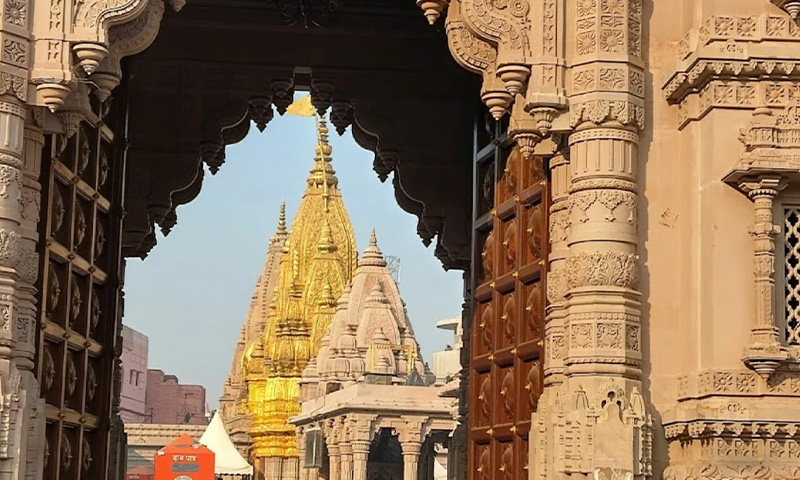
The Kashi Vishwanath Temple is one of the twelve Jyotirlingas of Lord Shiva and, according to the Uttar Pradesh Department of Tourism, the devotional focus of the entire city. The current sanctum was built in 1780 by Maharani Ahilyabai Holkar of Indore, and the golden plating on its shikhara was gifted later by Maharaja Ranjit Singh.
The visitor experience changed significantly after the Kashi Vishwanath Dham Corridor was inaugurated in December 2021. The corridor, described on the official Kashi Vishwanath portal, is a roughly 400-metre pedestrian pathway connecting the temple directly to Lalita Ghat on the Ganga, reclaiming space that had been buried under dense construction for centuries. For pilgrims, the practical result is a calmer approach, cleaner queues, and dedicated facilities for luggage, footwear, and drinking water.
Practical notes:
About ten kilometres from central Varanasi lies Sarnath, where Gautama Buddha delivered his first sermon after enlightenment. The site is a working archaeological park with several key monuments in close walking distance.
The site also has active monasteries built by Buddhist communities from Thailand, Japan, Tibet, Sri Lanka, and Myanmar, each reflecting the architectural style of its home tradition. Walking between them gives a compact sense of how the Dharma travelled outward from this small clearing in the deer park more than two thousand years ago.
Sarnath is small enough to cover in three or four hours and rewards visitors who slow down. If Buddhist heritage is central to your trip, our Buddhist circuit tour connects Sarnath with Bodh Gaya, Kushinagar, and Lumbini in a single itinerary.
Across the Ganga from Assi Ghat, Ramnagar Fort has been the residence of the erstwhile Maharajas of Banaras since the eighteenth century. The fort museum houses an eccentric and rewarding collection: vintage American cars, palanquins, ivory work, astronomical instruments, and manuscripts. Come during Dussehra to see the Ramnagar Ramlila, a month-long enactment listed by UNESCO as an Intangible Cultural Heritage tradition.
A short walk from Varanasi Cantonment, this temple has no idol. It houses a large marble relief map of undivided India, commissioned by nationalist leader Babu Shiv Prasad Gupta and inaugurated by Mahatma Gandhi in 1936. The building is quiet, the caretakers are welcoming, and the map is a genuinely moving piece of pre-Independence craftsmanship.
BHU is one of Asia’s largest residential universities and worth an unhurried afternoon. The New Vishwanath Temple inside the campus, funded by the Birla family and completed in 1966, is open to visitors of all faiths, unlike the older Kashi Vishwanath. Bharat Kala Bhavan, the university museum, holds important Mughal miniatures, Banarasi textiles, and archaeological finds from the region.
The Banarasi sari is a Geographical Indication protected craft, and the weavers who make it live and work in a handful of Muslim-majority neighbourhoods including Peeli Kothi, Madanpura, and Lallapura. Arranging a workshop visit through a responsible guide gives you a direct look at handloom weaving, zari work, and the economics of a craft under pressure from power looms. It is one of the more meaningful things you can do in the city, and one of the least advertised.
Tulsi Manas, built in white marble in the 1960s, marks the site where the poet Tulsidas is believed to have composed the Ramcharitmanas. The nearby Durga Temple, easily identified by its red ochre paintwork and resident macaques, is one of the more atmospheric Shakta shrines in the old city.
For a first visit of three nights, a workable rhythm looks like this:
If you have only two nights, drop Ramnagar and one of the BHU or Bharat Mata visits. If you have four, add Chunar Fort or a day trip to Prayagraj by expressway.
October through March is the comfortable season, with daytime temperatures generally between 15 and 28 degrees Celsius. December mornings can be foggy enough to delay early boat rides, so build a little slack into a sunrise plan. Dev Deepawali, celebrated on Kartik Purnima in November, sees the ghats lit with more than a million earthen lamps and is spectacular but heavily crowded, with hotels booked out months ahead. Mahashivaratri, in February or March, brings the largest pilgrim footfall of the year to Kashi Vishwanath. Summer, from late April to June, is punishingly hot and the old-city lanes are best avoided in the afternoon. The monsoon months of July and August often see boat rides suspended when the Ganga runs high, though the ghats remain accessible on foot and the crowds are thinner.
Central old city hotels near the ghats offer atmosphere but noise and narrow-lane access. The Cantonment area, four to five kilometres away, has larger properties, quieter grounds, and easier vehicle access. Ride-hailing works in the newer parts of town, cycle rickshaws remain the most sensible option in Godowlia and the ghat lanes, and boats are booked directly at the ghats or through your hotel.
For travellers who prefer a curated single-day introduction, hiring a knowledgeable local guide and a private car for essentials, pre-booked aarti seating, and a morning boat ride removes most of the friction that trips up first-timers.
Varanasi is a lived-in sacred city, not an open-air museum. A few small habits go a long way:
Varanasi rewards travellers who arrive prepared and stay a little longer than they planned. If you would like help shaping an itinerary that combines the ghats, Sarnath, and a nearby heritage stop with the right choice of hotel and a knowledgeable local guide, our travel specialists at Memorable India can put a tailored plan together. Reach out through our contact page and a consultant will respond within a working day.
Dashashwamedh Ghat for the evening Ganga Aarti, Kashi Vishwanath Temple for darshan, a short sunrise boat ride from Assi Ghat, and Sarnath if time allows. A single day is tight; two nights is a more realistic minimum.
Yes. Foreign nationals can enter the temple with a valid passport at security screening. Mobile phones, cameras, and leather items are not permitted inside the sanctum. Advance passes for Sugam Darshan and Mangala Aarti can be booked on the official Shri Kashi Vishwanath portal.
Sarnath is about ten kilometres from central Varanasi and takes twenty to thirty minutes by road. Three to four hours is enough to cover the Dhamek Stupa, the archaeological ruins, and the museum at an unhurried pace.
The main Ganga Aarti is held every evening at Dashashwamedh Ghat around sunset, with the ceremony lasting forty-five minutes. Arrive well in advance for a good view, or watch from a hired boat on the river for a clearer perspective.
Varanasi is generally safe during daylight and early evening hours in the ghat and temple areas, which stay busy with pilgrims. Standard precautions apply: dress modestly, avoid empty lanes after dark, and use pre-booked transport for late arrivals or departures.
Three nights and three full days is the recommended minimum to cover the main ghats, Kashi Vishwanath, Sarnath, Ramnagar Fort, and one of the weaving quarters without feeling rushed. Pilgrims often stay longer.
12 Top Tourist Destinations in Jammu and Kashmir for a Memorable 2026 Trip
13 Oct 2026
12 Tips to Remember Before Holidaying in the Northeast Indian States
11 Oct 2026
10 Things to Do on a Family Vacation in Shimla, Himachal Pradesh
09 Oct 2026
10 Days in India: Where to Go and What to See
05 Oct 2026
10 Best Places in North India for Corporate Outings to Recharge and Build Team Spirit
01 Oct 2026


