 +919871148514
 info@memorableindia.com
For millions of devotees across India, the twelve Jyotirlingas are not simply temples marked on a pilgrimage map. They are living centres of belief, each rooted in an ancient story of how Lord Shiva chose to reveal himself to the world. From the salt breeze of the Somnath coast to the icy silence of Kedarnath, these shrines stretch across nearly every corner of the country, tying together landscapes, languages, and communities that would otherwise share very little.
This guide walks through the 12 Jyotirlingas of Lord Shiva in India, the mythological events linked to each site, and the reasons this circuit continues to hold such a central place in Hindu religion. It is written for readers preparing a serious yatra, as well as for those who simply want to understand what these twelve shrines actually stand for. Practical planning notes and a set of frequently asked questions are included at the end for travellers thinking of undertaking the journey.
The word Jyotirlinga is a compound of two Sanskrit terms. Jyoti means light, and linga is the aniconic form used to worship Shiva. Together, the word points to a pillar of light, a form in which Shiva is said to have made himself known in the world.
The origin story appears in the Shiva Purana. According to the text, Brahma and Vishnu once fell into an argument over which of them was supreme. Shiva appeared before them as an endless column of flame with no beginning and no end. Neither god could find its origin or its top, and both accepted Shiva as the highest reality. The twelve places where this luminous form is believed to have settled on earth came to be known as Jyotirlingas. Devotees hold that Shiva is present at these shrines in a self-manifested form rather than one installed by human hands. For deeper reading on the Shaiva tradition, see this reference on Jyotirlingas, which summarises the scriptural sources.
The list below follows the traditional order chanted in the Dwadasha Jyotirlinga Stotra, moving broadly from west to east and north to south. Each shrine has its own legend, its own presiding rituals, and its own regional character.
Standing on the Saurashtra coast near Veraval, Somnath is traditionally counted as the first among the twelve. Mythology links it to the moon god Chandra, who is said to have built the original shrine in gratitude after Shiva relieved him from a curse. Somnath has been destroyed and rebuilt several times through history, and the present structure, completed in the mid twentieth century, follows the Chalukya style. Standing before the sanctum with the Arabian Sea at your back is often described as the most emotionally charged moment of the entire yatra.
Set atop Srisailam hill on the banks of the Krishna river, Mallikarjuna is unique because it is both a Jyotirlinga and a Shakti Peetha. The legend tells of Shiva and Parvati travelling here to console their son Kartikeya after a family disagreement over the wedding of Ganesha. The temple therefore represents the union of masculine and feminine energies at one site. The dense Nallamala forest surrounding the shrine adds to its sense of remoteness and quiet power.
Mahakaleshwar in Ujjain, on the banks of the Shipra river, is the only Jyotirlinga where the deity is believed to face south. The presiding form here is Mahakala, the lord of time and death. The most famous ritual at this shrine is the Bhasma Aarti held before dawn, in which the linga is bathed with sacred ash. For Shaivites, receiving darshan during this ceremony is considered one of the most powerful spiritual experiences on the entire Jyotirlinga circuit.
Omkareshwar sits on Mandhata island in the Narmada river, and the island itself is said to be shaped like the sacred syllable Om. Two shrines are worshipped together here: Omkareshwar on the island and Amareshwar on the southern bank. The legend connects the site to King Mandhata, who is believed to have undertaken severe penance until Shiva agreed to reside here permanently. Pilgrims traditionally take a boat across the Narmada and complete a parikrama of the island on foot.
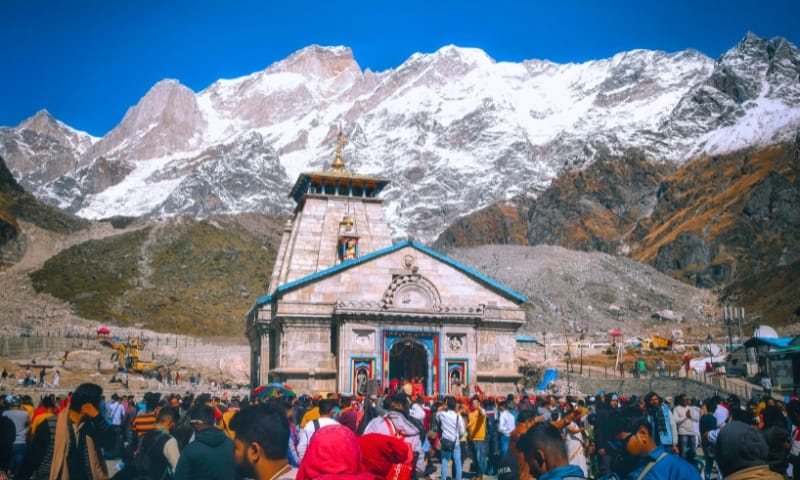
Kedarnath stands at over 3,500 metres in the Garhwal Himalayas and is accessible only from late April to early November. According to the Mahabharata tradition, the Pandavas sought Shiva after the Kurukshetra war to be freed from the burden of the lives they had taken. Shiva evaded them by taking the form of a bull, and only his hump remained at Kedarnath when the Pandavas caught hold of him. That hump is the form worshipped at the shrine. Travellers planning this leg often choose our Kedarnath Yatra package from Delhi to manage the long drive, the trek from Gaurikund, and the altitude adjustment safely.
Bhimashankar lies in the Sahyadri hills roughly 110 kilometres from Pune, inside a wildlife sanctuary that is also home to the Indian giant squirrel. The mythological story tells of Shiva defeating a demon named Bhima, a descendant of the demon king Kumbhakarna. The intense heat generated during the battle is said to have caused the Bhima river to rise near the temple. The Nagara style shrine and the forest around it make this one of the greenest and most atmospheric stops on the yatra.
No Jyotirlinga circuit is complete without a visit to Kashi Vishwanath in Varanasi, on the banks of the Ganga. Kashi is described in scripture as the eternal city of Shiva, and a darshan here is traditionally believed to grant moksha, or liberation from the cycle of birth and death. The recently completed Kashi Vishwanath Corridor has opened up direct access from the ghats to the temple sanctum, making it easier for pilgrims to combine the Ganga aarti at Dashashwamedh Ghat with their temple visit on the same evening.
Trimbakeshwar in Nashik district of Maharashtra is closely tied to the Godavari river, which rises nearby at Brahmagiri hill. The shrine is one of the few where the linga features three faces representing Brahma, Vishnu, and Shiva. Many families visit Trimbakeshwar specifically to perform Narayan Nagbali and Kaal Sarp Dosh puja, rituals believed to resolve ancestral difficulties. The town becomes especially important once every twelve years, when it hosts one of the four Kumbh Melas.
Also called Baba Baidyanath Dham, this shrine sits in Deoghar in eastern Jharkhand. The legend connects the site to Ravana, the king of Lanka, who is said to have performed severe penance to please Shiva. When Shiva agreed to travel with him to Lanka in the form of a linga, Ravana was tricked into setting it down at Deoghar, where it fixed itself permanently. Millions of Kanwariyas walk here every Shravan month carrying Ganga water from Sultanganj, making it one of the largest annual pilgrimages in India.
Nageshwar sits close to Dwarka on the coast of Gujarat. Its story revolves around a demon named Daruka, who tormented Shiva’s devotee Supriya, and Shiva’s appearance to protect his follower. The temple is easily identified by the large seated Shiva statue outside the sanctum, and it pairs naturally with Somnath on any western India pilgrimage. Our complete guide to Jyotirlingas temple tour in Gujarat covers the practical circuit between these two western shrines, along with Dwarka darshan.
At the southern tip of the Jyotirlinga circuit, Ramanathaswamy temple in Rameshwaram is where Lord Rama is believed to have worshipped Shiva before crossing the sea to Lanka. Sita is said to have fashioned the original linga from sand while Hanuman was away collecting a linga from Kailash. Both are worshipped inside the temple even today. Rameshwaram is also known for its immense pillared corridors, considered among the longest of any Hindu temple, and for the twenty-two theerthams whose waters pilgrims bathe in before darshan.
The last of the twelve, Grishneshwar, stands just a short drive from the Ellora Caves near Aurangabad. The temple’s legend centres on a devoted woman named Ghushma, whose faith in Shiva survived a family tragedy so severe that Shiva himself appeared to restore what she had lost. The current red sandstone structure was rebuilt in the eighteenth century under the patronage of Ahilyabai Holkar. Its proximity to Ellora allows pilgrims to combine devotion with one of India’s greatest heritage sites in a single day.
The mythological importance of Jyotirlingas rests on the idea that Shiva did not simply choose to be worshipped at these places. He revealed himself there. That distinction shapes how devotees approach the shrines. A pilgrimage to a Jyotirlinga is treated as a direct encounter with the divine rather than a symbolic act of remembrance.
Together, the twelve shrines also map a spiritual geography of India. The circuit crosses seven states, several climatic zones, and a wide range of temple architectures, from the coastal Chalukya style of Somnath to the wooden Katyuri work at Kedarnath. Completing the darshan of all twelve, whether in one long journey or in stages spread over years, is considered by tradition to grant release from the cycle of rebirth. Even a partial circuit, such as the shrines within a single region, carries deep religious merit.
A full 12 Jyotirlinga circuit typically requires between 25 and 28 days on the road, with air travel connecting the widely spaced regions. Shorter, region-focused routes are far more manageable for most travellers.
For a fully guided experience, our 28 Days Sacred Twelve Jyotirlingas Tour Package covers every shrine with private transport, darshan assistance, and priest coordination. Travellers preparing a shorter itinerary can also read our note on the benefits of visiting the 12 Jyotirlingas for a fuller sense of what the journey involves.
The 12 Jyotirlingas of Lord Shiva in India are more than a checklist of temples. Each shrine carries a story that connects a landscape, a community, and a form of Shiva that has been worshipped there for centuries. Whether you undertake the full yatra or begin with two or three shrines in one region, the journey has a way of settling something quiet inside its travellers. To plan a personalised Jyotirlinga darshan aligned to your dates, budget, and mobility, please reach out to our team, and a travel specialist will respond within 24 hours with a tailored itinerary.
The twelve Jyotirlingas are Somnath in Gujarat, Mallikarjuna in Andhra Pradesh, Mahakaleshwar in Ujjain, Omkareshwar in Madhya Pradesh, Kedarnath in Uttarakhand, Bhimashankar in Maharashtra, Kashi Vishwanath in Varanasi, Trimbakeshwar in Nashik, Vaidyanath in Deoghar, Nageshwar near Dwarka, Rameshwaram in Tamil Nadu, and Grishneshwar near Ellora.
Jyotirlingas are considered places where Lord Shiva himself appeared as an infinite column of light. Unlike temples where a deity is installed by priests, these shrines are believed to be self-manifested, which is why they carry the highest devotional status in Shaiva tradition.
A complete circuit generally takes between 25 and 28 days when travelling with a mix of flights and road transport. Region-specific tours covering four to six shrines can be completed comfortably in five to ten days.
Tradition places Somnath first in the standard chant of the Dwadasha Jyotirlinga Stotra, and many pilgrims begin their yatra there. In practice, most travellers plan the route based on geography and season rather than strict ritual order.
The Shiva Purana describes an argument between Brahma and Vishnu over supremacy. Shiva appeared as a limitless pillar of light, and neither god could locate its ends. The twelve places on earth where this cosmic light rested came to be revered as the Jyotirlingas.
October to March is the most comfortable season for most shrines. Kedarnath, being at high altitude, is open only from late April to early November. Mahashivratri and the month of Shravan draw the largest crowds at all twelve shrines.

20 Best Hill Stations in Uttarakhand for Family Vacation, Corporate Trips, Nature Lovers & Adventure
26 Aug 2026
15 Best National Parks and Wildlife Sanctuaries in North East India
25 Aug 2026
16 Best Romantic Hill Stations in India for Honeymoon Holidays
23 Aug 2026
Top 30 Must-See Forts and Palaces in Rajasthan
21 Aug 2026
Top 30 Krishna Temples in India: A Complete Pilgrim and Traveller Guide
21 Aug 2026


