 +919871148514
 info@memorableindia.com
Most travellers meet their first stupa by accident. A dome on a hill outside Bhopal. A brick cylinder in a deer park near Varanasi. A white curve catching last light above Leh. The pattern only becomes clear later. These are relic mounds, raised to hold something sacred and designed to be walked around rather than entered. India holds the deepest concentration of them anywhere, spanning Mauryan brickwork from the third century BCE to concrete peace pagodas finished within living memory. This guide covers fifteen, arranged by region, with the practical detail that decides whether a detour earns its place in your itinerary.
A stupa is not a building you enter. It is a solid mound raised over relics, and the ritual attached to it is circumambulation: walking clockwise along the pradakshina path at its base. Four elements repeat across almost every site.
Buddhist stupas in India fall into three broad categories. Saririka stupas hold bodily relics. Paribhogika stupas hold objects the Buddha used. Uddeshika stupas commemorate an event without containing any relic at all. Knowing which type you are looking at changes how a site reads, and it explains why some are austere brick mounds while others carry dense narrative carving.
This is where the story starts and ends. Five sites anchor almost every serious pilgrimage itinerary.
Sarnath sits roughly 10 km from Varanasi, and Dhamek Stupa is the reason most people make the trip. The cylinder rises about 43.6 metres with a base diameter close to 28 metres, rebuilt around 500 CE over a much older structure commissioned by Ashoka in 249 BCE. It marks the deer park where the Buddha delivered his first sermon to five disciples, the moment Buddhists describe as turning the wheel of dharma. The lower band carries Gupta-era floral carving in Chunar sandstone. Pair the visit with the Sarnath Archaeological Museum, which holds the Lion Capital that became India’s state emblem.
Ramabhar marks the cremation ground, about 1.5 km east of the Mahaparinirvana Temple. Ancient texts call it Mukut Bandhan Chaitya. The brick mound stands on a raised platform beside a tank, consistently quieter than the main temple complex. Through the winter pilgrimage season, monks from Myanmar, Thailand and Sri Lanka circumambulate here in robes of noticeably different colours. Kushinagar now has its own international airport, which has cut journey times from Delhi and Kolkata.
Piprahwa is where William Peppe excavated a relic casket in 1898 carrying a Brahmi inscription that linked the contents to the Sakya clan. Scholars still argue over the exact reading, but the site is widely treated as among the earliest stupas in the country. The mound sits in flat farmland near the Nepal border, with an adjoining monastery complex and a small site museum. There is no spectacle here, only archaeology. Most visitors reach it as a long day trip from Gorakhpur.
Kesaria Stupa Bihar holds the title of the tallest Buddhist stupa in India, rising roughly 104 feet with a circumference near 400 feet. Excavated by an Archaeological Survey of India team under K.K. Muhammed in 1998, it stands about 110 km from Patna in East Champaran district. Six polygonal terraces hold niches with Buddha figures in bhumisparsha mudra. According to Bihar Tourism, the structure measured 123 feet before the 1934 earthquake reduced it. Tradition connects the site to the Buddha handing his alms bowl to the Licchavis on his final journey.
The white marble peace pagoda crowns Ratnagiri Hill at around 400 metres, completed in 1969 by the Nipponzan Myohoji order founded by Nichidatsu Fujii. Four gilded Buddha figures face the cardinal directions, marking birth, enlightenment, first sermon and parinirvana. A ropeway carries visitors up from the base, and the older single-seater chairlift is a small adventure in itself. Rajgir pairs naturally with Nalanda, roughly 12 km away, making this one of the easiest half-day additions to any Bihar itinerary.
Three very different monuments, spanning more than two thousand years of continuous stupa building.
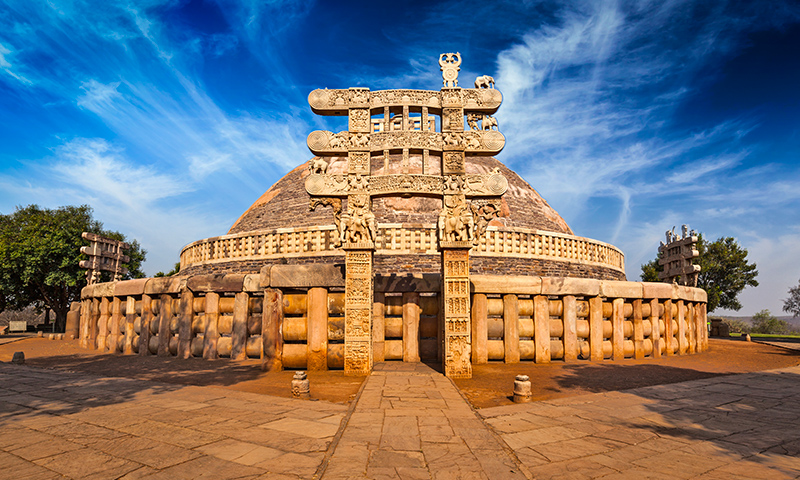
The Great Stupa at Sanchi is the most complete early Buddhist monument surviving anywhere, inscribed by UNESCO in 1989. Commissioned by Ashoka in the third century BCE and enlarged under the Shungas, the dome measures about 36.6 metres across and roughly 16.5 metres high. The four toranas carry the finest narrative relief of the period, with Jataka scenes and aniconic symbols standing in for the Buddha himself. Sanchi lies about 46 km northeast of Bhopal in Raisen district, under an hour by road. Our Sanchi Stupa tour package pairs it with Bhimbetka and the Aurangabad caves.
Gorai, at the northwestern edge of Mumbai, holds the largest stone dome in the world built without supporting pillars. Inaugurated in February 2009 and modelled on the Shwedagon Pagoda in Yangon, the hall seats around 8,000 meditators beneath an internal span of roughly 85 metres. Buddha bone relics are enshrined in the central locking stone of the dome. Entry is free and the viewing gallery is open to all, though the meditation hall is reserved for those who have completed a ten-day Vipassana course. Most visitors arrive by ferry from Gorai jetty.
Deekshabhoomi commemorates 14 October 1956, when Dr B.R. Ambedkar and roughly 400,000 followers embraced Buddhism, reshaping the religious map of modern India. Designed by architect Sheo Dan Mal and inaugurated in December 2001, it is the largest hollow stupa in the world, with a dome about 120 feet across sheltering a prayer hall below. Dhammachakra Pravartan Din each October draws enormous crowds. The architecture follows Sanchi closely, but the meaning here is contemporary and political as much as devotional.
Odisha holds the ground where Ashoka changed course, plus one of India’s richest monastic clusters.
Dhauli overlooks the Daya river about 8 km south of Bhubaneswar, on the plain associated with the Kalinga War and Ashoka’s turn away from violence. The white peace pagoda was built in 1972 through a collaboration between the Japan Buddha Sangha and the Kalinga Nippon Buddha Sangha. Stone panels around the drum show a reclining Buddha, an elephant procession and Ashoka surrendering his sword. The Ashokan rock edicts, carved beneath a rock-cut elephant, sit just below the hill.
Lalitgiri forms one corner of Odisha’s Diamond Triangle alongside Ratnagiri and Udayagiri. Excavations in 1985 recovered three khandolite caskets beside the mahastupa, two of them containing nested gold and silver caskets with charred bone fragments now displayed in the site museum. The apsidal chaitya hall and monastery ruins rank among the oldest Buddhist remains in eastern India. The triangle works best as a full day out of Bhubaneswar with a private vehicle, which is how our Odisha Buddhist tour sequences it.
The Deccan and the Andhra coast preserved a sculptural tradition that shaped Buddhist art across Asia.
On the south bank of the Krishna, the Amaravati Mahachaitya was once the largest stupa in the Deccan, built in phases between the third century BCE and about 250 CE. Its limestone panels defined the Amaravati school, ranked with Mathura and Gandhara among the three great styles of ancient Indian art. Most sculpture now sits in the Government Museum in Chennai, the site museum and the British Museum, so the mound reads as archaeology rather than spectacle. Visit the museum first and the ruins will make far more sense.
The Ikshvaku capital of Vijayapuri was submerged when the Nagarjuna Sagar dam was built, so its stupas and monastery remains were dismantled and reassembled on high ground that is now an island. Reaching the site means a boat ride across the reservoir to a museum built in the shape of a vihara. Ferry timings are limited and the crossing depends on weather and water levels, so start early and confirm departures a day ahead.
Thotlakonda occupies a hill roughly 128 metres above sea level on the Vizag to Bheemili beach road, about 15 km from Visakhapatnam. The mahastupa, votive stupas, chaitya hall and rock-cut cisterns that give the site its Telugu name make it one of the most photogenic Buddhist complexes in the south. The sea view is the real draw, particularly in early morning light. Bavikonda sits on the same stretch of coast and takes barely an extra hour.
Near Sannati on the Bhima river, excavations from the mid-1990s uncovered the Adholoka Maha Chaitya and, with it, the only known inscribed stone portrait of Ashoka, labelled Raya Asoko in Brahmi script. Limestone drum slabs carry Jataka scenes, dharmachakras and portraits of Satavahana rulers. Access is genuinely rural, with Nalwar the nearest railhead about 19 km away and very little infrastructure on site. This one is for travellers who will trade comfort for working archaeology.
Above Changspa village in Leh, the white two-tier Shanti Stupa was inaugurated in 1991 under Bhikshu Gyomyo Nakamura, with Buddha relics enshrined at its base by the 14th Dalai Lama. Reliefs across the two levels depict the birth, the defeat of Mara and the parinirvana. Steps or a short drive get you up, and both sunrise and sunset justify the effort for the view across the Indus valley towards the Stok range. Allow two days in Leh to acclimatise before attempting the stairs.
These fifteen sites are spread across seven states, so nobody covers them in one trip. Three routes do the heavy lifting.
The classic Buddhist circuit tour of India, 8 to 10 days. Fly into Varanasi for Sarnath, drive to Bodh Gaya, then Rajgir and Nalanda, north to Kesaria, and finish at Kushinagar. Exit from Gorakhpur or Kushinagar airport. This is the route most international pilgrims follow, and it covers the four principal Buddhist pilgrimage sites in India along the way.
Central India, 4 to 5 days. Base yourself in Bhopal for Sanchi, Satdhara and Bhojpur, then extend west to Ajanta and Ellora. Short drives and comfortable hotels make this the easiest option for seniors and first-time visitors.
The Deccan and coast, 6 to 7 days. Vijayawada gives you Amaravati and Nagarjunakonda, then move up the coast to Visakhapatnam for Thotlakonda and Bavikonda. Kanaganahalli needs a separate detour from Kalaburagi.
Leh and Mumbai sit outside all three and work better as standalone trips. If you would rather not assemble the logistics, our Buddhist pilgrimage tour packages handle guides, permits and transfers across the northern circuit, with the option to extend into Nepal for Lumbini.
Buddha Purnima, on the full moon of April or May, brings the strongest atmosphere at Sarnath, Bodh Gaya and Kushinagar, along with the largest crowds. Book accommodation months ahead if you plan around it.
These monuments reward slow travel more than most Indian heritage sites. A stupa gives up very little in fifteen minutes and a great deal in an hour, especially with someone beside you who can read the panels. If your interest runs wider than stupas, our guide to Buddhist temples in India covers the monasteries and living shrines that complete the picture.
Memorable India has been arranging Buddhist and heritage journeys since 2005, with ISO certified operations, transparent pricing and 24/7 on-trip support. Tell us which of these must visit stupas in India matter most to you and we will build the route around them. Contact our travel team to start planning.
Q1. Which is the oldest stupa in India?
Piprahwa Stupa in Siddharthnagar district, Uttar Pradesh, is generally regarded as among the oldest surviving stupas in India, dated to shortly after the Buddha’s parinirvana. Sanchi Stupa No. 2 in Madhya Pradesh holds the oldest extensive decorative relief work, dated to roughly 125 to 100 BCE.
Q2. Which is the tallest Buddhist stupa in India?
Kesaria Stupa in East Champaran district, Bihar, is the tallest Buddhist stupa in India at approximately 104 feet, with a circumference close to 400 feet. It stood at around 123 feet before the 1934 Bihar earthquake reduced its height.
Q3. How many days do you need to see the main Buddhist stupas in India?
Allow 8 to 10 days for the northern circuit covering Sarnath, Bodh Gaya, Rajgir, Kesaria and Kushinagar. Add 4 to 5 days for Sanchi and central India, and a further 6 to 7 days for the southern sites in Andhra Pradesh and Karnataka. Ladakh and Mumbai are best treated as separate trips.
Q4. Can non-Buddhists visit stupas in India?
Yes. Every site listed here is open to visitors of all faiths, and most are protected monuments under the Archaeological Survey of India rather than active places of worship. The only common restriction is at the Global Vipassana Pagoda in Mumbai, where the inner meditation hall is limited to people who have completed a ten-day course.
Q5. What is the best time to visit stupas in India?
October to March suits the plains of Uttar Pradesh, Bihar and Madhya Pradesh, and November to February works well for Odisha and coastal Andhra Pradesh. Ladakh is accessible from June to September. Buddha Purnima in April or May offers the richest atmosphere but the heaviest crowds.
Q6. Which stupas in India are UNESCO World Heritage Sites?
The Buddhist Monuments at Sanchi in Madhya Pradesh were inscribed by UNESCO in 1989 and remain the only stupa complex in India with full World Heritage status. Sarnath has been on the UNESCO tentative list since 1998.
The Kerala Backwaters: 11 Things To Know Before You Visit
23 Sep 2026
Udaipur Itinerary: How to Spend 3 Days in Udaipur
22 Sep 2026
The Best Places to See in Varanasi, India
22 Sep 2026
11 Ancient Temples in Palakkad That Deserve to Be Seen
22 Sep 2026
Best Places to Visit in Tamil Nadu, India: A Traveller’s Guide for 2026
21 Sep 2026


